
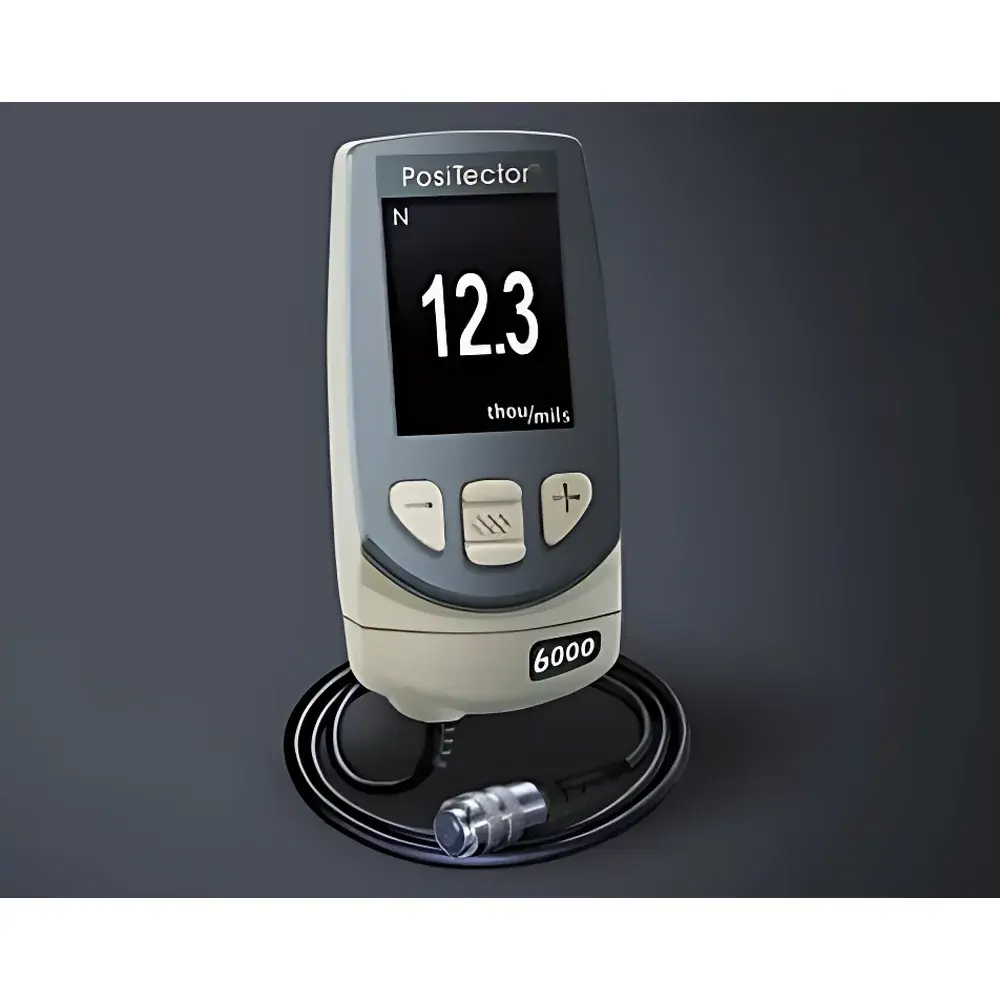
TQC Positector 6000 Coating Thickness Gauge
| Origin | Netherlands |
|---|---|
| Manufacturer Type | Authorized Distributor |
| Origin Category | Imported |
| Model | LD6057 / LD6058 |
| Pricing | Upon Request |
| Measurement Principles | Magnetic Induction (for ferrous substrates) & Eddy Current (for non-ferrous substrates) |
| Display | Monochrome High-Contrast LCD (LD6057) / Reversible Color LCD (LD6058) |
| Data Storage Capacity | 250 readings (LD6057) / 100,000 readings (LD6058) |
| Data Transfer Interfaces | USB (standard), Wi-Fi & Bluetooth (LD6058 only) |
| Compliance Standards | ISO 2808, GOST R 51694 |
| Alarm Function | Audible and visual Hi/Lo limit alert |
| Calibration | Sensor-integrated, auto-recalled per probe |
| Probe Compatibility | Interchangeable modular probes (sold separately) |
Overview
The TQC Positector 6000 Coating Thickness Gauge is a precision-engineered, fully electronic instrument designed for non-destructive measurement of dry film thickness (DFT) on coated metallic surfaces. Built upon dual physical principles—magnetic induction for ferrous substrates (e.g., steel, iron) and eddy current for non-ferrous conductive substrates (e.g., aluminum, stainless steel, copper)—the Positector 6000 delivers repeatable, traceable, and ISO-compliant thickness data across industrial maintenance, automotive refinishing, marine fabrication, and protective coating inspection workflows. Its modular architecture separates the gauge body from interchangeable sensor modules, enabling rapid adaptation to varying surface geometries, curvature radii, and coating system requirements without recalibration. Unlike analog or single-technology gauges, the Positector 6000 embeds calibration parameters directly within each probe’s firmware, ensuring measurement integrity is preserved across instrument swaps and field deployments.
Key Features
- Modular probe design with automatic calibration recall—no manual reconfiguration required when switching sensors
- Hi/Lo limit alarm system with simultaneous audible beep and visual indicator for real-time pass/fail assessment against user-defined specification thresholds
- Dual-display options: LD6057 features a high-contrast monochrome LCD optimized for outdoor legibility; LD6058 upgrades to a reversible color display supporting ambient light adaptation and intuitive status coding
- Integrated data management: LD6057 stores up to 250 sequential measurements with timestamp and probe ID; LD6058 expands capacity to 100,000 readings with full metadata logging (date, time, operator ID, substrate type, probe serial)
- Multi-interface connectivity: Standard USB interface for direct PC synchronization; LD6058 adds optional Wi-Fi and Bluetooth 5.0 for wireless export to cloud-based QA platforms or LIMS systems
- Ruggedized IP65-rated housing with reinforced rubber overmolding—tested for drop resistance up to 1.2 m onto concrete and operational stability in temperatures ranging from –10 °C to +50 °C
Sample Compatibility & Compliance
The Positector 6000 accommodates a broad spectrum of coated substrates, including but not limited to hot-dip galvanized steel, anodized aluminum, electroplated nickel, epoxy-coated pipelines, and powder-coated structural components. It supports measurement on flat, curved, and contoured surfaces down to 3 mm radius (with appropriate probe selection). All measurements adhere to internationally recognized standards: ISO 2808 (Paints and varnishes — Determination of film thickness), GOST R 51694 (Russian Federation standard for non-destructive coating thickness testing), and ASTM D7091 (Standard Practice for Nondestructive Measurement of Dry Film Thickness of Nonmagnetic Coatings Applied to Ferrous Metals and Nonconductive Coatings Applied to Non-Ferrous Metals). The device meets electromagnetic compatibility (EMC) requirements per IEC 61326-1 and carries CE, UKCA, and RoHS markings for regulatory acceptance in EU, UK, and global markets.
Software & Data Management
Data collected by the Positector 6000 is structured for seamless integration into quality assurance ecosystems. The included PosiSoft Desktop software (Windows-compatible) enables report generation compliant with ISO/IEC 17025 documentation requirements—including audit trails, calibration history, and operator authentication logs. LD6058 users may leverage PosiSoft Connect—a secure cloud portal supporting role-based access control, automated report scheduling, and FDA 21 CFR Part 11–compliant electronic signatures when paired with validated user accounts. All stored datasets retain embedded probe identification, environmental timestamping, and statistical summaries (mean, standard deviation, min/max), facilitating trend analysis and SPC charting without third-party tools.
Applications
- Pre-commissioning verification of pipeline internal linings per NACE SP0108 and ISO 21809-2
- In-process QA during coil coating production lines (ASTM D6132)
- Marine hull coating audits under IMO PSPC guidelines
- Aerospace component primer and topcoat validation (per Boeing D6-17487 and Airbus AITM 1-0005)
- Automotive OEM body shop audits requiring GLP-aligned documentation
- Third-party inspection agencies performing API RP 571 or ISO 12944–part 5 conformity assessments
FAQ
Does the Positector 6000 require annual recalibration?
No—calibration is stored within each probe module and remains valid until physical damage or environmental exposure exceeds manufacturer-specified limits. However, daily verification using certified reference standards (e.g., NIST-traceable foils) is recommended per ISO 21748 and internal QA protocols.
Can the same probe measure both ferrous and non-ferrous substrates?
No—probes are substrate-specific. Dual-principle operation is achieved by selecting either a magnetic induction probe (F-series) or an eddy current probe (N-series); hybrid probes are not supported.
Is the Wi-Fi module on the LD6058 compatible with enterprise WPA2-Enterprise networks?
Yes—the LD6058 supports IEEE 802.1X/EAP-TLS authentication and integrates with existing corporate certificate infrastructures for secure deployment in regulated environments.
How is measurement uncertainty quantified for compliance reporting?
Uncertainty budgets follow ISO/IEC Guide 98-3 (GUM) and incorporate probe-specific repeatability (typically ±1–3% of reading), temperature drift coefficients, and substrate conductivity variability—all documented in the instrument’s Type Evaluation Report available upon request.



