
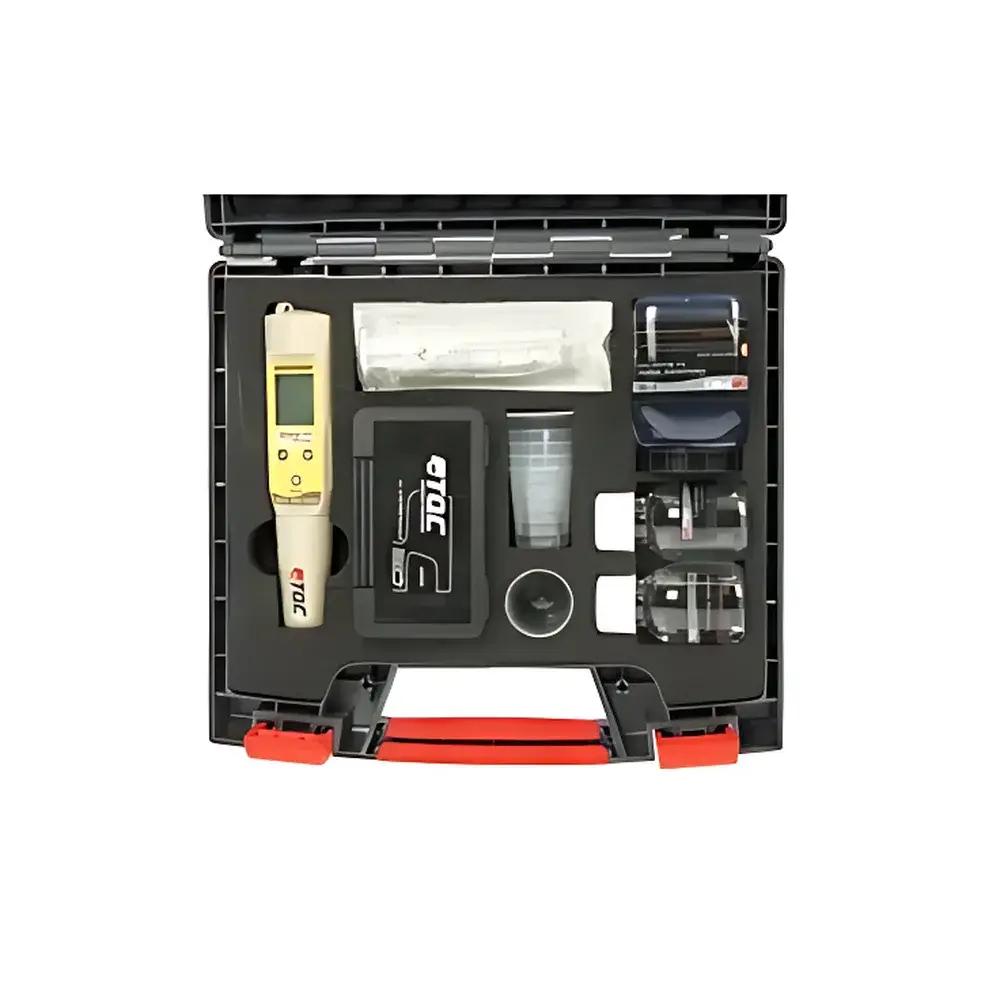
TQC SP7310 Surface Soluble Salt Test Kit
| Origin | Netherlands |
|---|---|
| Manufacturer Type | Authorized Distributor |
| Origin Category | Imported |
| Model | SP7310 |
| Price | Upon Request |
| Compliance | ISO 8502-6, ISO 8502-9, ISO 11127-6, ISO 11127-7, ISO 1769, ISO 2574, ISO 32 |
| Measuring Range | 0.1–20,000 mg/m² NaCl-equivalent |
| Resolution | 0.1 μS/cm ≡ 0.1 mg/m² |
| Accuracy | ±1% of reading |
| Operating Temperature | 0–50 °C |
| Bresle Patch Type | A-1250′ (residue-free adhesive patch) |
Overview
The TQC SP7310 Surface Soluble Salt Test Kit is a field-deployable, standardized instrumentation system engineered for quantitative assessment of soluble salt contamination—primarily chloride ions (Cl⁻), sodium (Na⁺), and nitrate (NO₃⁻)—on steel substrates prior to protective coating application. It implements the Bresle method as defined in ISO 8502-6 (extraction using a sealed, water-filled patch) and ISO 8502-9 (electrolytic conductivity measurement of the extract), enabling trace-level quantification of surface salts expressed as sodium chloride (NaCl) equivalent in mg/m². The kit integrates a calibrated conductometer, precision Bresle patches, deionized water delivery components, and extraction accessories into a single portable configuration optimized for offshore platforms, shipyards, pipeline maintenance crews, and industrial blast-cleaning facilities. Its design prioritizes repeatability under variable ambient conditions and compliance with international surface preparation quality assurance protocols.
Key Features
- Pre-assembled, ISO-compliant Bresle test system validated per ISO 8502-6 and ISO 8502-9 for on-site use without external calibration labs
- A-1250′ residue-free adhesive Bresle patch—engineered for consistent 12.5 cm² extraction area, high conformability on curved or roughened surfaces, and zero polymer transfer to substrate
- Dual-range digital conductometer with auto-ranging capability (0.1–20,000 µS/cm), factory-calibrated against NIST-traceable KCl standards
- Temperature-compensated conductivity measurement (0–50 °C), minimizing drift due to ambient thermal variation during field operation
- Integrated data logging function supporting timestamped readings and manual annotation for audit-ready documentation
- Modular, ruggedized carry case with foam-cut compartments for instrument protection, patch storage, syringe calibration, and distilled water handling
Sample Compatibility & Compliance
The SP7310 kit is compatible with all common blast-cleaned ferrous substrates—including carbon steel, weathering steel, and galvanized surfaces—as well as concrete and fiber-reinforced polymer (FRP) substrates where soluble salt evaluation is required for coating adhesion validation. All components meet material compatibility requirements outlined in ISO 11127-6 and ISO 11127-7 for non-reactive contact with test solutions. The conductometer conforms to IEC 61000-4 electromagnetic immunity standards and carries CE marking for use within EU regulatory frameworks. Full traceability documentation—including certificate of conformance, patch lot verification, and conductometer calibration report—is supplied with each unit. The system supports GLP-compliant recordkeeping when paired with TQC’s optional digital reporting module (sold separately), enabling full 21 CFR Part 11 audit trails for regulated industries.
Software & Data Management
While the SP7310 operates as a standalone analog-digital hybrid instrument, its conductometer features a USB-C interface for optional connection to TQC’s Surface Quality Manager (SQM) desktop software (v3.2+). SQM enables automated conversion of conductivity values to NaCl-equivalent mass loading (mg/m²) using ISO 8502-9’s empirical correlation algorithm, generates PDF test reports with embedded operator ID, location tag, and photo capture, and exports CSV files for integration into enterprise CMMS or LIMS platforms. All stored measurements retain temperature-stamped metadata and are encrypted at rest. Audit logs record user login events, parameter changes, and firmware updates—supporting FDA and ISO 9001 internal audit requirements.
Applications
- Pre-coating verification on offshore wind turbine towers and subsea structural components
- Quality gate inspection during ship hull refurbishment in dry dock environments
- Third-party certification audits for ISO 12944 C5-I / C5-M corrosion protection systems
- In-process monitoring of abrasive blasting efficacy in pipeline right-of-way projects
- Root cause analysis of premature coating delamination or blistering in petrochemical infrastructure
- Training and competency assessment for NACE Level 1/2 and SSPC PCI-certified inspectors
FAQ
What does “0.1 μS/cm ≡ 0.1 mg/m²” mean in practice?
This equivalence is derived from ISO 8502-9 Annex A and assumes a standard 12.5 cm² Bresle patch area and 15 mL extraction volume. Conductivity readings are converted to NaCl-equivalent surface concentration using a linear calibration curve traceable to reference solutions prepared per ISO 1769.
Can the A-1250′ patch be reused?
No. Each A-1250′ patch is single-use only, as residual moisture or ionic carryover compromises measurement integrity. Batch-lot certification ensures consistent adhesive performance and dimensional accuracy across production runs.
Is temperature compensation mandatory for accurate results?
Yes. Conductivity is inherently temperature-dependent; uncorrected readings at 10 °C vs. 35 °C may deviate by up to 25%. The SP7310’s built-in Pt1000 sensor applies real-time compensation per ISO 8502-9 Section 7.2.
Does the kit include certified reference standards?
The base SP7310 kit includes a primary calibration certificate but not physical reference standards. TQC offers optional ISO 1769-compliant KCl reference solutions (100, 500, and 2000 µS/cm) for daily verification—recommended before each shift in critical applications.



