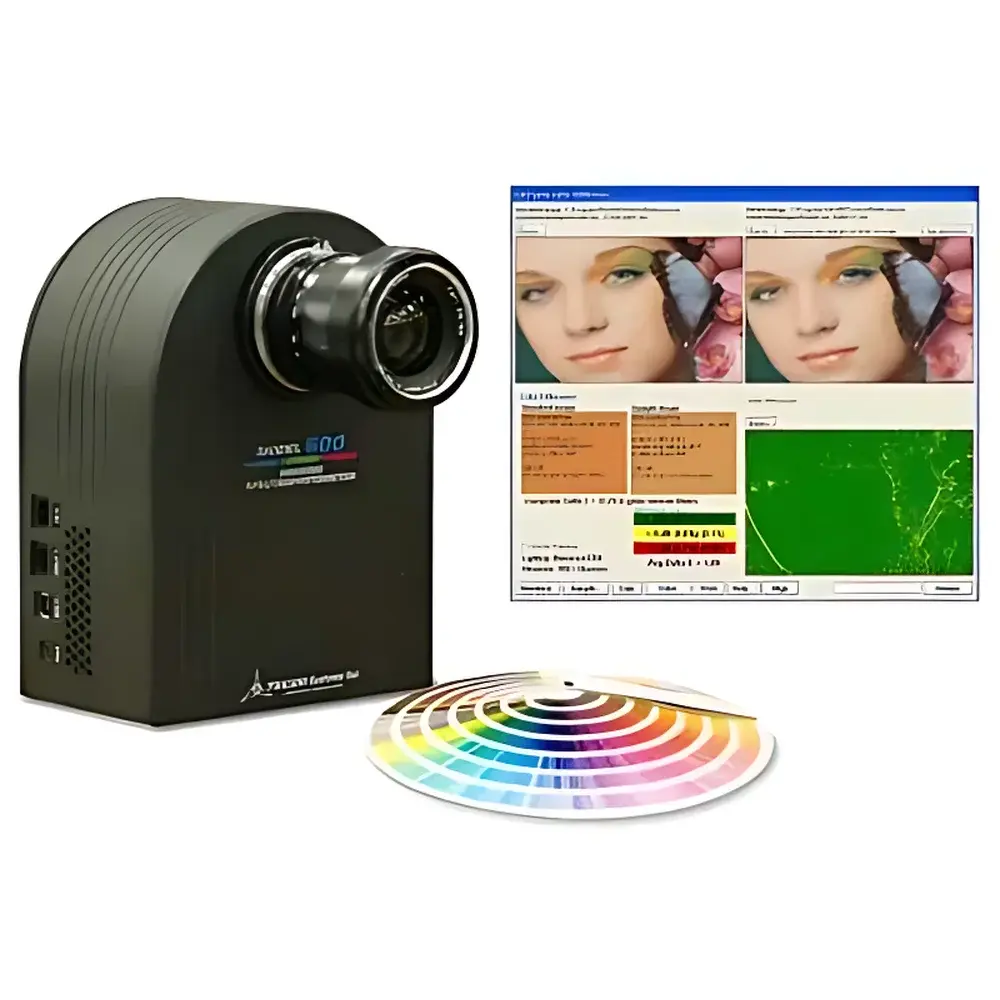
TRICOR 600 Imaging Spectrophotometer
| Brand | TRICOR |
|---|---|
| Origin | USA |
| Manufacturer Type | Authorized Distributor |
| Import Status | Imported |
| Model | 600 |
| Pricing | Upon Request |
Overview
The TRICOR 600 Imaging Spectrophotometer is a high-resolution, spatially resolved spectral measurement system engineered for quantitative color analysis across extended surface areas. Unlike conventional tristimulus colorimeters or single-point spectrophotometers, the TRICOR 600 employs a calibrated CCD-based imaging sensor coupled with a diffraction grating monochromator to acquire full spectral reflectance, transmittance, or radiance data—spanning 380 nm to 780 nm at 20 nm spectral bandwidth—simultaneously across every pixel in its 1280 × 960 field of view. This architecture implements true imaging spectrophotometry: each pixel functions as an independent virtual spectrophotometer, yielding over 1.2 million spatially registered spectral curves per acquisition. The system operates on CIE-compliant spectral convolution principles, enabling accurate computation of colorimetric values—including XYZ, xyz, CIELAB (L*a*b*), CIELUV (L*u*v*), u’v’, Hunter Lab, and CCT—under user-defined illuminants (11+ standard and custom sources) and observers (CIE 1931 2° and CIE 1964 10°). Its fundamental advantage lies in spectral fidelity: by capturing full spectral response rather than filtered tristimulus signals, it inherently supports metamerism detection, spectral similarity assessment, and illumination-invariant color specification—critical for R&D, quality assurance, and regulatory compliance in industries where visual match consistency is non-negotiable.
Key Features
- Imaging spectrophotometric architecture: 1280 × 960 pixel resolution with 10-bit spectral depth per pixel
- Full visible spectrum coverage: 380–780 nm at 20 nm optical bandwidth; no interpolation or extrapolation required
- Modular lens options: 35 mm (7.0° × 5.1° FOV), 24 mm (10.2° × 7.3°), 15 mm (16.3° × 12.7°), and fisheye variant (distortion-corrected for colorimetry)
- CIE-compliant color calculation engine supporting multiple color spaces: CIELAB (ΔEab, ΔE00), CIELUV, Hunter Lab, u’v’, XYZ/xyz, and correlated color temperature (CCT)
- Short-term repeatability: ≤0.026 ΔEab (mean), ≤0.019 ΔEab (statistical) using BCRA Series II white tile under controlled conditions (25°C, 35% RH)
- Short-term reproducibility: ≤0.06 ΔEab (mean), ≤0.05 ΔEab (statistical) across 12 BCRA tiles
- Measurement flexibility: supports reflectance, transmittance, and absolute radiance modes with configurable integration time (30–60 s typical at ~100 ft-L, D65-equivalent)
- Rugged mechanical design: 22.8 × 17.8 × 10.2 cm (H × W × D), 3.3 kg (body only); ¼”-20 tripod mount; operating temperature range 0–32°C, <85% RH non-condensing
Sample Compatibility & Compliance
The TRICOR 600 accommodates flat, curved, textured, and heterogeneous surfaces without contact—ideal for printed substrates, painted automotive panels, pharmaceutical tablets, textile swatches, food packaging, architectural finishes, and display screens. Its non-destructive, non-contact methodology ensures integrity of delicate or hygroscopic samples. From a regulatory perspective, the system supports traceable, auditable color measurement workflows aligned with ISO 11664 (CIE colorimetry standards), ASTM E308 (computing color tolerances), ISO 12233 (spatial resolution validation), and FDA-relevant documentation requirements for GLP/GMP environments. While the instrument itself does not carry FDA 21 CFR Part 11 certification out-of-the-box, its software architecture permits integration with validated electronic lab notebook (ELN) or LIMS platforms that implement audit trail, electronic signature, and role-based access controls—enabling compliant deployment in regulated manufacturing and QC laboratories.
Software & Data Management
Bundled ISP Control software provides real-time image acquisition, spectral visualization, region-of-interest (ROI) definition, statistical mapping (e.g., ΔE heatmaps), batch export (CSV, TIFF, HDF5), and customizable reporting templates. All raw spectral data are stored in open-format containers preserving wavelength-pixel metadata, enabling post-acquisition reprocessing with updated illuminants or observers without rescanning. The software supports automated calibration via NIST-traceable reference tiles and includes built-in diagnostics for sensor uniformity, dark current correction, and spectral drift monitoring. For enterprise integration, the SDK (C/C++, Python APIs) enables scripting of measurement sequences, trigger synchronization with external lighting or motion stages, and direct ingestion into MES or SPC systems. Data exports comply with ISO/IEC 17025 documentation requirements, including timestamped metadata, operator ID, environmental logs, and instrument configuration snapshots.
Applications
- Print & Packaging: Spot-to-spot color uniformity verification across CMYK process prints; spectral mismatch detection in brand-critical logos
- Automotive: Paint batch consistency across body panels; gloss-independent color evaluation on metallic and pearlescent finishes
- Pharmaceuticals: Tablet coating homogeneity assessment; excipient-induced hue shifts in solid dosage forms
- Food & Beverage: Surface color stability monitoring during shelf-life studies; bruise detection in fresh produce via spectral anomaly mapping
- Displays & Lighting: Angular color shift analysis of OLED/LCD panels; chromaticity binning of LED arrays
- Textiles & Plastics: Dye lot matching across woven/knitted structures; weathering-induced spectral degradation tracking
FAQ
What distinguishes the TRICOR 600 from tristimulus-based imaging colorimeters?
It captures full spectral reflectance/transmittance at every pixel—not just RGB-filtered intensities—enabling metamerism detection, spectral reconstruction, and observer/illuminant flexibility unavailable in tristimulus systems.
Can the TRICOR 600 measure curved or non-planar surfaces?
Yes—within the depth-of-field limits of the selected lens; fisheye and wide-angle optics support large-area mapping of moderately curved geometries while maintaining colorimetric accuracy.
Is spectral calibration traceable to national standards?
Yes—factory calibration uses NIST-traceable ceramic tiles and spectral irradiance standards; users may perform routine verification with supplied BCRA reference sets.
Does the system support automated pass/fail inspection against tolerance limits?
Yes—ISP Control allows defining ΔE thresholds per ROI, generating binary pass/fail overlays and exporting compliance reports with statistical summaries.
What computing resources are required for real-time spectral processing?
A dual-core 2.9 GHz CPU, 4 GB RAM, and IEEE-1394b interface are minimum; for full-frame spectral cube processing and heatmap generation, 16 GB RAM and SSD storage are recommended.