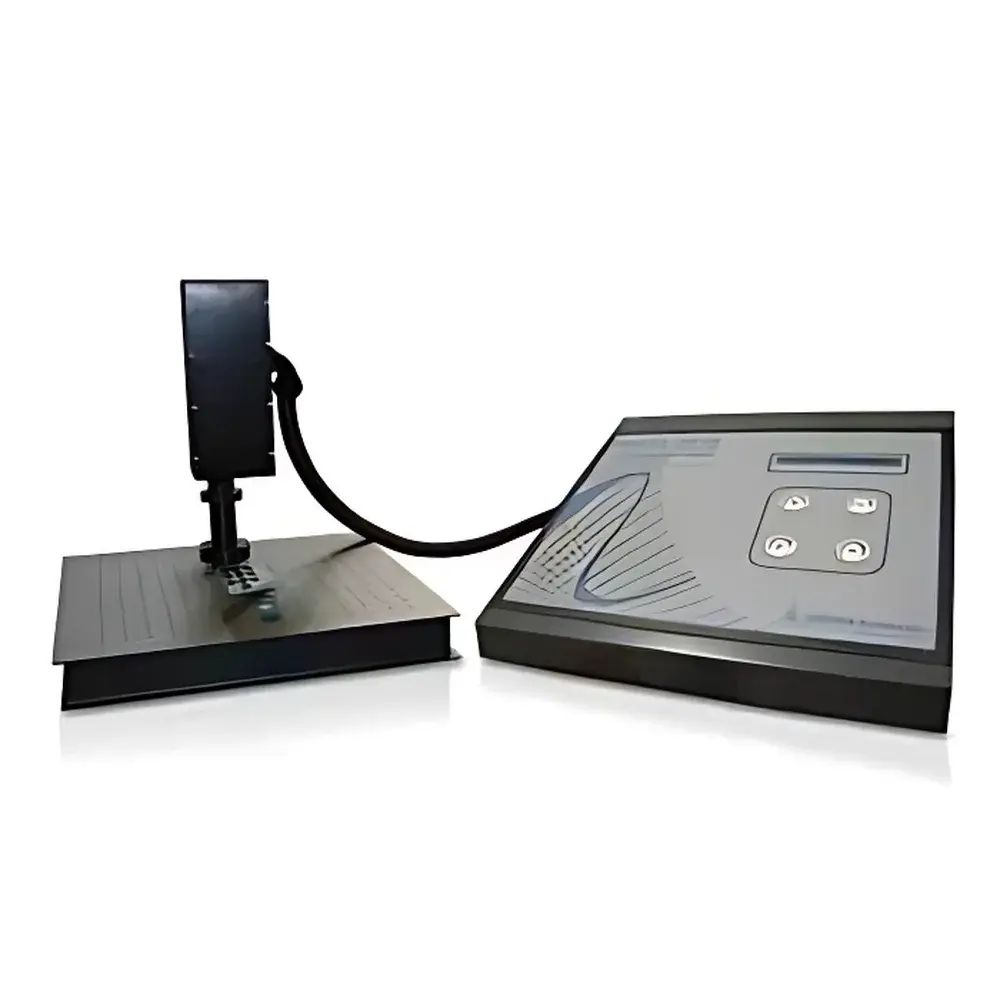
TRICOR 921B Displacement-Force Test Station
| Brand | TRICOR |
|---|---|
| Origin | USA |
| Model | 921B |
| Power Supply | 115/220 V AC, 50/60 Hz, 230 VA |
| Max Test Speed | 8 mm/s |
| Min Test Speed | 0.0254 mm/s |
| Displacement Range | 0–62.51 mm |
| Displacement Resolution | 0.00254 mm |
| Displacement Accuracy (Abs) | ±0.00762 mm |
| Force Ranges | 0–75 g, 0–360 g, 0–2.00 kg, 0–3.60 kg, 0–22.68 kg |
| Force Resolution | 1 g |
| Force Accuracy (FS) | ±0.25% |
| Force Repeatability (FS) | ±0.1% |
| Optional Impedance Channel | 0–16 kΩ or 0–4 V |
| Compliance | ASTM F1570, ASTM F1597 |
| Software | Windows™ XP or later, Excel™-compatible output |
Overview
The TRICOR 921B Displacement-Force Test Station is a precision-engineered electromechanical test system designed for high-reliability mechanical and electrical characterization of microswitches, tactile buttons, membrane switches, contactors, and other electro-mechanical components prevalent in semiconductor packaging, advanced assembly, and high-integrity electronics manufacturing. It operates on a controlled linear actuation principle, integrating synchronized displacement control with real-time force acquisition to quantify mechanical response curves—specifically the relationship between applied displacement (in mm or inch) and resulting contact force (in grams, ounces, or kilograms). The system supports both static and dynamic test modes—including full compression-release cycles—and delivers traceable, repeatable measurements aligned with industry-standard mechanical testing protocols such as ASTM F1570 (Standard Test Method for Measuring the Actuation Force and Travel of Membrane Switches) and ASTM F1597 (Standard Test Methods for Electrical Contact Resistance of Conductive Elastomers). Its modular architecture enables deployment in standalone production-floor environments or integration into automated test cells via digital I/O or serial communication interfaces.
Key Features
- High-resolution displacement sensing with 0.00254 mm (0.0001 in) resolution and ±0.00762 mm absolute accuracy across a 62.51 mm stroke range
- Multi-range force transducers supporting five selectable capacities—from 75 g to 22.68 kg—with 1 g resolution and ±0.25% full-scale accuracy
- Programmable test velocity from 0.0254 mm/s to 8 mm/s, enabling compliance with low-speed tactile evaluation and high-throughput screening requirements
- Integrated calibration routine for complete fixture compensation—automatically correcting for mechanical deformation, mounting compression, and probe deflection effects
- Dual-mode operation: Standalone Pass/Fail mode with front-panel LED indicators, and PC-connected mode for full data capture, visualization, and statistical analysis
- Optional impedance measurement channel (FDR mode) supporting resistance (0–16 kΩ) or voltage (0–4 V) acquisition synchronized with force-displacement profiles
- Configurable unit system (metric or imperial), user-defined pass/fail thresholds, and programmable test sequences including make/break, low-force, and restore-point detection
Sample Compatibility & Compliance
The 921B accommodates a broad spectrum of semiconductor-adjacent components, including wafer-level bump structures, flip-chip interconnects under compression, die-attach bondline integrity verification, MEMS actuator validation, and fine-pitch connector mating force assessment. Its interchangeable probe kits and modular fixture platform support custom tooling for DUTs ranging from 2 mm × 2 mm die to 150 mm × 150 mm substrate assemblies. All measurement data are traceable to NIST-traceable standards through factory calibration certificates. The system meets functional safety expectations for Class 1 industrial environments per IEC 61000-6-2/-4 and complies with electromagnetic compatibility (EMC) directives. For regulated manufacturing, audit-ready data logs—including timestamped configuration parameters, operator ID, test sequence ID, and raw sensor traces—can be exported in CSV or native Excel format to support GLP/GMP documentation workflows and FDA 21 CFR Part 11–aligned electronic record retention when paired with validated software configurations.
Software & Data Management
The TRICOR SwitchTest™ application provides intuitive GUI-based test definition, real-time waveform monitoring, and post-test analytics. It runs natively on Windows™ platforms (XP or newer) and requires no proprietary runtime libraries. Each test generates two complementary output formats: (1) a summary report (.xlsx) containing calculated metrics—FMAX, FMIN, TMAX, TMIN, contact ratio, make/break forces, and restore points—and (2) a full-resolution time-series dataset (.xlsx) preserving every sampled point of displacement, force, and optional impedance at user-specified acquisition rates. Files are automatically appended to batch-specific workbooks using configurable naming conventions tied to lot number, operator ID, or equipment ID. Built-in search and indexing tools allow rapid retrieval of historical waveforms by parameter range, date stamp, or pass/fail status. Exported Excel files integrate seamlessly with third-party SPC platforms (e.g., Minitab, InfinityQS) and enterprise MES/QMS systems via standard ODBC or REST API gateways.
Applications
- First-article inspection (FAI) of switch actuation behavior in semiconductor packaging lines
- Process validation and capability studies for thermocompression bonding, solder bump compression, and underfill cure monitoring
- Reliability stress testing—including cyclic fatigue, creep, and hysteresis analysis—across temperature-controlled chambers
- Engineering failure analysis of contact resistance degradation versus mechanical wear
- Automated inline testing when integrated with robotic handlers, vision-guided X-Y stages, or conveyor-based feeding systems
- Qualification of conductive elastomer pads, anisotropic conductive films (ACF), and metal dome arrays used in fan-out wafer-level packaging (FOWLP)
FAQ
What standards does the 921B comply with for switch testing?
The system implements test methodologies defined in ASTM F1570 and ASTM F1597, and its calibration traceability aligns with ISO/IEC 17025 requirements when operated under documented procedures.
Can the 921B perform impedance measurements simultaneously with force and displacement?
Yes—when equipped with the optional FDR module, it acquires resistance or voltage synchronously at up to 1 kHz sampling rate, enabling correlation of electrical continuity events (e.g., contact closure) with mechanical displacement thresholds.
Is fixture calibration required for each new test setup?
A full mechanical calibration is recommended whenever probe geometry, mounting configuration, or load cell range changes; the system guides users through a stepwise routine that compensates for parasitic deflections.
How is data security and audit trail managed in regulated environments?
While the base software does not include built-in electronic signatures, its structured Excel output and metadata tagging (time, user, configuration hash) enable integration with validated document management systems compliant with 21 CFR Part 11.
What is the maximum data throughput during continuous testing?
At default settings (100 Hz sampling), the system captures and buffers up to 5,000 points per test cycle; full waveform export to disk occurs post-test and imposes no bottleneck on cycle time in production mode.