
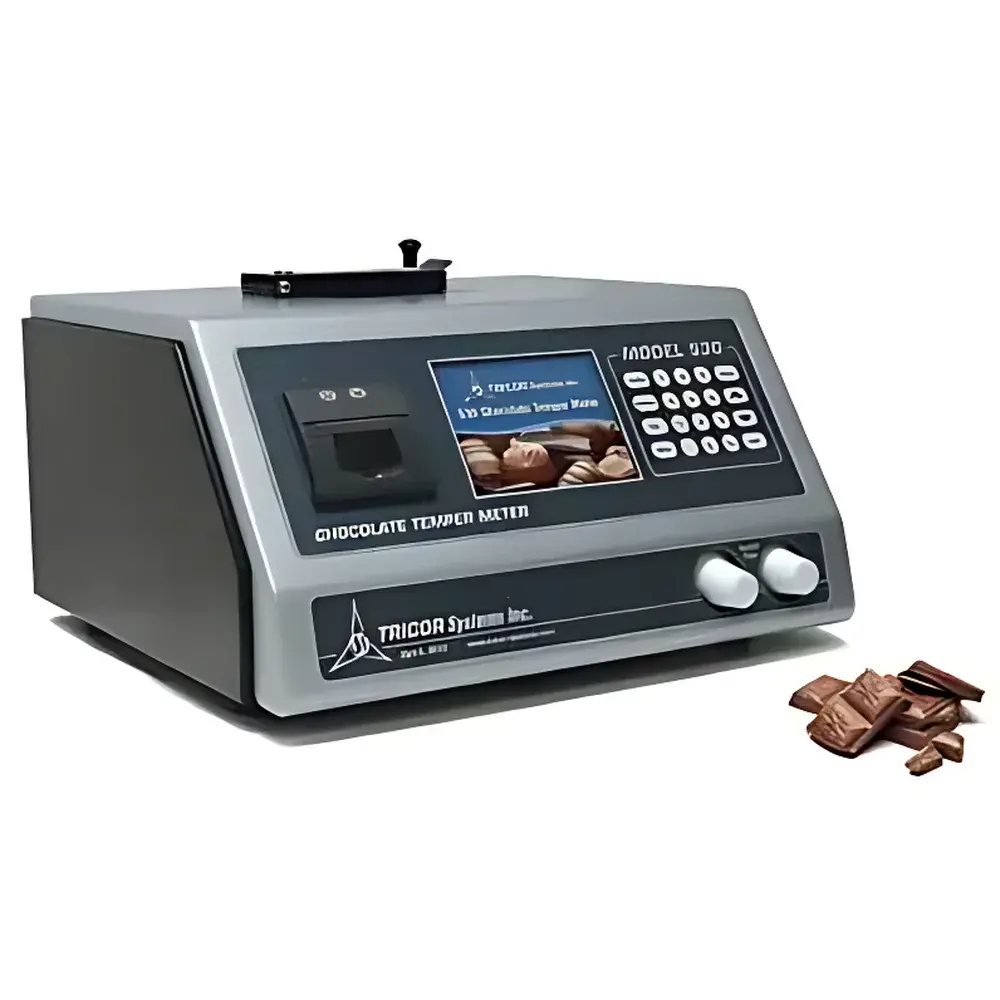
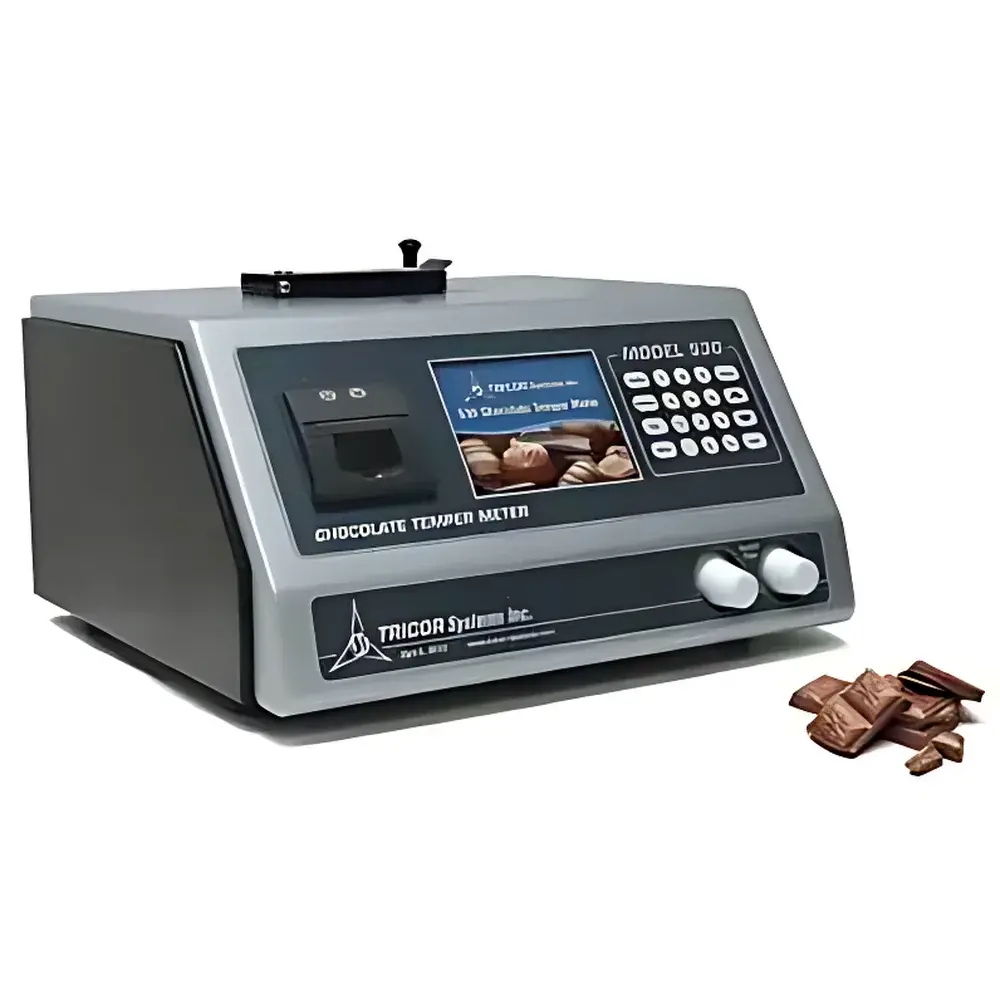
TRICOR Model 530 Chocolate Tempering Unit (CTU) Analyzer
| Brand | TRICOR |
|---|---|
| Origin | USA |
| Manufacturer Type | Authorized Distributor |
| Origin Category | Imported |
| Model | TRICOR 530 |
| Price | Upon Request |
Overview
The TRICOR Model 530 Chocolate Tempering Unit (CTU) Analyzer is a precision-engineered instrument designed for the quantitative, repeatable measurement of chocolate tempering quality—specifically the Chocolate Tempering Unit (CTU) value, crystallization onset temperature, inflection point temperatures, and second-inflection slope of the tempering curve. It operates on the fundamental principle of controlled isothermal crystallization kinetics: by subjecting a standardized 11.0 mL chocolate sample to a precisely programmed three-stage thermal profile (cooling from ~40 °C to 27 °C, followed by controlled reheating to 29–30 °C), the instrument monitors real-time temperature decay and identifies thermodynamic signatures associated with β-crystal nucleation and growth—the only polymorph of cocoa butter conferring optimal gloss, snap, contraction, and shelf stability. Unlike empirical visual or tactile assessments, the TRICOR 530 delivers objective, metrologically traceable data aligned with industrial process control requirements for confectionery manufacturing.
Key Features
- Precision closed-loop thermoelectric cooling system with ±0.06 °C temperature stability over the full test cycle
- High-resolution thermocouple probe with ±0.6 °C absolute accuracy and ±0.003 °C sensitivity across –8 °C to +55 °C range
- Programmable test duration (3–10 minutes) and user-selectable Y-axis baseline (14–32 °C) and X-axis time scale (5 or 10 min)
- Integrated 320 × 234 pixel color TFT LCD display with 16 selectable LED backlight colors and step-by-step operator guidance
- Onboard non-volatile memory storing up to 165 full-resolution temperature/time datasets (sampled every 5 seconds)
- Automatic self-calibration at power-on; real-time clock stamping all measurements, prints, and stored records
- Disposable polypropylene sample cups (11.0 mL volume) dispensed from front-panel magazine—ensuring consistent geometry, zero cross-contamination, and rapid cleanup
- Built-in thermal printer supporting both compact (ID, CTU, slopes, timestamps) and extended formats (full 5-sec interval data + curve plot)
Sample Compatibility & Compliance
The TRICOR 530 is validated for use with dark, milk, and white chocolate formulations—including those containing inclusions, emulsifiers (e.g., lecithin, PGPR), and alternative fats. It complies with RoHS Directive 2002/95/EC and 2005/618/EC. While not certified to ISO/IEC 17025, its measurement methodology supports internal validation under Good Manufacturing Practice (GMP) and Hazard Analysis Critical Control Point (HACCP) frameworks. The instrument’s CTU metric correlates directly with ASTM E2933-22 (Standard Guide for Sensory Evaluation of Chocolate) and serves as a critical process parameter for FDA-regulated food production environments where thermal history impacts final product safety and quality attributes.
Software & Data Management
Data acquisition, analysis, and archival are supported via the optional TRICOR TMDAS (Tempering Measurement Data Acquisition System) software suite. TMDAS enables bidirectional communication with one or multiple TRICOR 530 units, permitting centralized configuration, remote monitoring, and batch-level statistical process control (SPC). All stored runs include X-bar and sigma calculations per product ID, with trend charts plotting the last 120 CTU and slope values. Export functionality adheres to regulatory documentation standards: raw datasets and summary reports can be exported in native Excel format using validated TMDAS templates—facilitating audit readiness for 21 CFR Part 11-compliant environments when deployed with appropriate electronic signature and audit trail configurations.
Applications
- Real-time verification of tempering line performance prior to molding or enrobing
- Rapid qualification of new chocolate formulations or fat-replacement systems
- Root-cause analysis of bloom, poor release, or inconsistent snap in finished products
- Establishment and maintenance of target CTU windows for specific product lines (e.g., 28–32 CTU for premium dark chocolate)
- Training and standardization of tempering operators across global manufacturing sites
- Supporting R&D efforts in crystal polymorph stabilization, seeding strategies, and cooling rate optimization
FAQ
What does CTU stand for, and why is it critical for chocolate quality?
CTU stands for Chocolate Tempering Unit—a dimensionless index derived from the slope of the second inflection point on the tempering curve. It quantifies the degree of stable β-crystal formation; higher CTU values (typically 25–35) indicate greater β-polymorph content, directly correlating with gloss retention, mechanical snap, mold release efficiency, and resistance to fat bloom.
How does the TRICOR 530 ensure measurement repeatability across operators and shifts?
Through hardware-level controls: fixed-depth thermocouple positioning, automated sample cup dispensing (ensuring identical 11.0 mL volume and geometry), pre-conditioned probe temperature, and closed-loop thermal regulation eliminating ambient drift. Combined with ID-tagged runs and statistical trending, it reduces operator-dependent variability to ±0.5 CTU.
Can the TRICOR 530 be integrated into an existing factory MES or LIMS system?
Yes—via RS-232 or USB serial interface, the instrument outputs ASCII-formatted data compatible with most industrial data collection platforms. When used with TMDAS and configured with time-stamped CSV exports, it meets common MES integration requirements for process KPI tracking.
Is calibration traceable to NIST or other national standards?
The TRICOR 530 performs automatic internal calibration at startup using reference junctions and thermistor-based thermal references. While the unit itself is not NIST-traceable out-of-box, users may perform external verification using calibrated dry-block calibrators (e.g., Fluke 914x series) across its operational range per internal SOPs.
What maintenance is required to sustain long-term accuracy?
Minimal: routine cleaning of the sample well and probe tip with food-grade ethanol; annual verification of thermoelectric cooler performance and probe offset using certified reference baths; replacement of disposable cups—no consumables beyond cups and thermal paper.





