
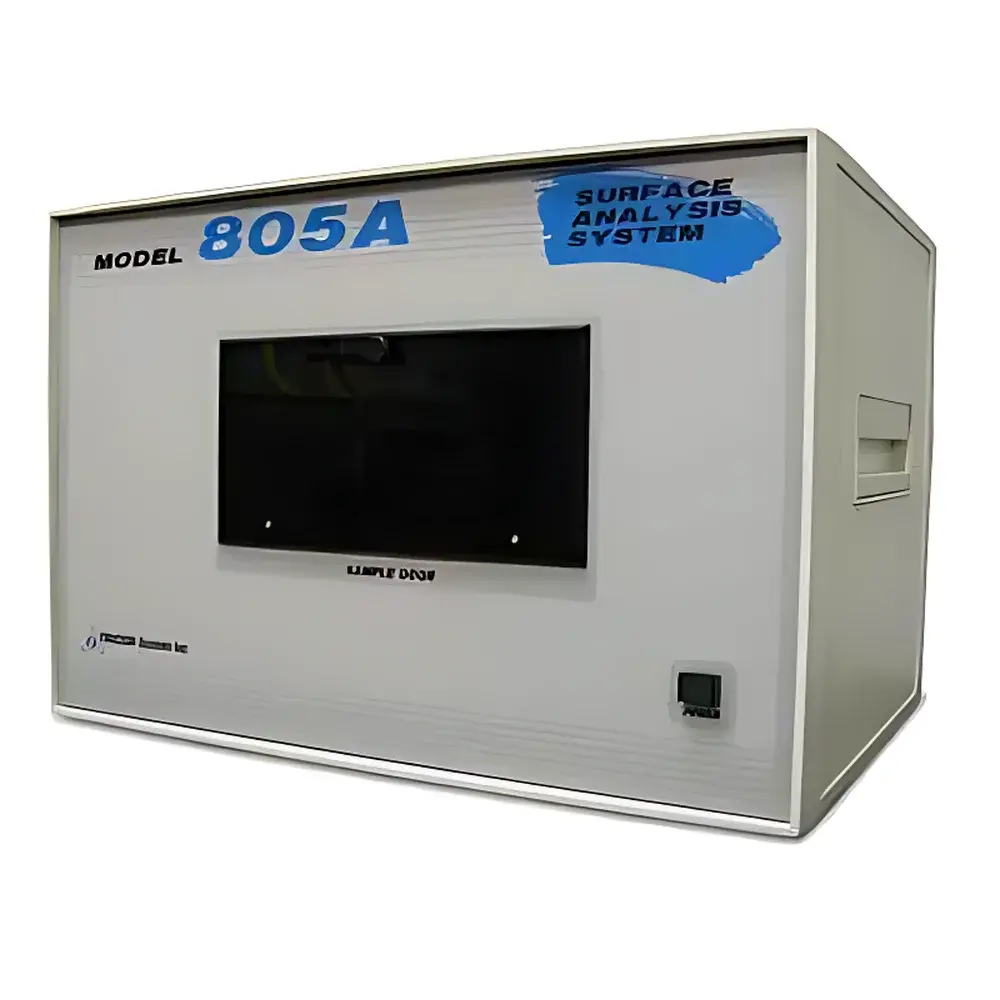
TRICOR Model 805A Surface Analysis System
| Brand | TRICOR |
|---|---|
| Origin | USA |
| Manufacturer Type | Authorized Distributor |
| Origin Category | Imported |
| Model | Model 805A |
| Type | Fully Automated |
| Power Supply | 115/220 V AC, 50/60 Hz, 300 W |
| Absolute Accuracy | ±1.0% of Full Scale |
| Repeatability | ±1.0% of Full Scale |
| Measurement Time | 20 s |
| Warm-up Time | 10 min (typical) |
| Geometry | Standard 60° gloss angle |
| Measurement Area | Ø63.5 mm (2.5 in) |
| Rotating Stage | Ø178 mm (7 in), 0–360° rotation in 1° increments |
| Sample Height Adjustment | 0–76 mm |
Overview
The TRICOR Model 805A Surface Analysis System is a fully automated, high-resolution optical metrology platform engineered for quantitative characterization of surface appearance properties—including gloss, Distinctness of Image (DOI), orange peel, haze, and texture uniformity. Operating on the principle of controlled-angle specular reflectance combined with high-fidelity digital imaging and spatial intensity analysis, the system delivers objective, traceable metrics independent of sample geometry, color, or material composition. Unlike subjective visual assessment or single-point glossmeters, the Model 805A captures up to 240,000 discrete data points across a 63.5 mm diameter measurement field—enabling spatial mapping of surface heterogeneity at micron-level resolution. Its integrated rotating stage and motorized Z-axis adjustment support rigorous evaluation of complex, non-planar, or textured surfaces under standardized illumination and viewing conditions compliant with ASTM D523, ASTM E430, ISO 2813, ISO 13803, and ISO 10216.
Key Features
- Fully automated operation with intuitive menu-driven interface—no specialized operator training required
- Simultaneous multi-parameter acquisition: gloss (60°), DOI, orange peel (waviness and long-wave distortion), haze index, and texture consistency
- High-precision rotating sample stage (Ø178 mm, 0–360° in 1° increments) enabling azimuthal symmetry analysis and anisotropic surface profiling
- Motorized vertical sample height adjustment (0–76 mm) accommodating thick substrates, molded parts, and curved components
- Internal reference calibration routine ensuring long-term stability and compliance with GLP/GMP documentation requirements
- Real-time visualization of surface topography maps, histograms, and comparative overlays for batch-to-batch or time-series analysis
- Onboard data storage and one-touch export to CSV, PDF, or proprietary binary formats for audit-ready reporting
Sample Compatibility & Compliance
The Model 805A accommodates rigid and semi-rigid samples up to 178 mm in diameter and 76 mm in height—including painted automotive panels, coated metal sheets, injection-molded plastics, architectural finishes, and aerospace composites. Its non-contact optical architecture eliminates mechanical loading artifacts and enables repeatable measurement of soft, delicate, or thermally sensitive surfaces. All measurement protocols adhere to international standards: gloss per ASTM D523 and ISO 2813; DOI per ASTM E430 and ISO 13803; orange peel quantification per ISO 10216 and SAE J2225; and haze per ASTM D1003. The system supports 21 CFR Part 11-compliant user authentication, electronic signatures, and immutable audit trails when configured with optional software modules for regulated environments.
Software & Data Management
The embedded Windows-based control software provides real-time image acquisition, spatial filtering, and algorithmic decomposition of surface reflectance profiles. Advanced analysis tools include region-of-interest (ROI) masking, cross-sectional line scans, statistical process control (SPC) charting, and deviation mapping against master reference samples. Data sets are timestamped, version-controlled, and exportable with full metadata—including instrument configuration, environmental conditions (optional sensor integration), and calibration history. Optional network connectivity enables centralized data aggregation into LIMS or MES platforms, while built-in report templates satisfy internal QA/QC, supplier qualification, and regulatory submission requirements.
Applications
The Model 805A is deployed extensively in R&D labs and production quality control settings across industries where surface aesthetics and functional optics intersect. Key use cases include: optimization of clear-coat formulations and curing parameters in automotive OEM paint lines; validation of anti-glare coatings on display covers and medical device housings; monitoring of surface degradation during UV/weathering exposure testing per ASTM G154 and ISO 4892; quantification of machining-induced waviness on precision-milled aluminum alloys; and consistency auditing of decorative laminates and wood veneers. Its ability to decouple geometric scattering (haze) from directional reflectivity (gloss) makes it indispensable for developing next-generation functional surfaces—such as self-cleaning glass, low-observability coatings, and tactile feedback interfaces.
FAQ
What standards does the Model 805A comply with for gloss and DOI measurement?
ASTM D523, ISO 2813, ASTM E430, and ISO 13803.
Can the system measure curved or irregularly shaped parts?
Yes—the rotating stage, adjustable Z-axis, and wide-field imaging enable robust measurement of convex, concave, and contoured surfaces without fixturing artifacts.
Is haze measurement performed simultaneously with gloss and DOI?
Yes—haze index is calculated from the same raw image dataset using standardized annular integration algorithms per ASTM D1003.
How is calibration maintained over time?
The system performs automated internal reference checks before each measurement sequence and supports scheduled NIST-traceable ceramic standard recalibration.
Does the software support automated pass/fail decision logic based on tolerance limits?
Yes—user-defined specification limits can be applied to any parameter, triggering visual alerts and generating compliance reports.




