
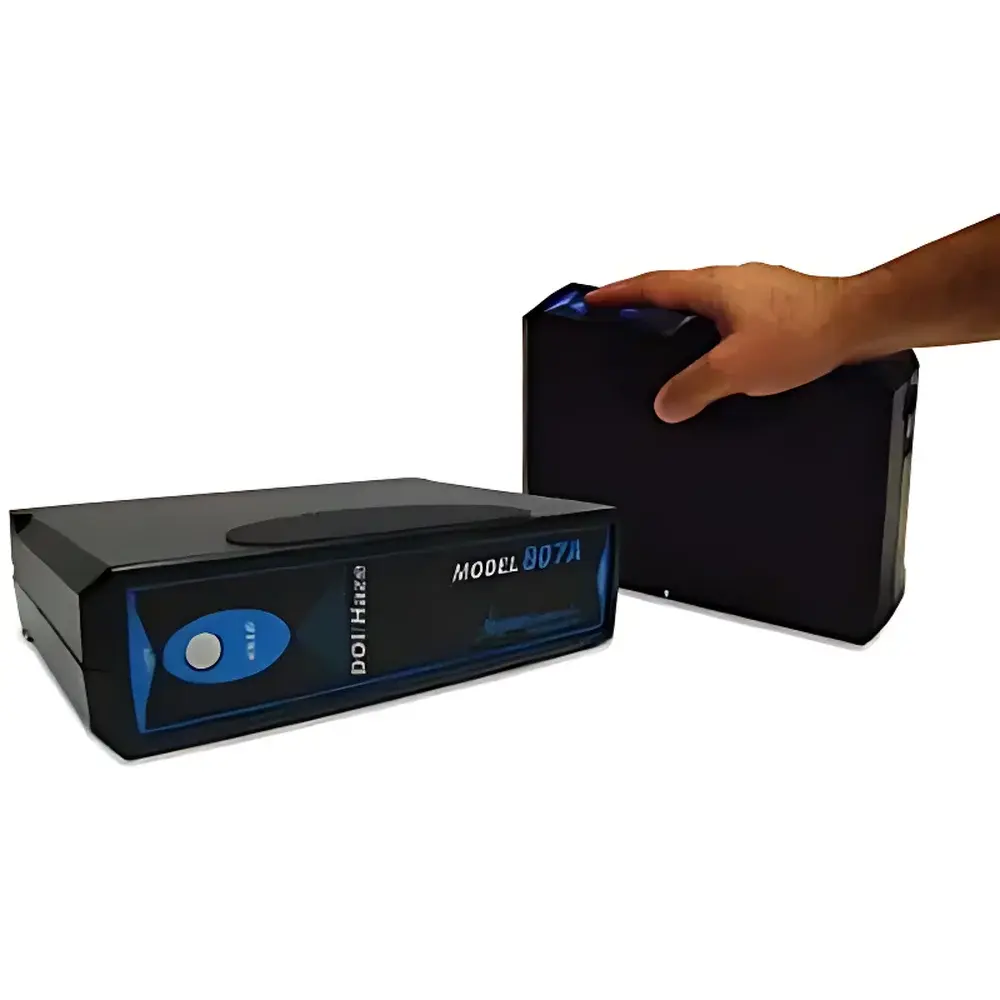
TRICOR Model 807A DOI and Haze Meter
| Brand | TRICOR |
|---|---|
| Origin | USA |
| Manufacturer Type | Authorized Distributor |
| Origin Category | Imported |
| Model | Model 807A |
| Price | Upon Request |
| Standard | ASTM E430-97 Method A, ASTM D5767 Method A |
| Optical Geometry | Illumination @ 30°, Specular Detector @ 30°, Haze Detector @ 15° |
| Measured Parameters | Specular Gloss (Rs), Distinctness of Image (DOI), Haze at 2° and 15°, Reflection Direction (indirect), Reflectance, Metallic Appearance |
| Measurement Area | 5.3 mm Ø (0.21 in) |
| Angular Resolution | ~220 pixels across ±2.98° field |
| Light Source | White LED |
| Measurement Time | < 4 s |
| Power | 2 × 1.5 V AA NiCd batteries (10 h continuous operation) |
| Dimensions (H×W×D) | 22.9 × 17.8 × 6.1 cm (9 × 7 × 2.4 in) |
| Weight | 1.86 kg (4.1 lb) |
| Operating Temperature | 10–38 °C |
| Storage Temperature | 0–60 °C |
| Relative Humidity | < 85 % RH at 35 °C |
| Software Interface | RS-232 to Windows® 9x/NT/2000/XP (Pentium III @ 400 MHz minimum) |
| Optional Accessories | Calibration mirror standard, black glass calibration tile, AC adapter/charger, PDA with connectivity software, carrying case |
Overview
The TRICOR Model 807A DOI and Haze Meter is a precision optical instrument engineered for the quantitative assessment of surface appearance characteristics on high-gloss, specularly reflective materials. It operates on the principle of angular-resolved reflectance measurement, utilizing a fixed 30° illumination geometry aligned with a co-located specular detector—per ASTM E430-97 Method A and ASTM D5767 Method A—to isolate and quantify deviations from ideal mirror-like reflection. The system simultaneously captures scattered light within two defined angular bands: a narrow ±2° cone centered on the specular direction (for haze evaluation) and a broader ±15° band (for extended haze characterization). With 220 discrete angular sampling points over a ±2.98° field, the Model 807A resolves microstructural variations at a resolution approaching human visual acuity—enabling detection of subtle defects arising from pigment agglomeration, film formation irregularities, or surface topography below 1 µm scale. Its white LED source ensures stable, repeatable spectral output without thermal drift, while the compact, handheld form factor supports both laboratory-grade metrology and in-line process monitoring.
Key Features
- Simultaneous measurement of Specular Gloss (Rs), Distinctness of Image (DOI), and Haze at both 2° and 15° angular apertures in a single <4-second acquisition cycle
- High-angular-resolution photodetector array (220 pixels across ±2.98°) enabling discrimination of sub-micron surface texture effects on image clarity
- Dual-mode operation: contact-based for maximum repeatability on flat surfaces; non-contact mode (optional) for delicate, hot, or moving substrates in production environments
- Integrated time-stamping and automatic data logging for each measurement—fully compliant with GLP documentation requirements
- RS-232 serial interface supporting direct integration with Windows-based PCs or PDAs for real-time data streaming, statistical analysis (mean, SD, min/max), and automated report generation
- Low-power NiCd battery architecture delivering >10 hours of continuous operation; optional AC adapter enables uninterrupted benchtop use and battery recharging
Sample Compatibility & Compliance
The Model 807A is validated for use on rigid, planar, high-reflectance surfaces including electroplated metals, automotive clearcoats, polished ceramics, tempered glass, anodized aluminum, and high-gloss laminates. Its 5.3 mm measurement aperture accommodates typical QC sampling protocols for coated panels per ISO 2813 and ASTM D523. Instrument compliance with ASTM E430-97 Method A ensures traceability to national standards for DOI quantification, while adherence to ASTM D5767 Method A validates haze reporting for industrial coatings. All firmware and calibration routines are designed to support audit-ready workflows under FDA 21 CFR Part 11 when paired with validated software configurations—including electronic signatures, audit trails, and user-access controls.
Software & Data Management
The included DOI/Haze application software provides full instrument control, real-time waveform visualization of the reflected intensity distribution, and automated calculation of Rs, DOI, and haze indices. Raw angular intensity profiles are exportable in CSV format for third-party spectral analysis. Statistical summaries (n ≥ 3 measurements) are generated automatically, with configurable pass/fail thresholds based on internal specifications or customer-defined limits. Data synchronization with Microsoft Excel is achieved via drag-and-drop or scheduled batch export—eliminating manual transcription errors. For regulated environments, optional software validation packages include IQ/OQ documentation, change control logs, and electronic record integrity verification per ALCOA+ principles.
Applications
- Automotive OEM and Tier-1 suppliers: Monitoring clearcoat DOI loss during UV aging, evaluating spray booth contamination impact on gloss uniformity
- Precision optics manufacturing: Verifying surface homogeneity of anti-reflective coated lenses prior to assembly
- Architectural glass fabrication: Quantifying haze increase after tempering or chemical strengthening processes
- Consumer electronics: Assessing front-panel reflectivity consistency on smartphones and displays
- Coating R&D labs: Correlating pigment dispersion quality with measurable DOI degradation in acrylic and polyester systems
- Quality assurance in metal finishing: Detecting micro-etching anomalies on chrome-plated trim components
FAQ
What is the difference between DOI and haze measurements on this instrument?
DOI quantifies the sharpness of a reflected image by analyzing the angular spread of specular energy near the mirror direction; haze measures total scattered light outside the specular peak, reported at both 2° (micro-haze) and 15° (macro-haze) apertures.
Can the Model 807A measure curved or textured surfaces?
It is optimized for flat, smooth surfaces. Curved substrates introduce geometric distortion that violates ASTM E430 assumptions; textured surfaces require alternative methods such as gonio-spectrophotometry.
Is calibration traceable to NIST standards?
Yes—certified reference standards (mirror and black glass tiles) are available with NIST-traceable calibration certificates issued by TRICOR’s accredited metrology lab.
Does the instrument support GMP/GLP-compliant data archiving?
When used with validated software and configured audit trail settings, it meets core requirements for electronic records under 21 CFR Part 11 and EU Annex 11.
How often must the instrument be recalibrated?
Annual recalibration is recommended; however, daily verification using supplied reference standards is required to maintain measurement confidence per ISO/IEC 17025 guidelines.




