
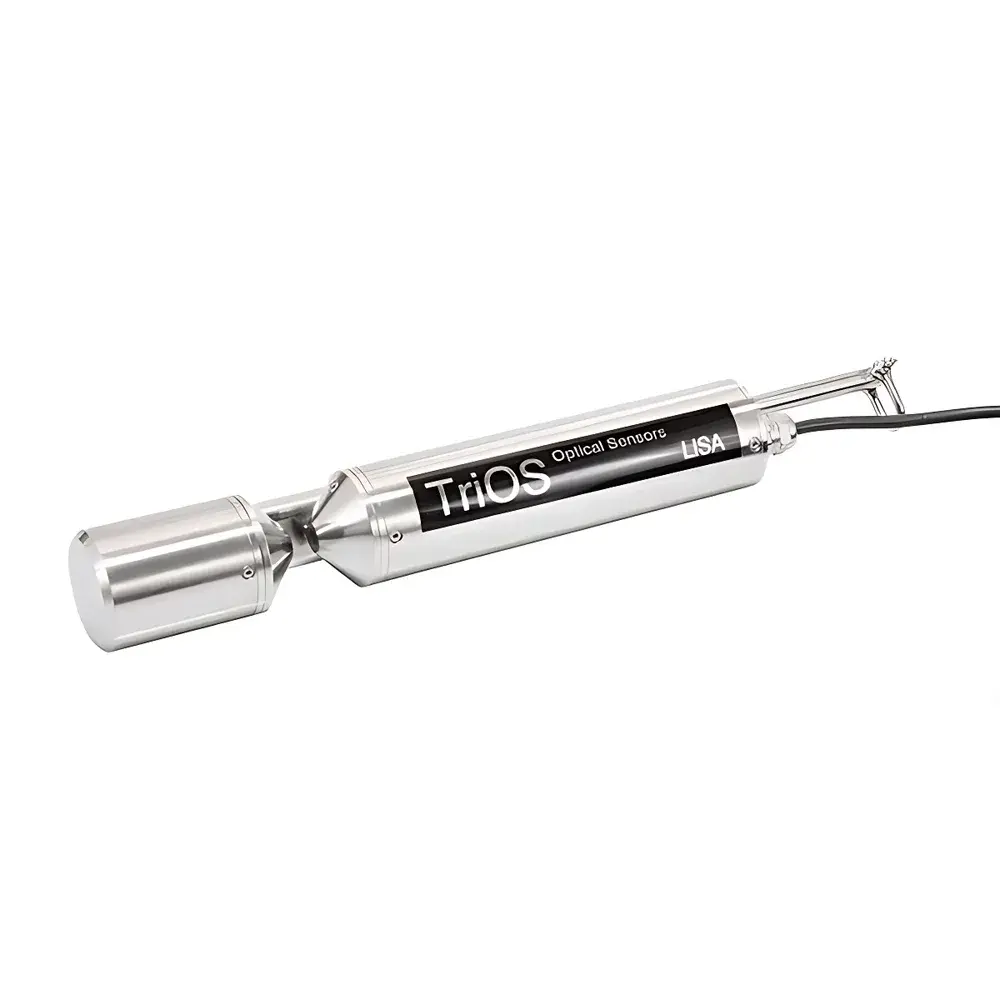
TriOS LISA color In-line Colorimeter for Water Quality Monitoring
| Brand | TriOS |
|---|---|
| Origin | Germany |
| Model | LISA color |
| Optical Path Lengths | 50 mm, 100 mm, 150 mm, 250 mm |
| Measurement Principles | Absorption-based attenuation at dual-wavelength LED pairs (e.g., 436 nm & 740 nm) |
| Compliance Standards | DIN EN ISO 7887:2012-04 (Methods B & C), DIN EN ISO 6271-2:2005-03, GOST 3351-74 |
| Measured Parameters | SAC (436/525/620 nm), True Color (410 nm), Hazen/APHA (390/455 nm), Cr-Co (380/413 nm) |
| Turbidity Compensation | Yes, via 740 nm reference channel |
| Accuracy | ±0.5 % of reading |
| Response Time | 4 s |
| Minimum Measurement Interval | 2 s |
| Housing Materials | Stainless Steel 1.4571 / 1.4404 or Titanium Grade 2 (3.7035) |
| Dimensions (L × Ø) | 340 mm × 48 mm (for 50 mm path) |
| Weight | ~2.4 kg (stainless), ~1.3 kg (titanium) |
| Digital Interfaces | Ethernet (TCP/IP), RS-232/RS-485 (Modbus RTU) |
| Analog Output | 4–20 mA |
| Power Supply | 12–24 VDC (±10 %), ≤1 W |
| Max. Pressure Rating | 30 bar (SubConn), 3 bar (fixed cable), 1 bar (flow cell) |
| IP Rating | IP68 |
| Operating Temperature | +2 °C to +40 °C |
| Storage Temperature | −20 °C to +80 °C |
| Flow Velocity Range | 0.1–10 m/s |
| Data Memory | ~2 MB |
| Calibration Interval | 24 months |
| Optical Window | Nano-coated sapphire |
| Cleaning Option | Optional pneumatic cleaning system |
Overview
The TriOS LISA color is a compact, high-stability in-line colorimeter engineered for continuous, real-time monitoring of color-related water quality parameters in demanding environmental and industrial applications. It operates on the principle of spectrophotometric absorption attenuation using precisely calibrated dual-wavelength LED sources—primarily at 436 nm (for Standard Color Value, SAC) and a secondary wavelength at 740 nm—to enable automatic turbidity and background interference compensation. This two-channel optical architecture ensures long-term measurement stability without drift, eliminating the need for frequent recalibration. Designed in accordance with internationally recognized standards—including DIN EN ISO 7887 (Methods B and C for SAC and true color), DIN EN ISO 6271-2 (Hazen/APHA), and GOST 3351-74 (Cr-Co)—the LISA color delivers traceable, metrologically sound data suitable for regulatory reporting, process control, and trend analysis. Its solid-state LED light source offers >50,000 hours of operational life, while the nano-coated sapphire optical window resists biofouling and chemical erosion—critical for deployment in raw water intakes, wastewater effluents, and chlorinated distribution systems.
Key Features
- Dual-wavelength LED photometry with integrated 740 nm turbidity compensation channel for robust, drift-free SAC and color measurements
- Selectably configurable optical path lengths (50 mm, 100 mm, 150 mm, 250 mm) to optimize sensitivity across low- to high-color matrices
- Titanium alloy (Grade 2, 3.7035) housing option rated for aggressive environments—including high-chloride, saline, or acidic conditions—complementing standard stainless-steel (1.4571/1.4404) variants
- Nano-structured anti-fouling coating on sapphire optical windows, significantly extending maintenance intervals in biologically active waters
- Optional pneumatic cleaning interface compatible with external air supply systems, minimizing manual intervention and sensor downtime
- Low-power design (<1 W) enabling deployment in solar-powered or battery-backed remote monitoring stations
- IP68-rated enclosure with pressure tolerance up to 30 bar (SubConn variant), certified for submersible and pressurized pipeline installation
Sample Compatibility & Compliance
The LISA color is validated for use with natural surface waters, groundwater, drinking water, treated wastewater, and industrial process streams—including those containing suspended solids, humic substances, or oxidizing agents. Its turbidity-compensated algorithm maintains accuracy under variable particulate load, fulfilling performance criteria specified in DIN EN ISO 7887:2012-04 Method B (SAC) and Method C (True Color), as well as DIN EN ISO 6271-2:2005-03 for Hazen/APHA units. For legacy compliance workflows, Cr-Co color per GOST 3351-74 is also supported. All firmware and calibration routines adhere to GLP-aligned traceability requirements; audit logs record calibration events, firmware updates, and configuration changes. While not FDA 21 CFR Part 11-certified out-of-the-box, the device supports secure, time-stamped data export and Modbus RTU register locking—facilitating integration into validated GMP/QA environments when paired with compliant SCADA or LIMS platforms.
Software & Data Management
The LISA color interfaces natively via Ethernet (TCP/IP) and serial protocols (RS-232/RS-485 Modbus RTU), enabling seamless integration into existing PLC, DCS, or cloud-based telemetry infrastructures. Onboard memory (~2 MB) stores timestamped measurement records with full parameter metadata—including raw ADC values, compensated absorbance, and diagnostic flags—for local retrieval or scheduled FTP push. TriOS provides the free TriOS ConfigTool for commissioning, spectral validation, and firmware updates; optional TriBox Mini and TriBox 3 HS controllers offer edge-computing capabilities—including alarm generation, linearization, and multi-sensor synchronization. Data output includes primary color units (SAC, Hazen, Cr-Co) alongside auxiliary diagnostics (signal-to-noise ratio, LED intensity decay, window contamination index). All digital outputs comply with IEC 61131-3 and Modbus Application Protocol v1.1b specifications.
Applications
- Drinking water treatment: Real-time SAC monitoring at intake, pre-oxidation, and final distribution points to ensure compliance with national color thresholds (e.g., <20 mg Pt/L in EU Directive 98/83/EC)
- Wastewater effluent compliance: Continuous reporting of APHA/Hazen values against discharge permits (e.g., US EPA NPDES limits)
- Industrial process water: Detection of dye bleed, tannin leaching, or oxidation byproducts in pulp & paper, textile, and food & beverage facilities
- Environmental monitoring networks: Long-term deployment in rivers, reservoirs, and estuaries where color serves as a proxy for dissolved organic carbon (DOC) loading
- Research-grade field studies: High-temporal-resolution profiling of chromophoric dissolved organic matter (CDOM) dynamics under varying hydrological conditions
FAQ
What color units does the LISA color measure, and which standards do they follow?
It measures SAC (DIN EN ISO 7887), Hazen/APHA (DIN EN ISO 6271-2), True Color (DIN EN ISO 7887 Method C), and Cr-Co (GOST 3351-74), all traceable to NIST-calibrated reference materials.
Can the LISA color operate in seawater or high-chloride environments?
Yes—the titanium alloy (3.7035) version is specifically engineered for sustained operation in saline, brackish, or chlorinated media where stainless steel would suffer pitting corrosion.
How often does the sensor require calibration or maintenance?
Factory calibration remains valid for 24 months under normal operating conditions; nano-coating and optional pneumatic cleaning extend functional uptime between manual interventions to 6–12 months depending on site fouling severity.
Is analog output available, and what is its resolution?
A fully isolated 4–20 mA current loop is provided, configurable per parameter (e.g., SAC 436 nm), with 16-bit DAC resolution and HART-compatible signaling capability.
Does the device support remote firmware updates and diagnostics?
Yes—via Ethernet or Modbus, users can initiate firmware upgrades, retrieve live diagnostics (LED health, temperature, signal stability), and export binary data logs without physical access.







