
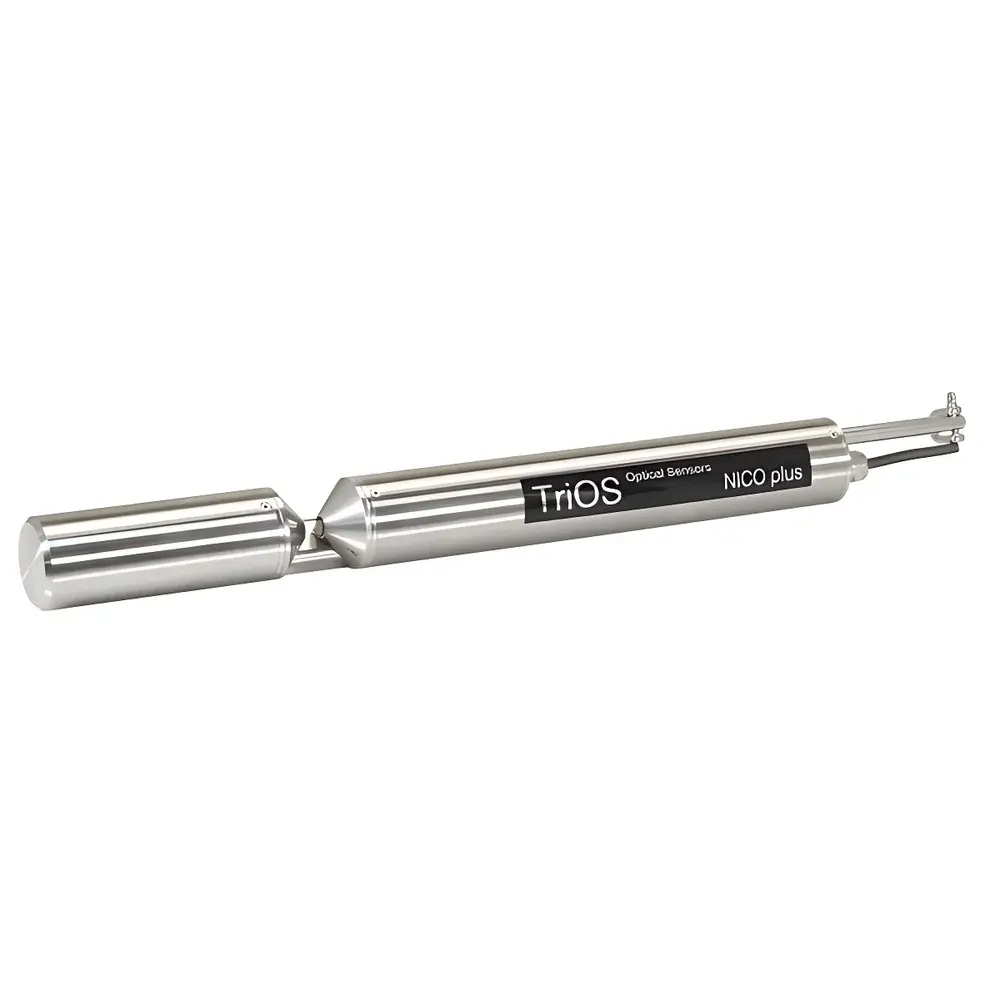
TriOS NICO plus Enhanced Nitrate Analyzer
| Brand | TriOS |
|---|---|
| Origin | Germany |
| Model | NICO plus |
| Measurement Principle | UV Absorption Spectrophotometry (254 nm) |
| Optical Path Length | 10 mm |
| Detection Method | Dual-wavelength (254 nm + reference) |
| Calibration | Built-in temperature compensation |
| Interface | G2 Web-enabled Ethernet interface |
| Compliance | DIN EN ISO 7027 (turbidity), ASTM D5540 (UVT), USP <643> (TOC estimation), GLP/GMP-ready data logging |
| Sample Handling | In-situ, flow-through or immersion mode |
| Reagent-Free | Yes |
| Optical Window | Nano-coated quartz |
| Data Storage | Internal SD card (optional), real-time streaming via Modbus TCP/RTU, HTTP API |
Overview
The TriOS NICO plus Enhanced Nitrate Analyzer is a high-precision, reagent-free ultraviolet absorption spectrophotometer engineered for continuous, in-situ quantification of nitrogenous species and organic load indicators in aqueous environments. Operating on the fundamental principle of Beer–Lambert law-based dual-wavelength UV absorbance at 254 nm (with reference wavelength correction), the instrument delivers stable, interference-compensated measurements of nitrate-nitrogen (NO₃–N), total nitrate (NO₃), nitroxide-nitrogen (NOx–N), and total nitroxides (NOx). Beyond traditional nitrate monitoring, the NICO plus extends analytical capability to surrogate parameters including ultraviolet transmittance at 254 nm (UVT₂₅₄), normalized UVT (UVT₂₅₄ₙ), spectral absorption coefficient (SAC₂₅₄), chemical oxygen demand equivalent (CODeq), biochemical oxygen demand equivalent (BODeq), total organic carbon equivalent (TOCeq), dissolved organic carbon equivalent (DOCeq), turbidity (in FAU), and total suspended solids equivalent (TSSeq). Its optical architecture features nano-coated quartz windows resistant to biofouling and scaling, ensuring long-term signal integrity in challenging wastewater and surface water matrices.
Key Features
- Reagent-free, maintenance-light operation—no consumables, no wet chemistry, no hazardous waste generation
- Integrated temperature compensation algorithm ensures measurement stability across 0–40 °C ambient and sample temperature ranges
- G2 web-enabled interface: full configuration, real-time diagnostics, firmware updates, and internal data logging accessible via standard browser
- Unified TriOS hardware platform enables cross-device compatibility with standardized spare parts, optical modules, and mounting accessories
- Dual-wavelength UV photometry (254 nm + reference) minimizes drift from lamp aging, window fouling, and particulate scattering
- Compliant with DIN EN ISO 7027 for turbidity measurement using formazin-based calibration traceability
- Modbus TCP/RTU and HTTP RESTful API support seamless integration into SCADA, DCS, and LIMS infrastructures
Sample Compatibility & Compliance
The NICO plus is validated for direct immersion or flow-cell deployment in raw sewage, secondary effluent, river water, reservoirs, drinking water distribution systems, and industrial process streams. It meets functional requirements for continuous emission monitoring under EU WFD (Water Framework Directive) reporting and supports regulatory compliance workflows aligned with ISO 5667 (water sampling), ASTM D5540 (UVT-based organic load estimation), and USP (non-specific TOC screening). All internal data logging adheres to ALCOA+ principles; audit trails, user access control, and electronic signature readiness align with FDA 21 CFR Part 11 and EU Annex 11 expectations for regulated environments. Calibration verification protocols are documented per ISO/IEC 17025 laboratory quality management standards.
Software & Data Management
Firmware v3.2+ includes embedded web server functionality enabling zero-client setup: users configure measurement intervals (1–300 s), select output parameters, define alarm thresholds, and export CSV/JSON logs directly from any networked device. Internal storage retains ≥12 months of 1-minute averaged data (expandable via microSD). Time-stamped raw spectra (254 nm + reference channel) are preserved for retrospective validation. Remote monitoring is supported via SNMP traps, email alerts, and MQTT publishing. TriOS DataCenter software (Windows/Linux/macOS) provides advanced spectral visualization, multi-sensor correlation analysis, and automated report generation compliant with ISO 14001 environmental management documentation.
Applications
- Real-time optimization of denitrification basins in municipal wastewater treatment plants (WWTPs)
- Early-warning detection of nitrate leaching in groundwater monitoring wells and agricultural runoff channels
- Process control of membrane filtration and UV disinfection units where UVT₂₅₄ serves as a critical performance indicator
- Drinking water source protection programs requiring simultaneous tracking of nutrient loading and organic contamination surrogates
- Industrial pretreatment compliance monitoring for food processing, pharmaceutical, and semiconductor facilities discharging nitrogen-rich effluents
- Research-grade longitudinal studies of aquatic biogeochemical cycling in mesocosms and field-deployed sensor networks
FAQ
Does the NICO plus require periodic recalibration?
No routine recalibration is required. The instrument performs automatic zero-reference correction during each measurement cycle using its internal dark-current reference. Field verification against certified nitrate standards (e.g., NIST SRM 3189) is recommended every 6–12 months depending on matrix severity.
Can it operate in highly turbid or colored water?
Yes. The dual-wavelength algorithm compensates for non-specific absorbance from suspended solids and humic substances. For TSS > 200 FAU or DOC > 50 ppm, optional flow-cell installation with mechanical wiper is advised to maintain optical clarity.
Is the TOCeq output traceable to certified TOC analyzers?
TOCeq is a predictive parameter derived from UVT₂₅₄ and SAC₂₅₄ using empirically validated regional correlations (e.g., German DWA-M 30 and US EPA Method 415.3). It is not a direct TOC measurement but demonstrates strong linear correlation (R² > 0.92) with combustion-based TOC analyzers in municipal wastewater applications.
What cybersecurity protocols does the G2 interface support?
The embedded web server supports TLS 1.2 encryption, configurable HTTP authentication (Basic/Digest), IP address whitelisting, and disabled default credentials upon first boot—meeting IEC 62443-3-3 SL1 requirements for industrial control system edge devices.







