
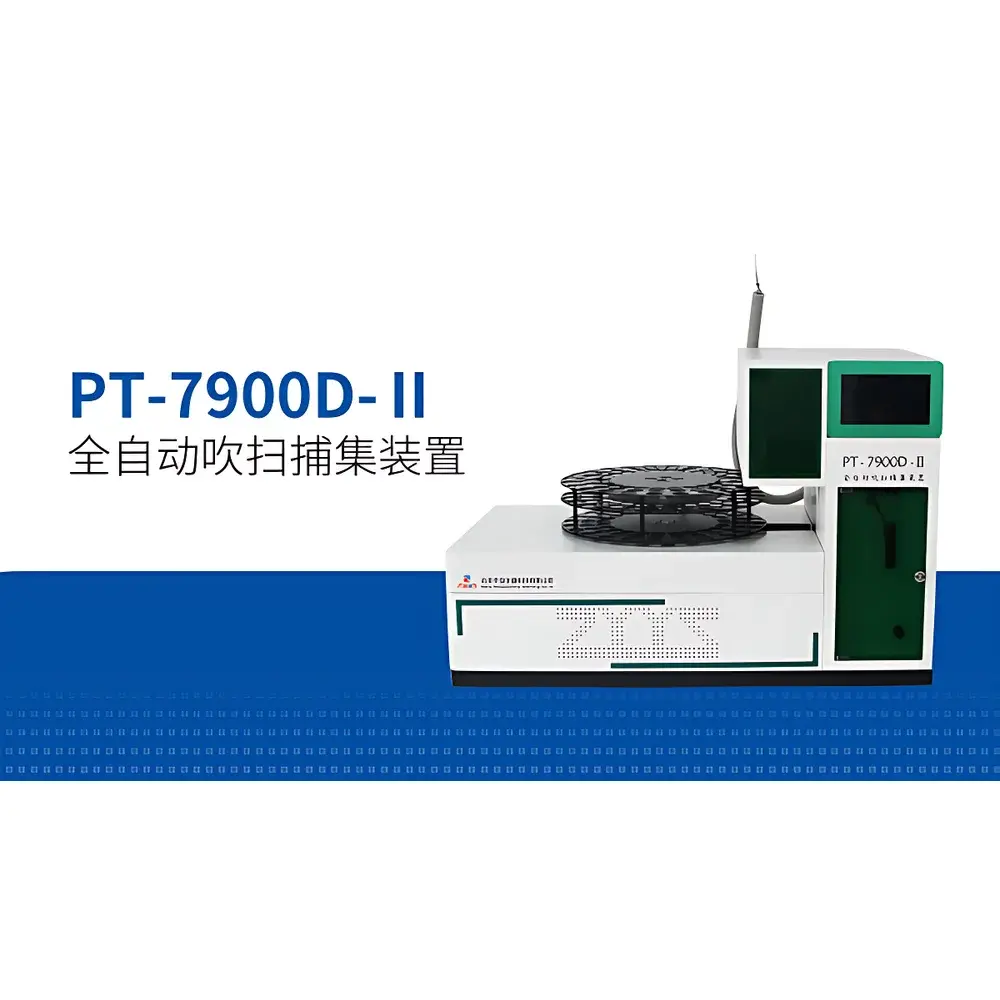
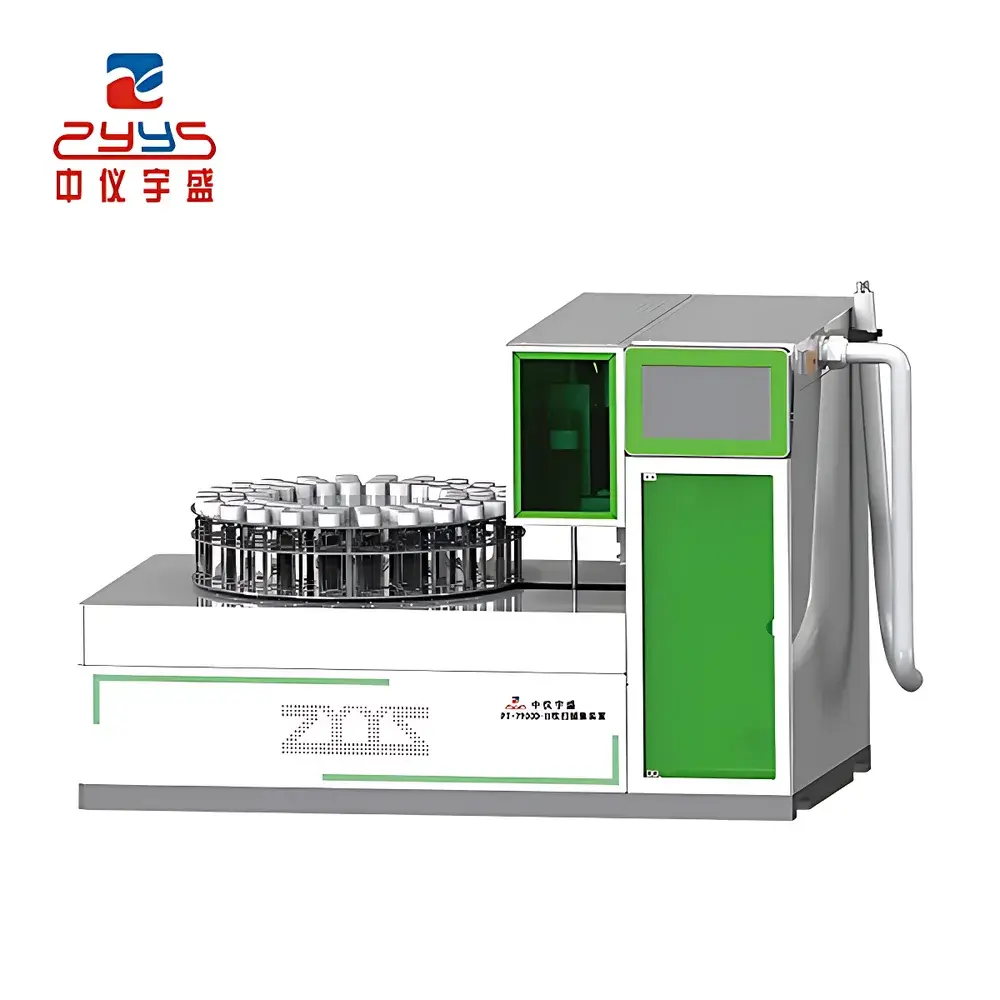
Zhongyi Yusheng PT-7900D-II Fully Automated Purge and Trap System
| Brand | Zhongyi Yusheng |
|---|---|
| Origin | Beijing, China |
| Manufacturer Type | Manufacturer |
| Product Category | Domestic |
| Model | PT-7900D-II |
| Instrument Type | Water & Soil Integrated Purge and Trap System |
| Sample Tray Capacity | 72 positions |
| Fluid Handling | Integrated Syringe Pump for Automated Liquid Addition |
| Temperature Control Zones | 7 (Sample Zone, Valve Oven, Purge Tube, Transfer Line, Cold Trap, Water Trap, Desorption Zone) |
| Desorption Ramp Rate | Up to 2000 °C/min |
| Gas Path Materials | Passivated Stainless Steel & PEEK |
| Valves | Imported Electromechanical Switching Valves |
| Pressure Monitoring | Digital Electronic Pressure Sensors |
| Flow Control | Mass Flow Controllers (MFCs) |
| User Interface | 7-inch Touchscreen with Real-time Status Visualization |
| Compliance Standards | ASTM D6866, EPA Methods 502.2, 524.2, 624, 8260D, 8270E |
| Safety Features | System Self-Check at Power-On, Over-Temperature Protection, Leak Detection, Electrical Leakage Protection |
| Cleaning Functions | Methanol Rinse, High-Temperature Water Rinse, Automated Back-Flush of Entire Gas Path |
| Sample Agitation | Motorized Stirring Module |
| Optional Purge Tube Configurations | U-shaped, 5 mL or 25 mL |
| GC/GC-MS Synchronization | Universal Trigger Interface for Major Chromatographic Platforms (Agilent, Thermo Fisher, Shimadzu, Waters, PerkinElmer) |
Overview
The Zhongyi Yusheng PT-7900D-II Fully Automated Purge and Trap System is an integrated sample preparation platform engineered for high-throughput, trace-level volatile organic compound (VOC) analysis in environmental, regulatory, and research laboratories. Based on the principle of dynamic headspace extraction—where inert carrier gas continuously purges VOCs from aqueous or solid-phase matrices into a cryogenically cooled trap—the system delivers quantitative recovery of analytes across C2–C12 hydrocarbons, halogenated compounds, nitriles, aldehydes, and other semi-volatile species. Its design adheres to fundamental requirements of EPA Method 524.2 (drinking water), EPA 8260D (soil/sediment), and ISO 15681-2 (water quality), enabling robust method transfer between regulatory-compliant workflows and routine QC environments. The instrument operates as a standalone autosampler-compatible front-end module, delivering fully automated, unattended processing of up to 72 samples per sequence without manual intervention.
Key Features
- 72-position carousel with programmable sample agitation—ensures homogeneous matrix presentation and improved extraction efficiency for heterogeneous soils and sludges.
- Seven independently controlled temperature zones—including sample incubation oven, purge tube heater, transfer line, cold trap (−30 °C to 300 °C), water removal trap (selective condensation at −10 °C), desorption zone, and valve manifold—enabling precise thermal management aligned with ASTM D6866 and EPA 8260D thermal desorption profiles.
- Ultra-rapid desorption ramp rate of up to 2000 °C/min minimizes band broadening and preserves chromatographic resolution during GC/GC-MS injection.
- Inert fluidic path constructed from electropolished stainless steel tubing and PEEK components, eliminating adsorptive losses and carryover for reactive analytes such as acrylonitrile and formaldehyde.
- Imported electromechanical switching valves and digital electronic pressure sensors ensure retention time stability (<0.02 min RSD) and long-term pneumatic reproducibility.
- Integrated syringe pump enables automated addition of internal standards, surrogates, or preservative reagents directly into vials—critical for isotope dilution quantitation and matrix-matched calibration.
- Universal GC/GC-MS trigger interface supports TTL-level synchronization with major chromatographic platforms, including Agilent 8890/8860, Thermo ISQ EM, Shimadzu GCMS-QP2020 NX, and Waters SELECT SERIES Cyclic IMS.
- Automated back-flush protocol cleans the entire gas path—including purge tube, transfer line, and water trap—between runs to prevent cross-contamination, validated per HJ 605-2011 blank criteria.
Sample Compatibility & Compliance
The PT-7900D-II accommodates liquid (aqueous, wastewater, leachate), solid (soil, sediment, sludge, tissue), and semi-solid (slurry, compost) matrices without hardware modification. Solid samples are processed using the optional U-shaped 25 mL purge tube with integrated stirring. All operational parameters—including purge time, temperature, flow rate, desorption profile, and bake-out duration—are configurable to meet method-specific requirements. The system satisfies data integrity prerequisites under GLP and GMP frameworks: audit trails record all parameter changes, user logins, and run events; method files are digitally signed and version-controlled; and system suitability tests (SST) can be embedded within sequences. It complies with EPA SW-846 Methods 502.2, 524.2, 624, 8260D, and 8270E; Chinese national standards HJ 605–2011 through HJ 1020–2019; and hydrometric standards SL 393–2007, SL 741–2016, and SL 748–2017.
Software & Data Management
The embedded 7-inch capacitive touchscreen runs a deterministic real-time OS with dedicated firmware for method development, sequence building, and status monitoring. Graphical workflow visualization displays live metrics—including MFC-adjusted purge flow (0–100 mL/min), cold trap temperature, valve actuation status, and elapsed run time. Method templates are exportable/importable in XML format for lab-wide standardization. Raw method files include embedded metadata (operator ID, instrument serial number, calibration date) compliant with FDA 21 CFR Part 11 Annex 11 requirements when paired with validated LIMS integration. Remote diagnostics and firmware updates are supported via Ethernet or USB port.
Applications
- Regulatory monitoring of VOCs in drinking water per GB/T 5750.8–2023 and EPA 524.2.
- Soil and sediment screening for petroleum hydrocarbons (C6–C9), chlorinated solvents, and BTEX compounds per HJ 605–2011 and HJ 1020–2019.
- Wastewater compliance testing for acrylonitrile, propionaldehyde, and acetonitrile per HJ 806–2016 and HJ 893–2017.
- Leachate characterization in landfill monitoring programs per HJ 713–2014.
- Research-scale method development for emerging contaminants—including halogenated furans and oxygenated VOCs—requiring low detection limits (<10 ng/L) and high inter-run precision (RSD <5% at 100 ng/L).
FAQ
Does the PT-7900D-II support EPA Method 8260D for soil analysis?
Yes. The system meets all thermal, timing, and flow specifications outlined in EPA 8260D, including mandatory use of a water removal trap and desorption ramp rates ≥1000 °C/min.
Can it be used with non-thermal desorption GC-MS systems?
Yes. The universal TTL trigger interface allows seamless synchronization with any GC or GC-MS equipped with external event input, regardless of vendor or acquisition software.
Is method validation documentation provided?
Instrument qualification reports (IQ/OQ/PQ templates), system suitability test protocols, and raw data traceability logs are included in the delivery package and align with ISO/IEC 17025:2017 clause 7.7 requirements.
What maintenance intervals are recommended?
Cold trap cleaning every 200 runs; water trap replacement every 500 runs; MFC recalibration annually or after 1000 operating hours—per manufacturer’s maintenance schedule included in the technical manual.





