
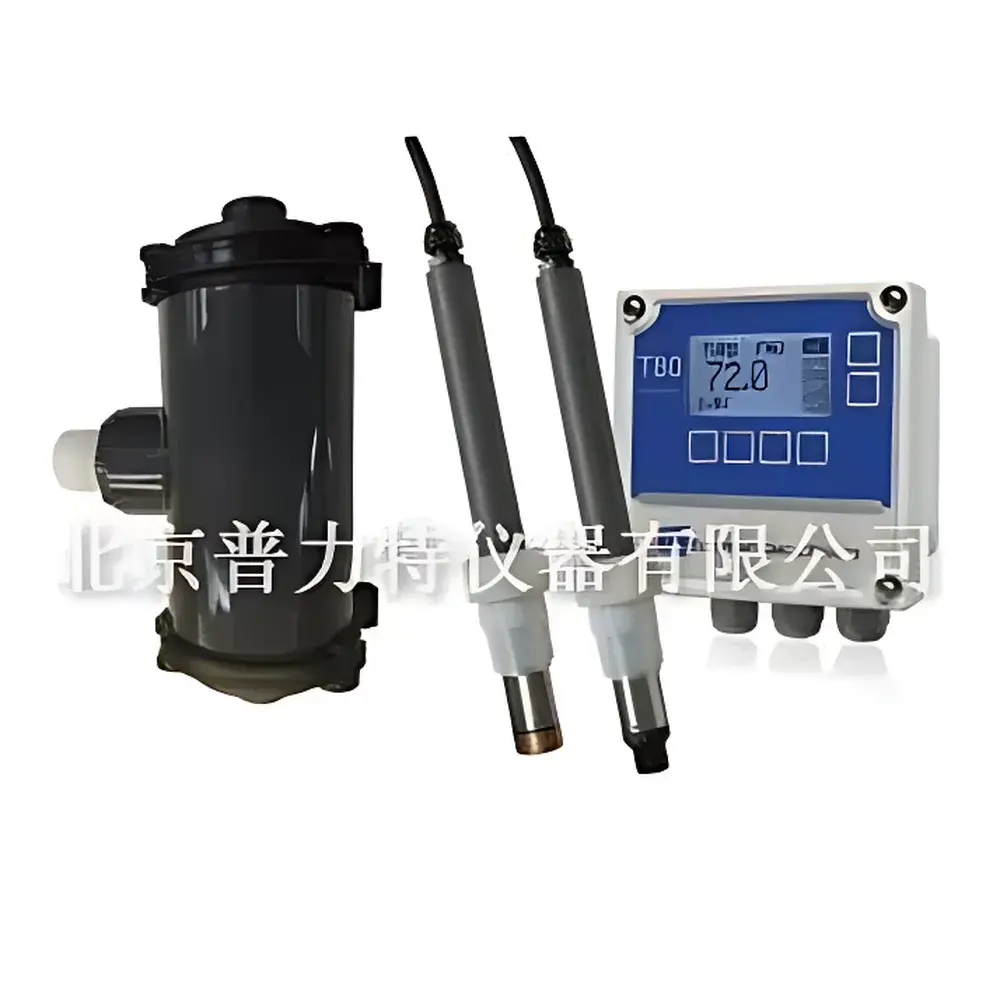
Triton TR86 Online Turbidimeter
| Origin | USA |
|---|---|
| Manufacturer Type | Authorized Distributor |
| Origin Category | Imported |
| Model | TR86 |
| Price Range | USD 2,700–6,800 (est.) |
| Product Type | Online / In-line |
| Measurement Range | 0–40 NTU / 0–1000 NTU / 0–2000 NTU / 0–4000 NTU |
| Resolution | 0.1 NTU |
| Operating Temperature | −5 to 50 °C (with built-in temperature compensation) |
| Accuracy | ±1% of reading |
| Light Source | 850 nm infrared LED |
| Detection Angle | 90° scattered light |
| Pressure Rating | up to 50 psi (for flow-through installation) |
| pH Range | 2–12 |
| Sensor Window Material | Sapphire |
| Housing Material | AISI 316 Ti stainless steel |
| Electrical Interface | 1″ NPT thread |
| Cable Length Options | 3.0 m / 6.1 m / 9.1 m |
| Dimensions | 25 cm length × 2.5 cm diameter |
Overview
The Triton TR86 Online Turbidimeter is an industrial-grade, in-line optical sensor engineered for continuous, real-time turbidity monitoring in water and wastewater process streams. It operates on the principle of 90° infrared scattered light detection—compliant with ISO 7027 and EPA Method 180.1—using a stable 850 nm LED light source. This wavelength minimizes interference from color absorption and chlorophyll fluorescence, ensuring high specificity for particulate scattering across low-to-high turbidity ranges. The sensor’s sapphire optical window provides exceptional scratch resistance and chemical inertness, maintaining long-term signal stability in aggressive environments. Built-in temperature compensation (−5 to 50 °C) and digital calibration constants stored permanently in the sensor’s embedded memory eliminate field recalibration drift. Designed for direct integration into pipelines or open-channel installations, the TR86 delivers repeatable NTU measurements with 0.1 NTU resolution and ±1% full-scale accuracy—validated under GLP-aligned operational protocols.
Key Features
- 90° infrared scattered light detection at 850 nm, optimized for compliance with ISO 7027 and US EPA Method 180.1
- Sapphire optical sensing surface—Vickers hardness >2000 HV—resistant to abrasion, scaling, and chemical attack in pH 2–12 media
- Embedded calibration memory: sensor-specific constants stored in non-volatile chip memory; no manual coefficient entry required
- Integrated self-diagnostic firmware: real-time status reporting for signal integrity, lamp output, temperature drift, and window fouling
- Modular mechanical design: compatible with submersible mounting brackets, PVC flow-through tees, and de-bubbling tees for gas-prone applications
- Dual-output interface: isolated 4–20 mA analog output + RS-485 MODBUS RTU digital communication (optional HART 7 or relay outputs)
- Robust housing: AISI 316 Ti stainless steel body rated for up to 50 psi operating pressure in flow-through configurations
Sample Compatibility & Compliance
The TR86 is validated for use in potable water distribution systems, surface water intake monitoring, pulp and paper effluent streams, and mixing/blending control loops. It is not suitable for organic solvent-based liquids, vacuum environments, or highly viscous suspensions (>50 cP). Its optical architecture meets the optical path geometry requirements of ISO 7027 for ratio-based turbidity measurement and supports audit-ready data logging when paired with compliant SCADA or DCS platforms. The device conforms to CE electromagnetic compatibility (EMC) Directive 2014/30/EU and RoHS 2011/65/EU. For regulated facilities, its deterministic response time (<2 s), traceable calibration history, and firmware-level diagnostic logs support 21 CFR Part 11-compliant electronic recordkeeping when deployed with validated data acquisition systems (e.g., T80 Data Logger).
Software & Data Management
The TR86 operates autonomously without host software but interfaces seamlessly with industry-standard PLCs, DCS controllers, and supervisory systems via MODBUS RTU (slave mode, addressable register map provided in technical documentation). When used with the optional T80 Data Acquisition Unit, real-time NTU values, temperature, and diagnostic flags are displayed locally and logged at user-defined intervals (1 s to 24 h). All configuration parameters—including range selection, damping factor, and alarm thresholds—are stored in EEPROM and persist through power cycles. Firmware updates are performed via UART or MODBUS register write commands, enabling remote maintenance without physical access. Audit trails—including calibration timestamps, sensor ID, and firmware version—are retained in non-volatile memory for GLP/GMP traceability.
Applications
- Drinking water treatment: filtration efficiency monitoring, coagulant dosing feedback control, and finished water quality assurance
- Surface and groundwater intake surveillance: early detection of sediment plumes, algal blooms, or runoff events
- Pulp and paper industry: whitewater clarity control, bleach plant effluent monitoring, and fiber loss quantification
- Chemical and pharmaceutical manufacturing: batch mixing homogeneity verification and cleaning-in-place (CIP) endpoint detection
- Municipal wastewater: secondary clarifier performance assessment and membrane bioreactor (MBR) feed monitoring
FAQ
What turbidity standards are supported for field verification?
The TR86 accepts standard formazin (FNU) or AMCO AEPA-1 (NTU) reference suspensions. Calibration verification is performed using two-point checks (zero and mid-range) per ISO 7027 Annex B.
Can the sensor be installed in pressurized pipelines?
Yes—when mounted via 1″ NPT threaded fitting in flow-through orientation, it withstands continuous pressure up to 50 psi (3.4 bar) at 25 °C.
Is temperature compensation automatic and traceable?
Yes—integrated Pt1000 RTD provides continuous temperature measurement; compensation algorithm is embedded in firmware and documented in the device’s type approval certificate.
How does the self-cleaning option function?
The optional ultrasonic transducer module emits controlled acoustic pulses at 40 kHz to dislodge biofilm, silt, or air bubbles from the sapphire window surface without mechanical contact or consumables.
Does the sensor require periodic recalibration?
No—factory calibration is permanent and stored in sensor memory; however, periodic verification against traceable standards is recommended every 6–12 months depending on application severity.




