
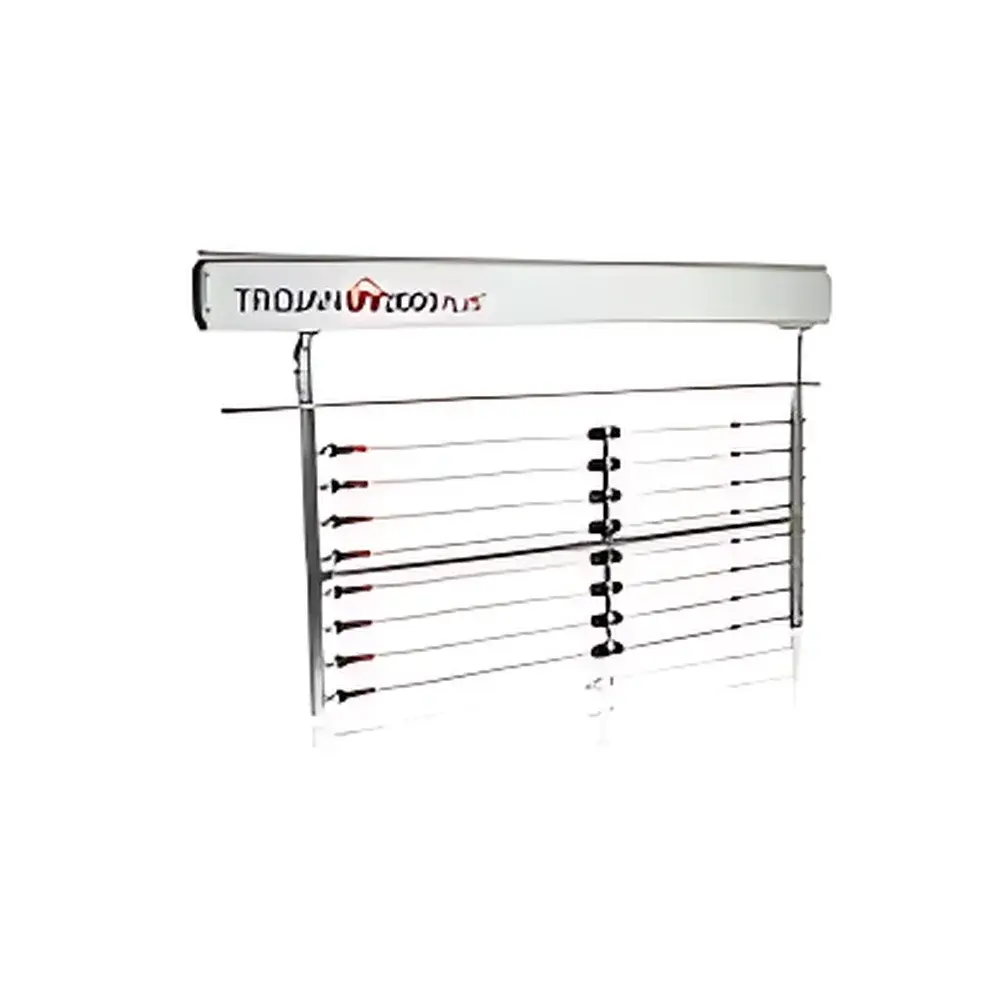
TrojanUV3000Plus UV Disinfection System
| Brand | Trojan |
|---|---|
| Origin | Imported |
| Manufacturer Type | Authorized Distributor |
| Model | TrojanUV3000Plus |
| Pricing | Available Upon Request |
Overview
The TrojanUV3000Plus is a high-intensity, medium-pressure ultraviolet (UV) disinfection system engineered for municipal and industrial wastewater treatment facilities requiring robust, adaptive pathogen inactivation across variable flow conditions and challenging water matrices. Unlike low-pressure UV systems limited to monochromatic 254 nm output, the TrojanUV3000Plus employs multiple medium-pressure UV lamps emitting a broad-spectrum polychromatic output (200–400 nm), enabling effective inactivation of chlorine-resistant microorganisms—including Cryptosporidium parvum, Giardia lamblia, and adenoviruses—without chemical residuals. Its modular reactor design accommodates hydraulic loading fluctuations typical of peak-flow scenarios in combined sewer overflow (CSO) and tertiary reuse applications. The system operates on a validated UV dose delivery principle: delivered fluence (mJ/cm²) is dynamically calculated in real time using integrated UV intensity sensors, flow rate telemetry, and lamp output monitoring—ensuring compliance with regulatory benchmarks such as US EPA UV Disinfection Guidance Manual (2006), Ontario Water Resources Act (OWRA) Class A standards, and ISO 15858:2016 for UV reactor performance.
Key Features
- ActiClean™ Integrated Cleaning System: Combines timed mechanical wiper motion with low-concentration sodium hypochlorite or citric acid dosing to prevent quartz sleeve fouling—reducing manual maintenance intervals by up to 70% compared to passive cleaning systems.
- Passive Thermal Management: Eliminates reliance on external HVAC or forced-air cooling via natural convection heat dissipation from ballast enclosures—lowering electrical demand and enhancing operational reliability in unconditioned equipment rooms.
- Modular Reactor Architecture: Scalable from 2 to 24 lamp modules per channel; supports parallel channel configurations for redundancy and phased capacity expansion without process interruption.
- Real-Time Dose Monitoring: Embedded UV-C radiometers (254 nm) and broadband UV sensors continuously validate delivered fluence against setpoint targets; data logged at 1-second resolution for regulatory audit trails.
- IEC 61508 SIL2-Capable Control System: PLC-based automation with fail-safe interlocks, lamp status diagnostics, and alarm prioritization aligned with IEC 62061 functional safety requirements for critical infrastructure.
Sample Compatibility & Compliance
The TrojanUV3000Plus is validated for use with secondary effluent, tertiary filtered wastewater, stormwater retention basin discharge, and reclaimed water meeting Class A or Title 22 (California) reuse criteria. It maintains ≥99.99% log reduction of target pathogens under UVT (UV transmittance) ranging from 55% to 90%, turbidity ≤10 NTU, and total suspended solids (TSS) ≤15 mg/L—conditions representative of advanced tertiary treatment trains. System validation reports comply with NSF/ANSI 55 Class A protocols and support regulatory submissions under US EPA Clean Water Act Section 402 NPDES permits and EU Urban Wastewater Treatment Directive (91/271/EEC) Annex I discharge requirements.
Software & Data Management
The TrojanUV3000Plus integrates with Trojan’s proprietary UV-SCADA platform, supporting Modbus TCP/IP, BACnet MS/TP, and OPC UA communication protocols for seamless integration into plant-wide SCADA networks. All operational parameters—including lamp-on hours, cumulative UV dose, sleeve transmittance decay, and cleaning cycle logs—are timestamped and stored locally for ≥18 months. Audit-ready data exports meet FDA 21 CFR Part 11 requirements for electronic records and signatures, including user access controls, change history tracking, and immutable log archiving. Optional cloud-based remote monitoring enables predictive maintenance alerts and historical trend analysis via secure TLS 1.2 encrypted connections.
Applications
- Municipal wastewater treatment plants requiring Class A disinfection for direct environmental discharge or irrigation reuse.
- Combined sewer overflow (CSO) and sanitary sewer overflow (SSO) emergency disinfection during wet-weather events.
- Water reclamation facilities producing recycled water for non-potable urban uses (e.g., landscape irrigation, industrial cooling).
- Industrial pretreatment systems serving food processing, pharmaceutical manufacturing, and semiconductor fabrication where chlorine-sensitive processes preclude chemical disinfectants.
- Decentralized treatment systems serving remote communities or military installations with limited operator staffing and infrastructure constraints.
FAQ
What UV wavelength range does the TrojanUV3000Plus emit, and why is it advantageous over low-pressure UV?
The system utilizes medium-pressure mercury-vapor lamps emitting a continuous spectrum from 200–400 nm, delivering higher germicidal efficacy per unit energy against UV-resistant pathogens compared to monochromatic 254 nm low-pressure systems.
Is third-party bioassay validation available for this model?
Yes—Trojan provides full-scale third-party validation reports conducted per USEPA/NSF protocols, including biodosimetry testing with MS2 coliphage and Bacillus subtilis spores under site-specific hydraulics.
How does the ActiClean™ system handle high-fouling influents like wastewater with elevated iron or manganese?
ActiClean™ automatically adjusts cleaning frequency and chemical dosage based on real-time sleeve transmittance decay rates; supplemental citric acid cycles are recommended for metal oxide scaling.
Can the system operate during scheduled power interruptions?
Lamp restart requires minimum 5-minute cooldown; uninterruptible power supply (UPS) integration is recommended for control system continuity, though UV lamp operation is not supported during blackout conditions.
Does Trojan provide lifecycle support beyond warranty?
Yes—comprehensive service contracts include annual lamp replacement, quartz sleeve inspection, sensor calibration traceable to NIST standards, and firmware updates aligned with evolving regulatory guidance.
Related Products







