
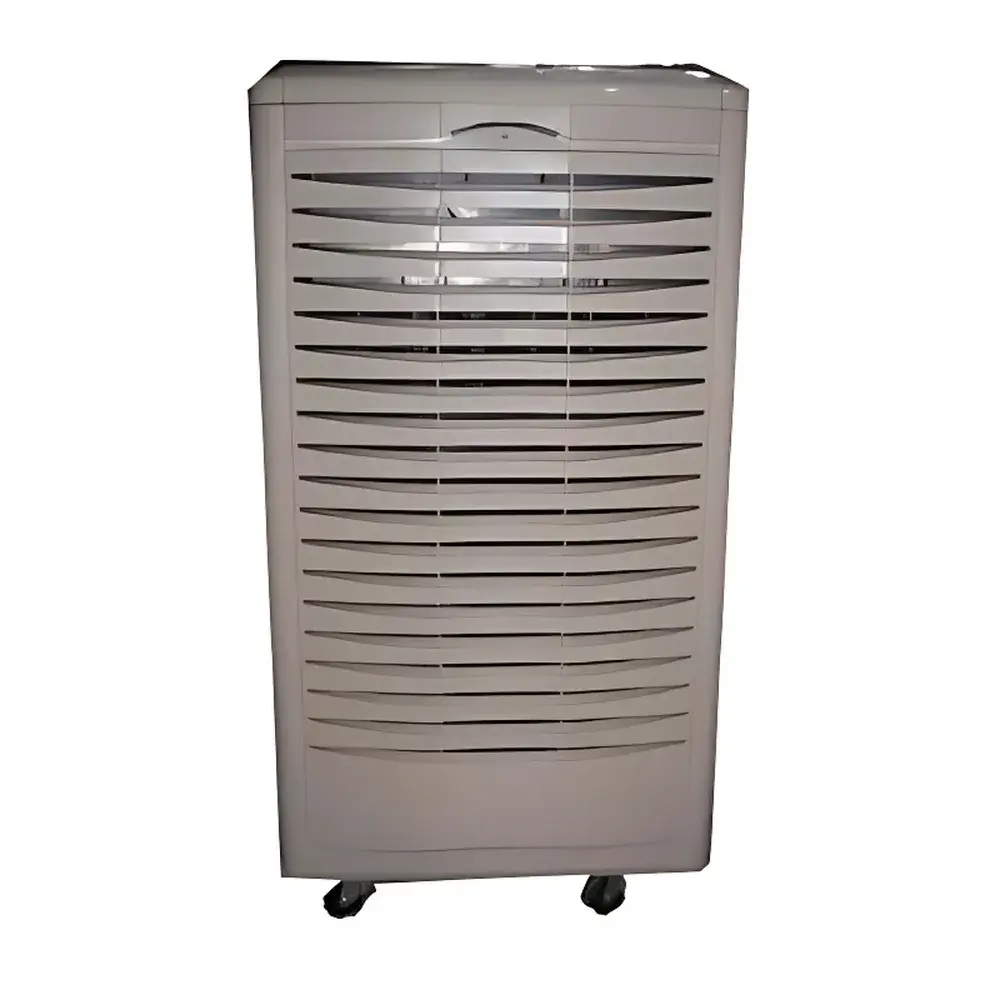
Truelab CFZ8120 Industrial-Grade Compressor Dehumidifier for Large-Scale Laboratory Environments
| Brand | Truelab |
|---|---|
| Origin | Shanghai, China |
| Model | CFZ8120 |
| Type | Compressor-Based Industrial Dehumidifier |
| Application | Laboratory Environmental Control |
| Rated Dehumidification Capacity | 120 L/day (at 30°C, 80% RH) |
| Air Circulation Rate | 120 m³/h |
| Recommended Coverage Area | 100–160 m² (ceiling height ≤ 2.6 m) |
| Operating Temperature Range | 5–40°C |
| Power Supply | 220 V / 50 Hz |
| Input Power | 1850 W |
| Dimensions (L×W×H) | 540 × 460 × 1115 mm |
| Net Weight | 60 kg |
| Compressor Type | Rotary |
| Control Method | Digital Humidity Setpoint with Real-Time Display |
| Defrost Function | Automatic (activated below 18°C ambient) |
| Drainage | Continuous via gravity hose or internal tank with auto-shutoff and audible alarm |
| Mobility | Equipped with four swivel casters (two with brakes) |
Overview
The Truelab CFZ8120 is an industrial-grade, compressor-driven dehumidifier engineered specifically for environmental stability in large-scale analytical and instrumentation laboratories. Maintaining precise relative humidity (RH) levels—typically between 40% and 60% RH—is critical for the operational integrity of sensitive equipment including electron microscopes, X-ray diffractometers, mass spectrometers, and high-precision weighing systems. Excess moisture accelerates corrosion of optical components, induces condensation in vacuum chambers, compromises calibration stability of hygroscopic sensors, and promotes microbial growth on sample handling surfaces. The CFZ8120 addresses these challenges through a robust refrigerant-based dehumidification cycle, utilizing a high-efficiency rotary compressor and optimized heat exchanger geometry to deliver consistent 120 L/day moisture removal under standard test conditions (30°C, 80% RH). Its design prioritizes thermal and mechanical stability across extended duty cycles, making it suitable for 24/7 operation in ISO Class 7–8 cleanrooms, QC/QA labs, and central instrument facilities where uninterrupted environmental control directly impacts data reproducibility and regulatory compliance.
Key Features
- High-capacity rotary compressor system with enhanced thermal cycling resilience and low-vibration operation—minimizing mechanical interference near vibration-sensitive instruments.
- Digital microprocessor controller with real-time RH monitoring, user-defined setpoint adjustment (30–80% RH), and automatic hysteresis management to prevent over-drying or oscillatory control.
- Left-side horizontal discharge airflow pattern with front-facing intake—engineered to integrate seamlessly into laboratory layouts without obstructing benchtop workflows or HVAC ducting.
- Auto-defrost functionality triggered below 18°C ambient temperature ensures uninterrupted performance during seasonal transitions or in climate-controlled cold rooms.
- Integrated water tank (capacity: ~6.5 L) with float-switch sensor and audible alarm; optional continuous drainage via 12-mm ID PVC hose (included) supports unattended operation for up to 72 hours.
- Structural chassis constructed from reinforced ABS+PC polymer housing with steel-reinforced base frame—resistant to chemical splash exposure and compliant with IEC 61000-6-3 EMC emission standards.
- Four heavy-duty dual-brake swivel casters (two locking) enable repositioning within shared lab spaces without requiring disassembly or service interruption.
Sample Compatibility & Compliance
The CFZ8120 does not interface directly with samples but functions as a critical environmental infrastructure component supporting ISO/IEC 17025-accredited testing environments. It contributes to conformance with ASTM E145–22 (Standard Specification for Gravity-Convection and Forced-Ventilation Ovens), ISO 14644–1 (Cleanroom classification), and USP (Environmental Control for Pharmaceutical Testing). Its stable RH output supports GLP-compliant storage of hygroscopic reference standards (e.g., potassium hydrogen phthalate, sodium chloride saturated solutions) and prevents drift in gravimetric moisture analyzers. No direct sample contact or material compatibility constraints apply, as the unit operates exclusively in ambient air space.
Software & Data Management
The CFZ8120 operates as a standalone hardware controller with no embedded firmware connectivity (e.g., no Wi-Fi, Bluetooth, or Ethernet interfaces). All operational parameters—including current RH reading, setpoint, runtime hours, and alarm status—are displayed on a 3-digit LED screen. While it lacks digital data logging or remote API access, its analog control architecture ensures electromagnetic isolation from adjacent instrumentation—critical in NMR suites and RF-sensitive measurement zones. For labs requiring audit-trail documentation, external RH loggers (e.g., Vaisala HMP155 or Omega OM-EL-USB-2-LCD) may be deployed in parallel to record environmental metadata synchronized with instrument acquisition timestamps—supporting FDA 21 CFR Part 11 traceability when paired with validated LIMS integration.
Applications
- Stabilization of ambient RH in multi-instrument laboratories housing HPLC-MS, GC-MS, and ICP-OES systems where humidity-induced detector noise or column degradation must be mitigated.
- Prevention of lens fogging and mirror corrosion in FTIR, Raman, and UV-Vis spectrophotometer enclosures.
- Protection of calibration laboratories maintaining Class E2 and F1 weights per OIML R111, where RH fluctuations >5% cause measurable buoyancy errors.
- Supporting accelerated stability studies (ICH Q1A) by enabling controlled low-RH storage conditions for pharmaceutical intermediates without introducing desiccant variability.
- Back-up humidity control in central utility rooms housing chilled water pumps, air compressors, and UPS battery banks—where condensate formation risks electrical short circuits.
FAQ
What is the minimum ambient temperature at which the CFZ8120 remains fully operational?
The unit maintains rated dehumidification capacity down to 5°C ambient. Below 18°C, the automatic defrost cycle engages to prevent evaporator coil icing.
Can the CFZ8120 be integrated into a building management system (BMS)?
No native BACnet, Modbus, or dry-contact relay outputs are provided. Integration requires third-party analog signal converters or external environmental controllers.
Is the unit suitable for use in explosion-proof laboratory zones?
It is not certified for hazardous locations (Class I Div 1/2 or ATEX Zone 1/2). Use only in general-purpose non-classified laboratory areas.
Does the dehumidifier include a HEPA or activated carbon filter?
No particulate or gas-phase filtration is incorporated. Airflow path is optimized solely for moisture condensation; supplemental air purifiers must be deployed separately if required.
What maintenance intervals are recommended for long-term reliability?
Compressor oil inspection every 24 months; condenser coil cleaning every 6 months using non-corrosive laboratory-grade cleaner; annual verification of refrigerant charge integrity by authorized HVAC technician.



