
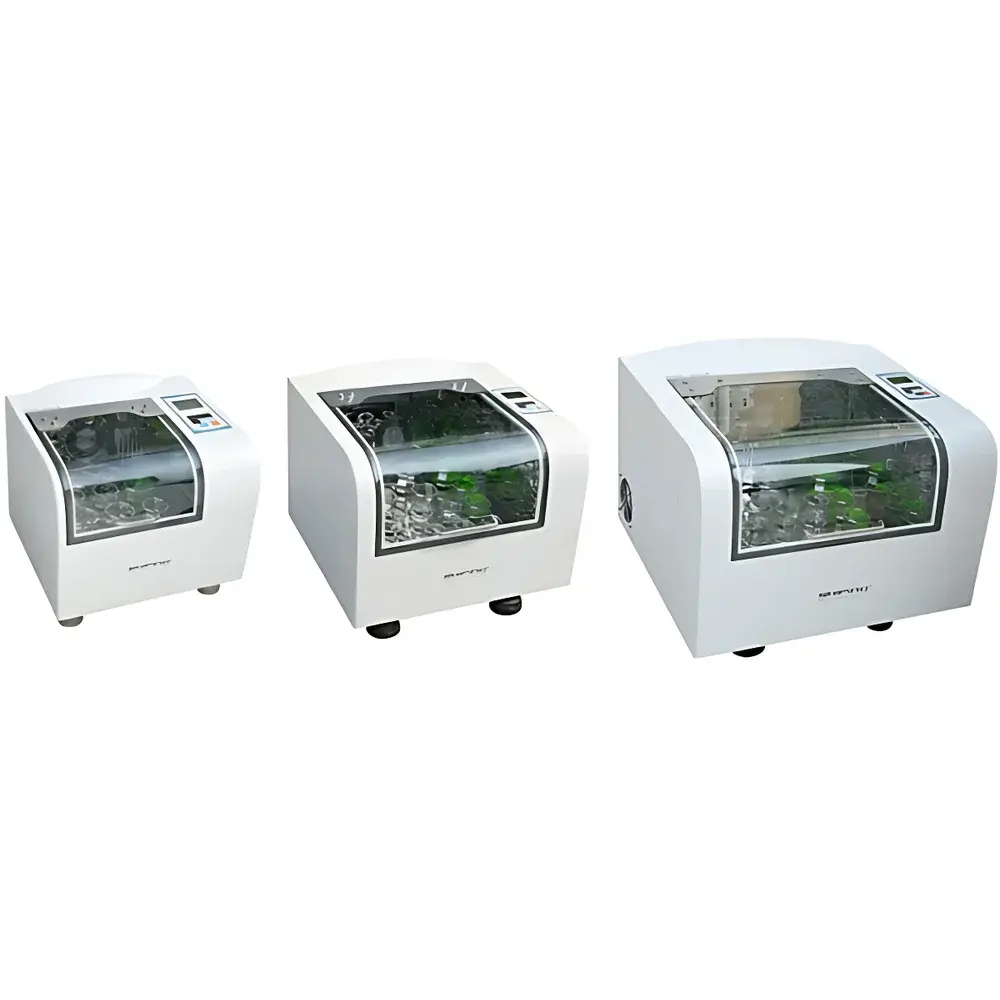
Truelab SPH-103D Advanced Compact Temperature-Controlled Orbital Shaker
| Brand | Truelab |
|---|---|
| Origin | Shanghai, China |
| Model | SPH-103D |
| Timer Range | 0–500 h |
| Oscillation Frequency | 30–600 rpm |
| Orbit Diameter | Φ0–50 mm |
| Temperature Range | Ambient +5°C to 60°C |
| Platform Quantity | 1 |
| Control System | PID microprocessor with LCD dual-display (setpoint & real-time) |
| Drive Mechanism | Patented single-axis balanced drive |
| Cooling System | CFC-free R134a refrigerant |
| Heating Power | 150 W |
| Motor | AC induction, brushless, maintenance-free |
| Safety Features | Over-temperature/over-speed audiovisual alarm, independent thermal cutoff, lid-open stop, auto-restart after power recovery |
| Platform Size | 260 × 260 mm |
| Capacity | 9 × 100 mL or 4 × 250 mL flasks |
| Internal Chamber | 360 × 340 × 280 mm (W×D×H) |
| Net Weight | 31 kg |
| Power Supply | AC 200–240 V, 50–60 Hz |
| Compliance | CE-marked design principles |
Overview
The Truelab SPH-103D Advanced Compact Temperature-Controlled Orbital Shaker is an engineered solution for precise, reproducible incubation and mixing of biological samples under tightly regulated thermal and mechanical conditions. Designed around orbital shaking dynamics—where the platform rotates in a circular motion at a defined diameter—the instrument delivers uniform agitation without vortexing or splashing, making it ideal for suspension cultures, enzymatic reactions, hybridization protocols, and gentle cell-based assays. Its integrated Peltier-free thermoregulation system maintains setpoint accuracy within ±0.1°C and uniformity within ±0.5°C across the chamber, enabled by forced-air convection and high-efficiency heating elements. Unlike benchtop shakers relying on ambient cooling, the SPH-103D incorporates a certified CFC-free R134a refrigeration module, permitting stable operation down to ambient +5°C—a critical capability for temperature-sensitive protein expression or low-temperature metabolic studies. The unit’s compact footprint (560 × 530 × 560 mm) and 31 kg net weight support flexible deployment: it operates reliably on standard laboratory benches or reinforced floor stands without structural reinforcement.
Key Features
- Patented single-axis balanced drive mechanism ensures minimal vibration transmission, low acoustic noise (20,000 operational hours.
- LCD dual-display interface shows real-time temperature, speed, elapsed time, and remaining timer duration simultaneously; all parameters adjustable via intuitive membrane keypad.
- Programmable multi-segment operation supports up to eight-step temperature/speed/time profiles, enabling unattended progression through complex protocols such as gradient-based solubilization or sequential lysis-wash-elution cycles.
- Ergonomic gas-spring-assisted lid provides smooth, controlled opening/closing and full visual access through a seamless, tempered curved glass viewport.
- Modular platform compatibility: accepts stainless-steel clamping plates (standard), spring-loaded platforms, microplate carriers (96-/384-well), tube racks (13–50 mm), and custom fixtures—all secured via standardized M4 threaded inserts.
- Comprehensive safety architecture includes dual-limit thermal protection (electronic + mechanical), speed deviation alarms, automatic shutdown on lid opening, and non-volatile memory for parameter retention during power interruption.
Sample Compatibility & Compliance
The SPH-103D accommodates standard microbiological and molecular biology vessels including Erlenmeyer flasks (up to 250 mL), test tubes (13–25 mm OD), PCR strips, and deep-well microplates. Its 260 × 260 mm platform and Φ25 mm default orbit (adjustable up to Φ50 mm) optimize oxygen transfer in aerobic bacterial cultures while minimizing shear stress on mammalian or insect cells. All wetted surfaces are constructed from electropolished AISI 304 stainless steel; external housing uses flame-retardant ABS engineering plastic (UL94 V-0 rated). Though not FDA-cleared as a medical device, the instrument’s control firmware and data logging structure align with core requirements of ISO/IEC 17025:2017 for testing laboratories and support audit-ready documentation when paired with validated external software. Its electrical design conforms to IEC 61010-1:2010 for laboratory equipment safety.
Software & Data Management
While the SPH-103D operates autonomously via its embedded PID controller, optional RS-485/Modbus RTU interface enables integration into centralized lab management systems (e.g., LabVantage, STARLIMS) for remote monitoring and event-triggered alerts. Time-stamped operational logs—including temperature deviations, speed fluctuations, and alarm events—are stored internally for ≥30 days and exportable via USB flash drive in CSV format. The system supports 21 CFR Part 11-compliant user access control when used with third-party electronic lab notebook (ELN) platforms that manage digital signatures and audit trails. No proprietary cloud dependency is required; all configuration and calibration adjustments remain locally executable without internet connectivity.
Applications
- Microbial growth kinetics: Escherichia coli, Bacillus subtilis, and yeast cultivations under defined aeration and thermal regimes.
- Recombinant protein expression: induction-phase shaking at 30°C followed by cold-shift to 16°C for soluble folding.
- Nucleic acid purification: binding, washing, and elution steps in magnetic bead-based kits requiring consistent orbital motion.
- Antibody-antigen binding assays: controlled agitation during incubation to reduce nonspecific adsorption on ELISA plates.
- Environmental microbiology: soil slurry homogenization and enrichment culture preparation under sub-ambient conditions.
- Cell line maintenance: suspension CHO or Sf9 cultures where excessive shear must be avoided during passaging.
FAQ
What is the minimum operating temperature relative to ambient?
The SPH-103D cools to ambient +5°C—not below ambient—making it suitable for applications requiring mild chilling but not cryogenic conditions.
Can the shaker accommodate microplates directly?
Yes, optional microplate carriers (96-well and 384-well) mount securely to the standard platform using included fasteners.
Is calibration traceable to national standards?
Temperature and speed sensors are factory-calibrated against NIST-traceable references; users may perform field verification using calibrated PT100 probes and optical tachometers.
Does the unit support continuous operation for >72 hours?
Yes—its 0–500 hour timer range and auto-restart function enable uninterrupted runs across weekends and holidays, provided ambient conditions remain within specified limits.
How is condensation managed inside the chamber?
The internal chamber features hydrophobic surface treatment and optimized airflow routing to minimize dew formation; no active dehumidification is included, so prolonged low-temperature operation in high-humidity environments should include desiccant placement.



