
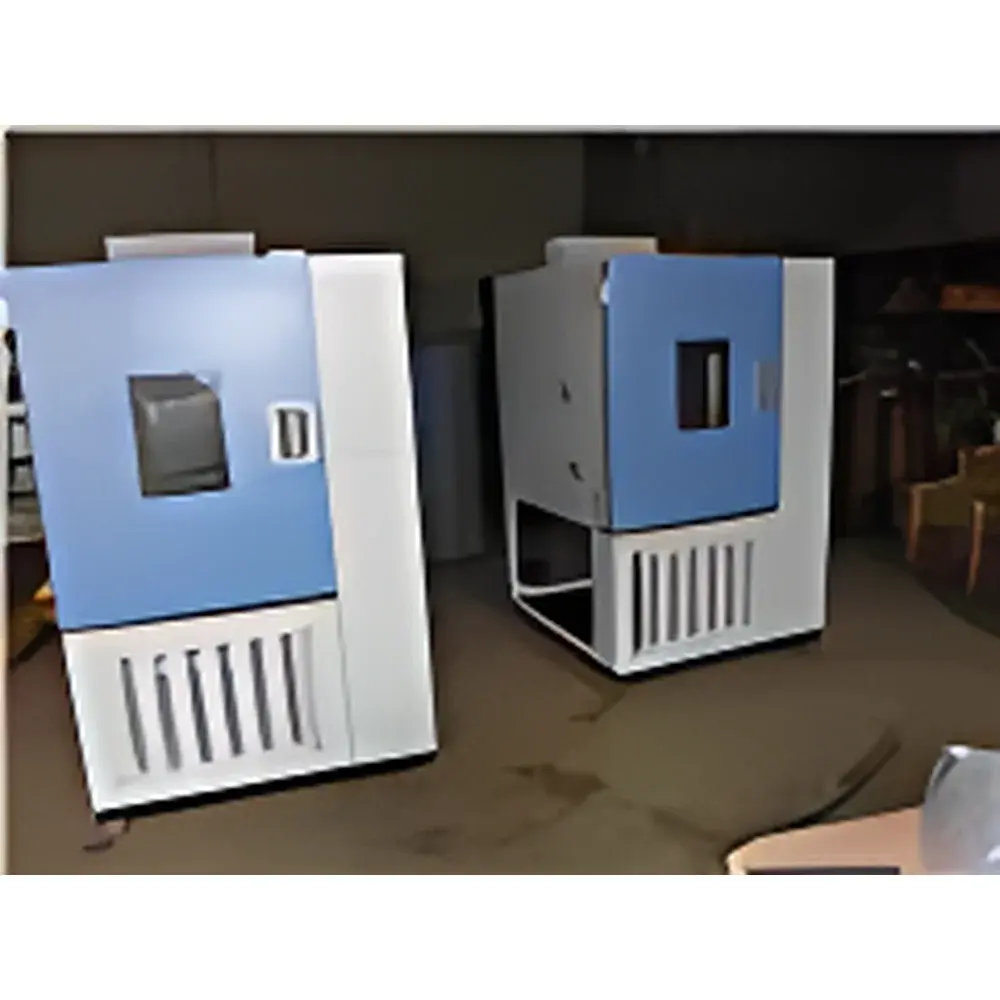
TS-100 Textile Moisture Vapor Transmission (MVT) Testing Chamber
| Origin | Jiangsu, China |
|---|---|
| Manufacturer Type | Authorized Distributor |
| Origin Category | Domestic (China) |
| Model | TS-100 |
| Pricing | Available Upon Request |
| Temperature Range | 5°C above ambient to 60°C (±0.5°C control accuracy) |
| Humidity Range | 70–95% RH (≤ ±2% RH uniformity) |
| Airflow Velocity | 0.3–0.5 m/s |
| Cup Dimensions | Ø60 mm ID × 22 mm depth |
| Cup Capacity | 8 units |
| Test Duration | 1–999 minutes |
| Humidification Power | 400 W |
| Heating Power | 200 W |
| Cooling Power | 270 W |
| Power Supply | AC 220 V ±10%, 50 Hz |
| Chamber Interior Dimensions | 400 × 500 × 500 mm |
Overview
The TS-100 Textile Moisture Vapor Transmission (MVT) Testing Chamber is an engineered environmental test system designed specifically for the quantitative assessment of water vapor permeability in woven, knitted, nonwoven, and coated textile materials. It operates on the gravimetric principle defined in GB/T 12704—2021 (Method A: Desiccant Method), where a standardized desiccant-filled cup is sealed with the test specimen and placed within a precisely controlled temperature- and humidity-regulated chamber. The mass gain of the cup over time—due to moisture diffusion through the fabric—is measured to calculate the Moisture Vapor Transmission Rate (MVTR), expressed in g/m²·24h. This method remains the industry benchmark for evaluating breathability in technical apparel, protective workwear, medical textiles, and laminated membranes, where regulatory compliance and functional performance are interdependent.
Key Features
- High-stability dual-zone climate control: Independent regulation of chamber temperature (5°C above ambient to 60°C, ±0.5°C accuracy) and relative humidity (70–95% RH, ≤ ±2% RH spatial uniformity) ensures strict adherence to GB/T 12704 test conditions.
- Eight-position cup carousel configuration: Accommodates eight standardized Ø60 mm × 22 mm aluminum or stainless-steel test cups simultaneously, enabling parallel testing and statistical repeatability per ISO 5725-2 guidelines.
- Low-turbulence airflow system: Adjustable laminar air circulation (0.3–0.5 m/s) minimizes convective interference at the cup surface while maintaining homogeneous environmental distribution across the test volume.
- Modular thermal management architecture: Integrated 400 W humidifier, 200 W heater, and 270 W refrigeration unit enable rapid stabilization and sustained operation under high-humidity, elevated-temperature conditions without condensation or thermal drift.
- Robust chamber construction: 400 × 500 × 500 mm internal workspace fabricated from corrosion-resistant stainless steel with insulated double-wall housing, supporting long-term calibration stability and GLP-compliant usage.
Sample Compatibility & Compliance
The TS-100 supports flat, flexible textile specimens up to 100 mm × 100 mm, including hydrophilic and hydrophobic coatings, microporous laminates, PU films, and multilayer composites used in sportswear, military uniforms, and wound-contact dressings. It fully complies with the apparatus requirements specified in GB/T 12704—2021 (equivalent to ISO 15496:2004 Annex A for desiccant-cup methodology). While not certified to ASTM E96 or ISO 11092 directly, its operational parameters align with the environmental boundary conditions stipulated in those standards—enabling cross-referenced reporting when validated per laboratory SOPs. All hardware components meet IEC 61000-6-3 EMC emission limits and conform to China’s CCC safety certification for Class II laboratory equipment.
Software & Data Management
The TS-100 operates via embedded microcontroller-based logic with front-panel membrane keypad and LED display for manual parameter entry and real-time monitoring of chamber status (T/RH/elapsed time). Mass change data is recorded externally using analytical balances meeting OIML R76 Class II or higher specifications; no proprietary software is bundled. Users integrate results into LIMS or Excel-based reporting templates compliant with ISO/IEC 17025 documentation requirements. Audit trails—including operator ID, cup ID, start/stop timestamps, and environmental logs—are maintained manually or via optional RS-232/USB data logging modules compatible with third-party SCADA platforms. The system supports 21 CFR Part 11 readiness when paired with validated balance interfaces and electronic signature workflows.
Applications
- Quality assurance of breathable outerwear fabrics in OEM supply chains
- Development validation of moisture-wicking finishes and hydrophilic coatings
- Regulatory testing for EN 343 (protective clothing against rain) and ISO 20743 (antibacterial textile efficacy, where MVTR impacts microbial viability)
- Comparative analysis of laminate integrity after abrasion, flexing, or chemical exposure
- Supporting R&D for smart textiles incorporating hygroscopic sensors or phase-change materials
FAQ
What desiccant is recommended for use with the TS-100 per GB/T 12704?
Anhydrous calcium chloride (CaCl₂) is specified in Method A; it must be freshly activated and loaded to standardized mass (typically 100 g ± 0.1 g) prior to sealing each cup.
Can the TS-100 perform tests at 37°C / 90% RH to simulate physiological conditions?
Yes—the chamber achieves 37.0°C ±0.5°C and 90.0% RH ±1.5% RH with full stability, making it suitable for accelerated wear simulation protocols aligned with AATCC TM115 and ISO 11092 Annex B.
Is calibration traceable to national standards?
Temperature and humidity sensors are factory-calibrated against NIM (National Institute of Metrology, China)-traceable references; users must perform periodic verification using portable NIST-traceable probes per ISO/IEC 17025 Clause 6.5.
Does the system support automatic cup weighing integration?
No native auto-weighing interface is included; however, the chamber’s RS-232 port enables synchronization with compatible analytical balances via custom scripting or LabVIEW drivers.
What maintenance intervals are recommended for long-term reliability?
Humidifier tank cleaning every 72 operating hours, refrigerant pressure check annually, and sensor recalibration every six months—documented in accordance with internal QA procedures.






