
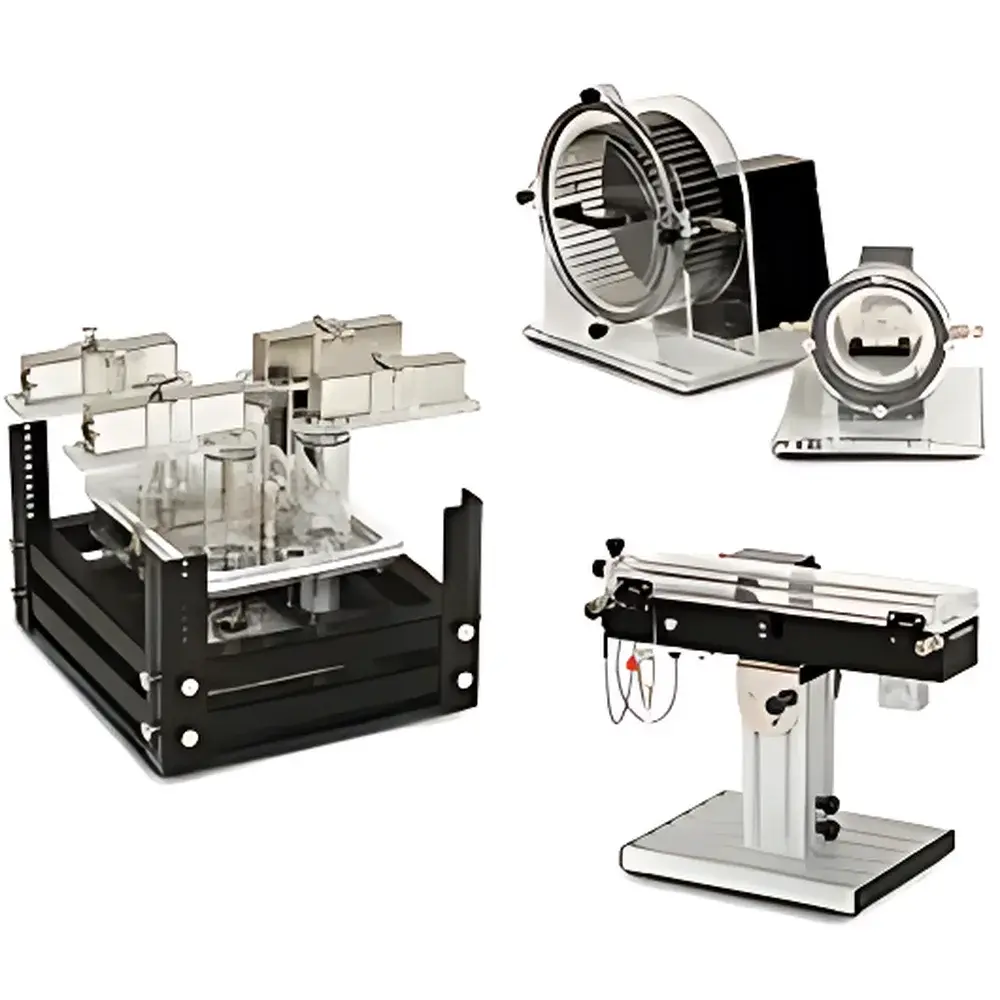
TSE Systems CaloSys Open-Circuit Indirect Calorimetry System
| Brand | TSE Systems |
|---|---|
| Origin | Germany |
| Model | CaloSys |
| Measurement Principle | Open-circuit indirect calorimetry |
| Animal Capacity | Single- or multi-cage configurations (CaloCages) |
| Gas Sampling Interval | ~40 s per cage |
| Supported Modalities | Voluntary wheel running (sealed enclosure, programmable speed profiles) |
| Data Output | VO₂, VCO₂, RER, EE (kcal/h or kJ/h), locomotor activity |
| Software | CaloSys control and analysis suite with real-time visualization, timestamped interval-based file updates, tabular + graphical data export |
| Compliance | Designed for GLP-compliant metabolic phenotyping studies |
Overview
The TSE Systems CaloSys Open-Circuit Indirect Calorimetry System is a rigorously engineered platform for quantitative assessment of energy metabolism in conscious, freely moving or activity-challenged small laboratory animals—primarily mice and rats. Operating on the validated principle of open-circuit indirect calorimetry, the system continuously measures oxygen consumption (VO₂) and carbon dioxide production (VCO₂) via high-fidelity gas analyzers, enabling precise calculation of respiratory exchange ratio (RER) and energy expenditure (EE) using standardized stoichiometric equations (e.g., Weir equation). Unlike closed-system or flow-through approximations, CaloSys employs dynamic airflow control and real-time gas concentration monitoring to minimize dead-space artifacts and ensure high reproducibility across longitudinal studies. Its modular architecture integrates seamlessly with TSE’s comprehensive phenotyping ecosystem—including home-cage monitoring, telemetry, and behavioral modules—supporting standardized metabolic phenotyping workflows aligned with NIH/NIAD guidelines for obesity, diabetes, mitochondrial dysfunction, and aging research.
Key Features
- Modular CaloCage design: Species-specific housing units with physically segregated inlet, outlet, and sampling zones—ensuring laminar, non-recirculating airflow and eliminating cross-contamination between cages during parallel measurements.
- High-temporal-resolution gas sensing: Dual-channel paramagnetic O₂ and NDIR CO₂ analyzers deliver stable, drift-compensated readings with <40-second cycle time per animal cage—enabling detection of acute metabolic shifts during circadian transitions or pharmacological interventions.
- Integrated activity monitoring: Simultaneous quantification of horizontal locomotion (via infrared beam breaks) and voluntary wheel-running activity within sealed, acoustically isolated enclosures—each with independently programmable rotation speed profiles and torque calibration.
- Forced exercise capability: CaloTreadmill module features motorized belt with closed-loop speed control, adjustable incline (0–25°), and optional low-intensity electrical foot shock (0.1–0.3 mA) for standardized endurance protocols—fully compliant with AHA/ACC exercise physiology standards.
- Real-time software control: CaloSys software provides experiment scheduling, hardware synchronization, live parameter visualization (VO₂, VCO₂, RER, EE, activity counts), and automated interval-based data archiving in HDF5 format with embedded metadata (animal ID, cage ID, timestamp, protocol version).
Sample Compatibility & Compliance
The CaloSys system is validated for use with C57BL/6, BALB/c, db/db, ob/ob, and other common murine strains (body mass range: 18–45 g). Cage dimensions accommodate single-housed or pair-housed animals without compromising airflow uniformity or gas mixing efficiency. All hardware components comply with IEC 61000-6-3 (EMC emissions) and IEC 61000-6-2 (immunity) standards. The CaloSys software architecture supports 21 CFR Part 11-compliant operation when deployed with electronic signatures, audit trails, and role-based access control—making it suitable for preclinical contract research organizations (CROs) conducting IND-enabling toxicology and metabolic safety studies under GLP conditions.
Software & Data Management
CaloSys software operates on Windows 10/11 (64-bit) and includes three core functional layers: (1) Acquisition Engine—handles hardware polling, analog/digital I/O synchronization, and sensor linearization; (2) Analysis Module—applies Bland-Altman correction for flow rate variability, calculates EE using Weir coefficients, and generates RER time-series with moving-window smoothing (default: 5-min window); (3) Export & Reporting Interface—exports raw and processed data to CSV, Excel, and MATLAB-compatible MAT files, with optional integration into LabArchives ELN or Benchling via REST API. All data files are automatically timestamped and include SHA-256 checksums for integrity verification—critical for regulatory submissions to EMA or PMDA.
Applications
- Longitudinal metabolic phenotyping in genetically modified models (e.g., PPARγ knockouts, UCP1 transgenics)
- Pharmacodynamic evaluation of anti-obesity compounds (GLP-1 analogs, AMPK activators, mitochondrial uncouplers)
- Circadian rhythm disruption studies (shift-work, jet-lag, clock gene mutants)
- Exercise physiology: substrate utilization shifts during endurance training vs. high-intensity interval protocols
- Toxicology endpoints: identification of drug-induced mitochondrial toxicity via suppressed RER variability or elevated resting EE
FAQ
What animal species and weight ranges are supported?
The system is optimized for mice (18–45 g) and rats (150–500 g) using size-matched CaloCages. Custom cage configurations for guinea pigs or hamsters are available upon request.
Can CaloSys be integrated with existing telemetry or behavioral systems?
Yes—via TTL synchronization pulses and shared network time protocol (NTP), CaloSys synchronizes with DSI telemetry, EthoVision XT, and ANY-maze for multimodal data fusion.
Is the software validated for GxP environments?
The CaloSys v4.2+ software package includes full validation documentation (IQ/OQ/PQ protocols) and supports 21 CFR Part 11 compliance when deployed with approved identity management infrastructure.
How is airflow calibrated and verified?
Each CaloCage undergoes factory calibration using traceable mass flow meters (Bronkhorst EL-FLOW Select). Users perform daily zero/span checks with certified gas mixtures (O₂ 20.9%, CO₂ 0.0%) prior to study initiation.
What level of technical support is provided post-installation?
TSE Systems offers on-site installation, operator training, annual preventive maintenance, and 24/7 remote diagnostics via secure VPN—backed by ISO 9001-certified service operations headquartered in Bad Homburg, Germany.




