
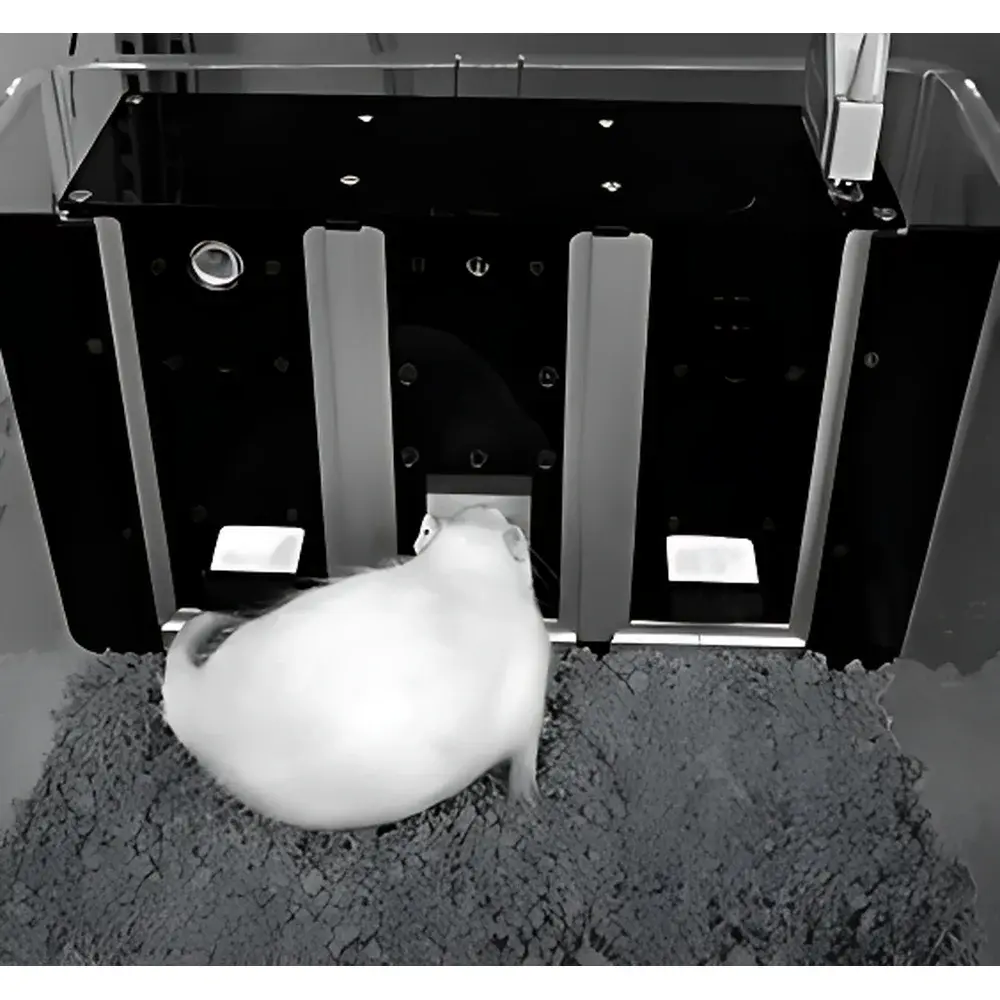
TSE Systems Operant Wall Modular Behavioral Learning System
| Brand | TSE Systems |
|---|---|
| Origin | Germany |
| Model | Operant Wall |
| Type | Modular operant conditioning chamber wall for home-cage-based behavioral assays |
| Compatibility | Integrates with TSE PhenoMaster housing modules (e.g., running wheel, food access control) |
| Actuators | Push lever (rat), nose-poke unit, pellet dispenser, liquid reward delivery system |
| Environmental context | Home-cage environment, stress-minimized operant testing |
| Configuration | Slide-in modular panel architecture |
| Regulatory alignment | Designed for GLP-compliant longitudinal behavioral phenotyping |
Overview
The TSE Systems Operant Wall is a modular, home-cage-integrated operant conditioning platform engineered for high-fidelity, long-term behavioral learning studies in rodents—primarily rats. Unlike traditional operant chambers requiring transfer and acclimation stress, the Operant Wall mounts directly onto standard PhenoMaster housing cages, enabling continuous, non-disruptive assessment of associative learning, motivation, response inhibition, and reinforcement schedules within the animal’s familiar living environment. Its core measurement principle relies on precise detection of discrete, voluntary operant responses—including lever press, nose-poke, or lick-port activation—coupled with programmable, time-locked delivery of calibrated food pellets or liquid rewards. This architecture supports both fixed-ratio (FR), variable-interval (VI), and progressive-ratio (PR) paradigms, facilitating quantitative analysis of acquisition rate, extinction kinetics, and effort-based decision-making under chronic experimental conditions.
Key Features
- Modular slide-in panel design: Interchangeable hardware inserts—including stainless-steel push levers optimized for rat forelimb biomechanics, infrared-based nose-poke detectors with adjustable aperture depth, 45 mg precision pellet dispensers (with jam-detection logic), and peristaltic liquid reward delivery units—allow rapid reconfiguration between experimental protocols.
- Native integration with TSE PhenoMaster ecosystem: Synchronizes bidirectionally with Food Access Control Modules (enabling automated, schedule-driven food restriction without manual handling) and Running Wheel Modules (to assess locomotor coupling with operant performance or fatigue-related decline).
- Stress-minimized home-cage paradigm: Eliminates transport, isolation, and novel-environment exposure—factors known to elevate corticosterone and confound dopamine-dependent learning metrics—thereby improving inter-session reproducibility and longitudinal data stability.
- Real-time event logging & temporal resolution: Records all operant responses, reward deliveries, and module state changes at ≤10 ms timestamp resolution, supporting millisecond-level analysis of reaction latency, inter-response times, and response burst patterns.
- Ruggedized, cage-mounted mechanical interface: IP54-rated enclosure with caging-compatible mounting brackets; lever actuation force calibrated to 5–15 g threshold (adjustable via firmware); nose-poke entry detection validated across 200–800 g rat weight range.
Sample Compatibility & Compliance
The Operant Wall is validated for use with adult Sprague-Dawley and Wistar rats (250–500 g), housed in TSE PhenoMaster standard or extended-size cages (dimensions: 40 × 25 × 18 cm). It complies with European Directive 2010/63/EU on protection of animals used for scientific purposes, specifically supporting Refinement through environmental continuity and Reduction via automated, unattended data collection over 7–28 day protocols. All reward delivery subsystems meet ISO 8570 (food pellet integrity) and ISO 8573-1 Class 4 (compressed air purity for liquid dispensing) requirements where applicable. Firmware supports audit-trail generation compliant with GLP Annex 11 and FDA 21 CFR Part 11 when deployed with TSE’s certified PhenoMaster Control Suite v5.2+.
Software & Data Management
Control and data acquisition are managed through TSE’s PhenoMaster Software Suite, which provides graphical protocol builder for multi-stage operant schedules (e.g., FR5 → extinction → reinstatement), real-time visualization of cumulative response curves, and export of timestamped CSV/BDF files compatible with MATLAB, Python (via TSE’s open API), and commercial neurobehavioral analysis platforms (e.g., EthoVision XT, NeuroBS). The system logs full metadata—including cage ID, animal RFID tag, session start/end timestamps, hardware calibration history, and environmental sensor readings (ambient temperature, humidity from integrated PhenoMaster sensors)—ensuring traceability for regulatory submissions. Raw event streams support post-hoc segmentation by circadian phase, feeding cycle, or wheel-running activity quartiles.
Applications
- Preclinical evaluation of dopaminergic, serotonergic, and glutamatergic pharmacotherapies in models of addiction, depression, and cognitive inflexibility.
- Longitudinal assessment of neurodegenerative progression (e.g., in transgenic rat models of Parkinson’s disease) via daily progressive-ratio breakpoint tracking.
- Investigation of metabolic-behavioral crosstalk: Coupling operant responding with automated food access control enables study of hunger-state modulation of reward valuation.
- Validation of closed-loop neuromodulation systems: Integration-ready with third-party electrophysiology or optogenetics rigs via TTL trigger I/O ports and low-latency Ethernet synchronization.
- Standardized behavioral phenotyping for international consortia (e.g., IMPC, EuroPhenome), adhering to SOPs for operant conditioning endpoints in rodent pipelines.
FAQ
Can the Operant Wall be used with mice?
The standard rat-configured lever and nose-poke geometry are not optimized for murine subjects; however, TSE offers a dedicated Mouse Operant Wall variant (Model: Operant Wall-M) with scaled actuators and reduced aperture dimensions.
Is remote monitoring supported during overnight sessions?
Yes—PhenoMaster Software enables secure, encrypted remote access via VPN; all operant events and system health metrics (e.g., pellet hopper level, dispenser motor status) are streamed in real time with configurable email/SMS alerts for critical faults.
How is calibration maintained across long-term studies?
Each hardware module includes factory-traceable calibration certificates; lever force thresholds and nose-poke IR sensitivity are verified biweekly using NIST-traceable reference weights and optical attenuators, with logs automatically appended to the experiment metadata archive.
Does the system support conditional discrimination tasks (e.g., visual cue + lever press)?
Yes—integrated LED stimulus panels (470 nm and 630 nm) mounted above the operant wall enable paired-associate learning designs; cue onset, duration, and contingency rules are fully programmable within the protocol editor.
What level of technical support is provided for method development?
TSE offers application-specific protocol consulting, including behavioral task design review, statistical power estimation for operant endpoints, and assistance with ethics application documentation aligned with national welfare guidelines.
Related Products



