
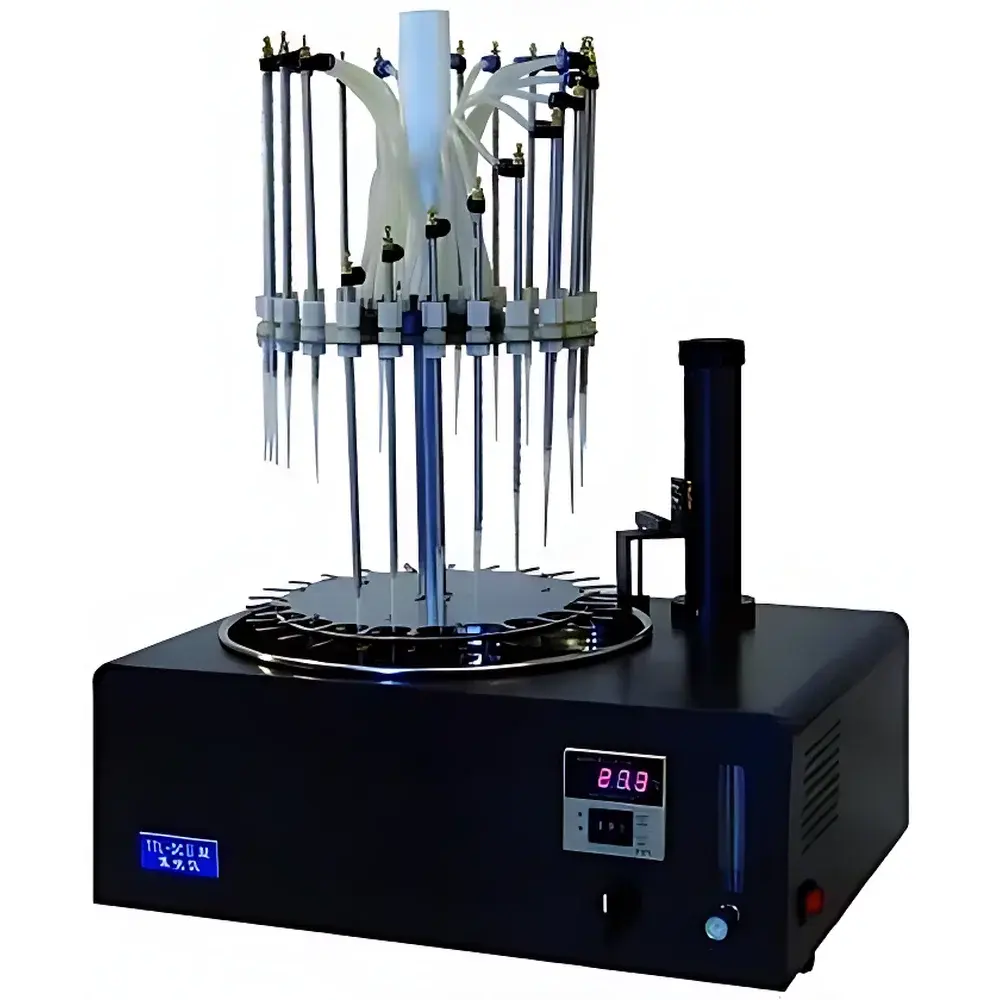
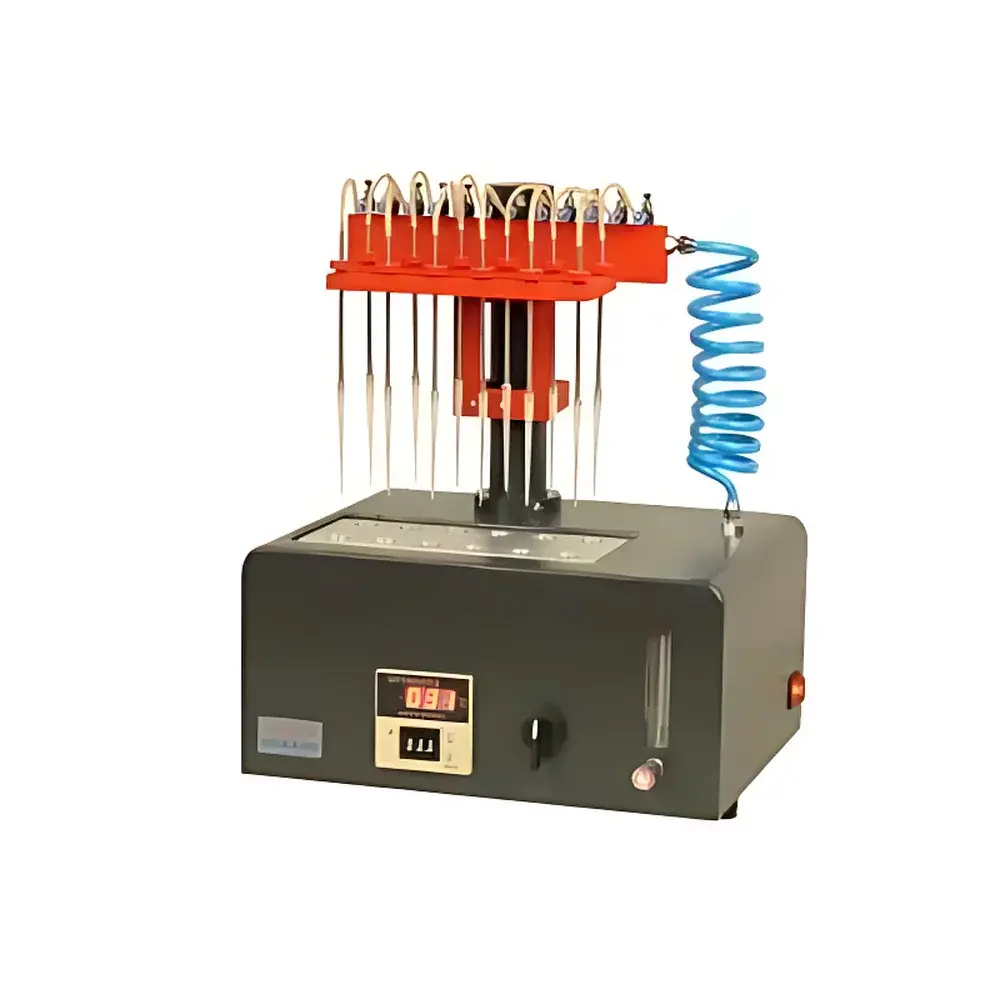
TTL TTL-DCII Multifunctional Nitrogen Evaporator
| Brand | TTL |
|---|---|
| Origin | Beijing, China |
| Manufacturer Type | Direct Manufacturer |
| Region of Origin | Domestic (China) |
| Model | TTL-DCII |
| Instrument Category | Purge-and-Trap Concentrator |
| Temperature Range | 0–99 °C |
| Temperature Control Accuracy | ±0.5 °C |
| Sample Capacity | 24 positions |
| Tube Diameter Compatibility | Ø10–29 mm |
| Optional Vessel Support | Ø30–55 mm (beakers, flasks) |
| Gas Flow Rate | 0–15 L/min (adjustable) |
| Gas Consumption per Position | 330 mL/min |
| Heating Method | Constant-Temperature Water Bath |
| Heating Power | 1000 W |
| Temperature Display | Digital LED |
| External Dimensions | 535 L × 390 W × 620 H mm |
Overview
The TTL TTL-DCII Multifunctional Nitrogen Evaporator is an engineered solution for parallel sample concentration in analytical laboratories requiring high reproducibility, operational flexibility, and compliance-ready design. It operates on the principle of inert gas-assisted solvent evaporation—specifically nitrogen or compressed air—delivered via precision-regulated capillary needles positioned above heated liquid surfaces. By increasing surface gas velocity and reducing local vapor pressure, the system accelerates solvent removal while minimizing thermal degradation of thermolabile analytes. Unlike dry-block or infrared-based concentrators, the TTL-DCII employs a constant-temperature water bath heating system, ensuring uniform thermal distribution across all 24 sample positions and eliminating hot-spot formation. This architecture supports method robustness in regulated environments where temperature homogeneity and inter-batch consistency are critical—particularly for residue analysis, environmental monitoring, and pharmaceutical QC workflows aligned with ISO/IEC 17025 and GLP guidelines.
Key Features
- Laboratory-grade construction: All wetted and structural components fabricated from electropolished stainless steel or PTFE-coated materials, delivering resistance to organic solvents, acidic/basic matrices, and repeated autoclaving cycles.
- Motorized vertical adjustment of the sample rack: Enables precise, repeatable positioning of gas needles relative to meniscus height—critical for optimizing evaporation kinetics without splashing or foaming.
- 360° continuously rotating sample platform: Facilitates unobstructed front-access operation, simplifying tube loading/unloading and visual inspection during active concentration.
- Independent per-position controls: Each of the 24 gas delivery needles features individual needle-height adjustment, independent flow valve actuation (on/off + fine-tuning), and quick-release coupling for routine cleaning or replacement.
- Modular vessel compatibility: Accommodates standard test tubes (Ø10–29 mm), centrifuge tubes, conical flasks, and beakers (Ø30–55 mm, optional adapter ring kit required).
- Dual-stage gas regulation: Integrated needle-valve flowmeter provides both total system flow visualization (0–15 L/min range) and real-time cumulative gas consumption tracking—supporting cost accountability and audit readiness.
- Positional identification: Laser-etched numeric labels (1–24) on the sample carrier ensure traceable sample mapping, essential for LIMS integration and chain-of-custody documentation.
Sample Compatibility & Compliance
The TTL-DCII accommodates a broad spectrum of biological, environmental, and pharmaceutical matrices—including serum, plasma, urine, plant tissue extracts, pesticide-spiked water, soil leachates, herbal decoctions, and dairy or beverage supernatants. Its inert gas environment and low-thermal-stress profile meet method requirements outlined in EPA Method 502.2, AOAC 2007.01, and USP residual solvent testing. The stainless-steel/PTFE material set complies with FDA-recommended contact-surface standards for GMP-compliant labs. While the instrument itself does not carry CE or UL certification, its electrical safety design conforms to IEC 61010-1:2010 for laboratory equipment, and its temperature control subsystem meets ASTM E220–21 calibration traceability expectations when paired with NIST-traceable reference thermometers.
Software & Data Management
The TTL-DCII operates as a standalone benchtop instrument with no embedded microprocessor or digital communication interface. Temperature setpoint, real-time bath temperature, and total gas flow are displayed via a dual-line LED interface. For laboratories implementing electronic recordkeeping under 21 CFR Part 11, external data logging is achieved using third-party USB or RS-232-connected temperature and flow transducers interfaced with validated LIMS or ELN platforms. The unit’s mechanical repeatability—verified via inter-laboratory round-robin studies—supports manual entry into audit trails with defined SOPs for parameter verification, calibration frequency (recommended semi-annually), and maintenance logs.
Applications
- Pesticide residue analysis: Final concentration step in QuEChERS workflows for fruits, vegetables, cereals, and botanical samples prior to GC-MS/MS or LC-MS/MS injection.
- Environmental monitoring: Pre-concentration of volatile and semi-volatile organic compounds (VOCs/SVOCs) from drinking water, groundwater, and wastewater per EPA 8260/8270 protocols.
- Pharmaceutical quality control: Solvent removal from herbal extract fractions, stability-indicating assay preparations, and residual solvent quantitation in API intermediates.
- Clinical toxicology: Batch processing of urine or serum specimens for drug metabolite screening, particularly where derivatization steps precede chromatographic separation.
- Food safety testing: Concentration of milk, wine, juice, or infant formula extracts prior to dioxin, PCB, or mycotoxin analysis by HRGC-HRMS.
FAQ
Is the TTL-DCII compatible with corrosive solvents such as hydrochloric acid or trifluoroacetic acid?
Yes—when equipped with PTFE-coated gas needles and stainless-steel bath components, the system withstands intermittent exposure to diluted mineral acids and halogenated solvents. Extended use with strong oxidizers (e.g., concentrated HNO₃) is not recommended.
Can the instrument be validated for GxP environments?
Yes—its mechanical design, temperature uniformity profile (±0.5 °C across all positions at 60 °C), and traceable calibration pathways support IQ/OQ/PQ execution per Annex 15 and ASTM E2500-13.
Does the system support automated start/stop sequencing?
No—the TTL-DCII lacks programmable timers or relay outputs; timing is managed externally via stopwatch or lab timer systems.
What maintenance intervals are recommended?
Daily: Visual inspection of needle integrity and bath water level. Quarterly: Descale bath chamber with citric acid solution. Annually: Verify temperature sensor accuracy against NIST-traceable reference and inspect gas line seals.
Are consumables included with purchase?
Standard configuration includes 24 reusable stainless-steel gas needles and one set of PTFE O-rings. Disposable PTFE-coated needles (pack of 100) and optional beaker support rings are available as accessories.



