
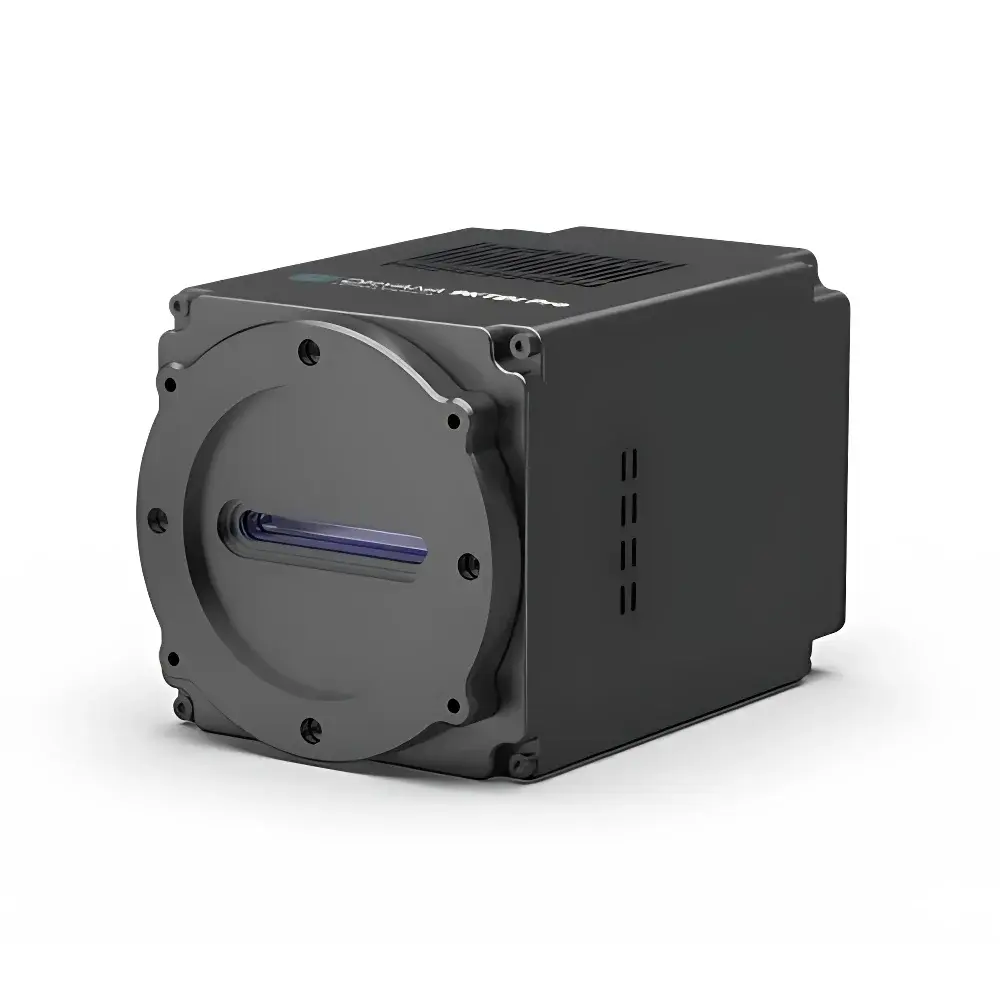
Tucsen Dhyana 9KTDI Pro Back-Illuminated sCMOS Time-Delay Integration Line-Scan Camera
| Brand | Tucsen |
|---|---|
| Origin | Fujian, China |
| Manufacturer Type | Original Equipment Manufacturer (OEM) |
| Product Category | Domestic High-Performance Scientific Imaging Device |
| Model | Dhyana 9KTDI Pro |
| Image Resolution | 9072 (H) × 256 (V) |
| Pixel Size | 5 µm × 5 µm |
| Sensor Active Area | 45.36 mm × 1.28 mm |
| Readout Speed | 600 kHz @ 10-bit |
| Dynamic Range | 68.7 dB @ 12-bit |
| Quantum Efficiency | 82% @ 550 nm |
| Spectral Response | 180–1100 nm |
| Cooling Method | Active Air & Liquid Cooling |
| Interface | CoaXPress-over-Fiber (2 × QSFP+) |
| TDI Stages | 4 to 256 selectable |
| Full-Well Capacity | 15.5 ke⁻ @ 12-bit |
| Read Noise | 7.2 e⁻ @ 12-bit |
| Dark Signal Non-Uniformity | 1.5 e⁻ @ 12-bit |
| Optical Interface | M72 or Custom |
| Power Supply | 12 V / 8 A |
| Max Power Consumption | < 75 W |
| Dimensions | 100 mm × 100 mm × 145 mm |
| Weight | 1.8 kg |
Overview
The Tucsen Dhyana 9KTDI Pro is a high-sensitivity, back-illuminated scientific sCMOS line-scan camera engineered for precision optical inspection and quantitative imaging in demanding industrial and research environments. Built around the Gpixel GLT5009BSI sensor, it implements advanced Time-Delay Integration (TDI) architecture with up to 256 programmable stages—enabling synchronous charge transfer aligned with object motion across the focal plane. This principle ensures cumulative signal integration while suppressing motion blur, making it uniquely suited for continuous high-speed inspection of moving substrates such as semiconductor wafers, flat-panel displays (FPDs), photomasks, and biological specimens under low-photon-flux illumination. Its verified spectral response spans 180 nm to 1100 nm—covering deep UV (e.g., 193 nm ArF excimer), visible, and near-infrared bands—without requiring external phosphor conversion or vacuum UV optics. The camera’s physical design integrates thermal management at the system level: dual-mode active cooling (air or liquid) maintains sensor temperature ≤35 °C below ambient, ensuring stable dark current, minimal pixel non-uniformity drift, and long-term measurement repeatability essential for automated optical inspection (AOI) and process control.
Key Features
- Back-illuminated sCMOS TDI sensor (Gpixel GLT5009BSI) with 9072 × 256 active pixels and 5 µm × 5 µm pixel pitch
- Programmable TDI staging from 4 to 256 stages, supporting forward/reverse scanning and external trigger synchronization
- CoaXPress-over-Fiber interface (2 × QSFP+) delivering sustained 600 kHz line rate at 10-bit depth—equivalent to >50× throughput versus legacy CCD-TDI systems
- Quantum efficiency of 82% at 550 nm, 50% at 350 nm, and 38% at 800 nm—optimized for broadband fluorescence, reflectance, and transmission metrology
- Low-noise readout architecture: 7.2 e⁻ RMS read noise @ 12-bit, 68.7 dB dynamic range, and <0.3% photo-response non-uniformity
- Integrated thermal regulation: liquid-cooling option achieves ΔT = −35 °C relative to ambient with <5 °C/min stabilization time
- Flexible operation modes: pure TDI, area-scan TDI hybrid, ROI-based sub-line acquisition, and hardware-level strobe output with 8 ns timestamp resolution
Sample Compatibility & Compliance
The Dhyana 9KTDI Pro is deployed in production-critical inspection workflows compliant with industry-standard quality frameworks including ISO 9001, IATF 16949, and SEMI S2/S8 safety guidelines. Its UV-enhanced quantum efficiency enables direct imaging of lithographic defects on 300-mm silicon wafers illuminated by 193 nm or 266 nm lasers—supporting defect detection down to sub-100 nm features in semiconductor front-end-of-line (FEOL) metrology. For flat-panel display inspection, the camera interfaces seamlessly with telecentric line-scan optics and automated stage controllers to detect micro-defects on OLED, LCD, and microLED panels at conveyor speeds exceeding 1 m/s. In life science applications, its high QE and low dark current support low-dose fluorescence imaging of fixed or live-cell samples labeled with DAPI, FITC, or Cy5—compatible with GLP-aligned documentation when used with SamplePro SDK’s audit-trail-enabled acquisition modules. All firmware and driver binaries are digitally signed and validated per NIST SP 800-193 guidelines for firmware integrity assurance.
Software & Data Management
The Dhyana 9KTDI Pro is fully supported by Tucsen’s SamplePro SDK—a cross-platform software development kit providing native C/C++, C#, and Python APIs for Windows and Linux (x86_64, ARM64). SDK features include real-time frame buffering with ring-memory management, hardware-triggered multi-channel synchronization (including external encoder input for precise motion correlation), and lossless 12-bit data streaming over CoaXPress-over-Fiber with configurable packet size and error correction. Acquisition metadata—including exposure time, TDI stage count, gain settings, sensor temperature, and hardware timestamps—is embedded in each frame header using standardized IEEE 1788.1-compliant tags. Export formats include TIFF (BigTIFF), HDF5, and vendor-neutral NIfTI for integration into MATLAB, Python (NumPy/SciPy), or commercial machine vision platforms such as Halcon or OpenCV. For regulated environments, optional SDK add-ons provide 21 CFR Part 11-compliant electronic signatures, user-access logging, and immutable audit trails for all acquisition parameter changes.
Applications
- Semiconductor wafer inspection: pattern fidelity verification, particle counting, and edge-profile analysis on 200 mm and 300 mm substrates
- Flat-panel display (FPD) manufacturing: pixel uniformity mapping, mura detection, and polarizer alignment verification on Gen 8.5+ glass substrates
- Photomask and reticle metrology: high-resolution defect review under deep-UV illumination without image intensifiers
- Biological fluorescence imaging: widefield TDI-based confocal-like sectioning of tissue sections and microfluidic assays
- Spectroscopic line-scan acquisition: coupling with imaging spectrometers for real-time hyperspectral analysis in process analytical technology (PAT) systems
- Automated optical sorting: high-throughput material classification based on spectral reflectance signatures across UV-VIS-NIR bands
FAQ
What TDI stage counts are supported, and how is stage selection controlled?
The Dhyana 9KTDI Pro supports discrete TDI stages from 4 to 256 in increments defined by sensor architecture—configurable via SDK or GUI using register-level commands synchronized to line triggers.
Is the camera compatible with third-party motion controllers and encoders?
Yes—the Hirose HR10A-7R-4S trigger interface accepts quadrature encoder signals and provides programmable strobe outputs with sub-microsecond jitter for deterministic synchronization with linear or rotary stages.
Does the CoaXPress-over-Fiber interface require proprietary frame grabbers?
No—it uses standard QSFP+ optical transceivers compliant with CPoF v2.0; certified compatibility is confirmed with BitFlow Axion-CLQ and Euresys CoaXPress 2.0 frame grabbers running Linux kernel ≥5.10.
How is calibration data stored and applied during acquisition?
Per-pixel gain, offset, and PRNU correction matrices are stored in non-volatile memory on the camera PCB and automatically loaded at initialization; users may load custom LUTs via SDK for application-specific flat-field compensation.
Can the camera operate continuously at full line rate for extended periods?
Yes—under liquid cooling at 20 °C ambient, thermal equilibrium is reached within 15 minutes and maintained for >72 h without performance degradation, as verified per MIL-STD-810H thermal cycling protocols.






