
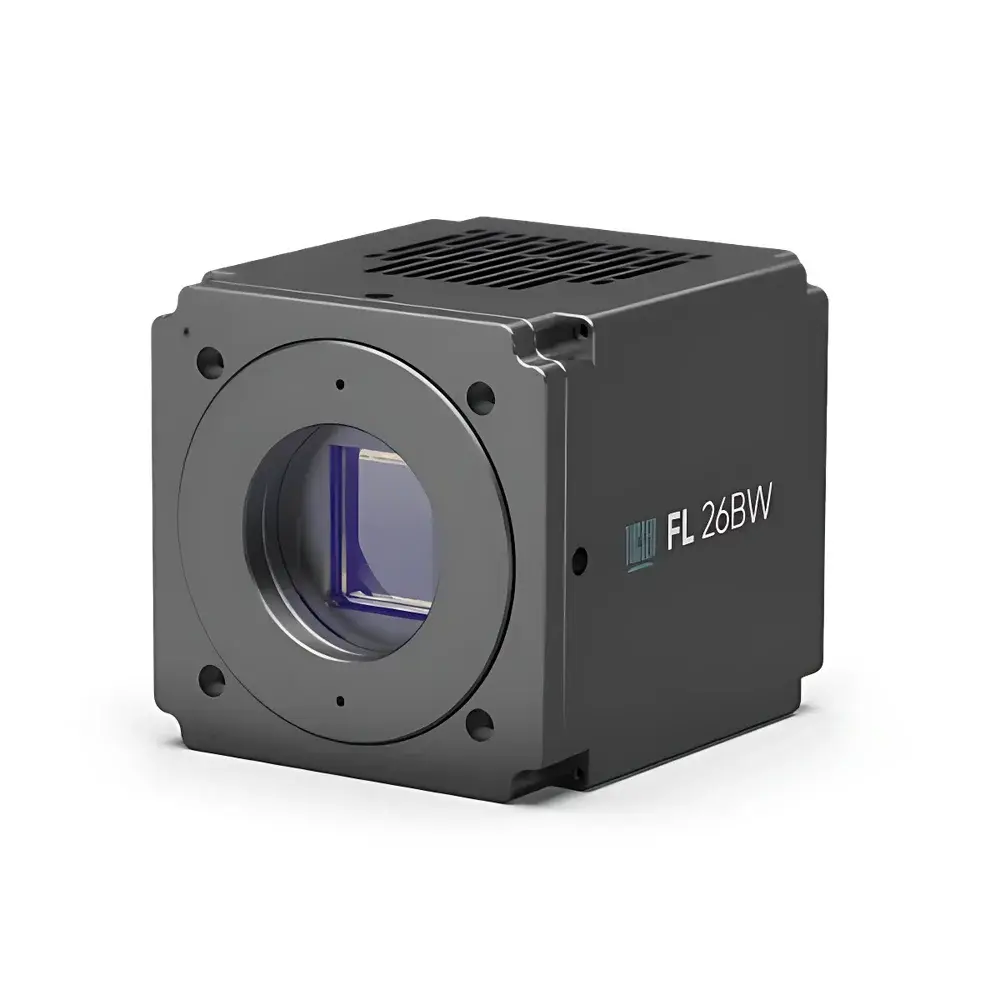
Tucsen FL26BW Scientific CMOS Camera for Chemiluminescence, Bioluminescence, dPCR and Fluorescence Imaging
| Brand | Tucsen |
|---|---|
| Origin | Fujian, China |
| Manufacturer Type | Original Equipment Manufacturer (OEM) |
| Region of Manufacture | Domestic (China) |
| Model | FL26BW |
| Price | Upon Request |
| Resolution | 6244 (H) × 4168 (V) |
| Pixel Size | 3.76 µm × 3.76 µm |
| Sensor Format | 23.4 mm × 15.6 mm |
| Readout Speed | 6.5 fps |
| Quantum Efficiency | 92% @ 530 nm |
| Dark Current | < 0.0005 e⁻/p/s @ −25 °C |
| Cooling Method | Air-cooled |
| Operating Temperature Range | 0–40 °C |
| Interface | USB 3.0 |
| Mount | M42 |
| Power Supply | 12 V / 6 A |
| Power Consumption | ≤ 50 W |
| Dimensions | 85 mm × 85 mm × 97 mm |
| Bit Depth | 16-bit |
| Full Well Capacity | 50 ke⁻ (Gain 0), 15 ke⁻ (Gain 1), 7.8 ke⁻ (Gain 2), 3 ke⁻ (Gain 3) |
| Read Noise | 0.9 e⁻ (Low-Noise mode, Gain 2) |
| Shutter Type | Rolling |
| Exposure Range | 34 µs – 60 min |
| Binning Options | 2×2 to 16×16 |
| Trigger Modes | Hardware & Software |
| SDK Support | C, C++, C#, Python |
| OS Compatibility | Windows / Linux |
Overview
The Tucsen FL26BW is a high-performance, air-cooled scientific CMOS camera engineered for demanding low-light optical imaging applications in life science research and clinical diagnostics. Built around the Sony IMX571BLR-J back-illuminated (BSI) CMOS sensor, it delivers exceptional sensitivity across chemiluminescence, bioluminescence, digital PCR (dPCR), and fluorescence modalities. Unlike conventional CCD-based systems, the FL26BW leverages modern BSI architecture to achieve peak quantum efficiency of 92% at 530 nm—combined with sub-electron read noise (as low as 0.9 e⁻ in Low-Noise mode) and ultra-low dark current (< 0.0005 e⁻/p/s at −25 °C)—enabling quantitative imaging over exposure durations up to 60 minutes without significant thermal signal accumulation. Its 23.4 mm × 15.6 mm active area (diagonal 28.3 mm, equivalent to 1.8″ format) supports wide-field sample coverage while maintaining spatial fidelity, making it suitable for whole-gel, blot, and microplate imaging workflows where dynamic range, linearity, and pixel uniformity are critical.
Key Features
- Back-illuminated Sony IMX571BLR-J sensor with 6244 × 4168 resolution (26 MP) and 3.76 µm square pixels
- Deep thermoelectric cooling to −25 °C (ambient 22 °C), stabilized via closed-loop air-cooling system
- Ultra-low dark current (< 0.0005 e⁻/p/s) enabling long-exposure applications previously reserved for cryogenic CCDs
- Multi-gain architecture (Gain 0–3) with configurable readout modes (Standard/Low-Noise) to optimize SNR across illumination conditions
- 16-bit digitization with full-well capacities scalable from 3 ke⁻ to 50 ke⁻ depending on gain setting
- Flexible binning (2×2 through 16×16) and region-of-interest (ROI) readout for accelerated acquisition or enhanced sensitivity
- Hardware- and software-triggered acquisition with TTL-compatible I/O for synchronization with external light sources or fluidic controllers
- Cross-platform SDK support (C/C++/C#/Python) and native drivers for Windows and Linux environments
Sample Compatibility & Compliance
The FL26BW is validated for use in regulated and non-regulated laboratory environments, including academic core facilities, pharmaceutical QC labs, and molecular diagnostics centers. Its linear response, high pixel uniformity, and stable thermal management support compliance with analytical method validation requirements per ICH Q2(R2) and ISO/IEC 17025. While not pre-certified for FDA 21 CFR Part 11, the camera’s deterministic exposure control, timestamped metadata embedding, and SDK-accessible audit trail capabilities enable integration into GLP- and GMP-aligned imaging platforms when paired with compliant host software. The absence of mechanical shutter eliminates motion-induced artifacts during dPCR endpoint detection and chemiluminescent Western blot quantification—critical for reproducible densitometry and spot intensity normalization.
Software & Data Management
Tucsen provides the Horise SDK, a modular, thread-safe API supporting synchronous and asynchronous image capture, real-time histogram analysis, and hardware-level parameter scripting. Integration with third-party platforms—including ImageJ/Fiji (via Bio-Formats), MATLAB, and Python-based analysis pipelines (e.g., scikit-image, OpenCV)—is facilitated by standardized TIFF and FITS output formats with embedded EXIF-style metadata (exposure time, gain, temperature, binning, ROI coordinates). Time-stamped frame headers and programmable trigger logging allow traceable data provenance, essential for longitudinal studies and multi-instrument assay harmonization. Optional OEM firmware customization supports proprietary calibration routines and LUT-based flat-field correction for specialized optical train configurations.
Applications
- Quantitative chemiluminescent and bioluminescent detection in Western blotting, ELISA, and reporter gene assays
- dPCR droplet imaging and endpoint fluorescence quantification with single-molecule sensitivity
- High-dynamic-range fluorescence imaging of stained gels, tissue sections, and live-cell reporters
- Time-lapse luminescence monitoring in circadian rhythm or metabolic activity studies
- Automated microplate readers requiring precise photon counting across 96-/384-well formats
- Preclinical imaging support for luciferase-based tumor xenograft models
FAQ
What is the minimum detectable photon flux under optimal conditions?
The FL26BW achieves single-photon-level detection capability in Gain 2 / Low-Noise mode with 0.9 e⁻ read noise and >90% QE in the green spectral band; theoretical detection limit is ~1.2 photons/pixel/sec at SNR = 3 for 60 s exposures.
Does the camera support global shutter operation?
No—the FL26BW uses a rolling shutter, which is standard for high-resolution scientific CMOS sensors. For applications requiring temporal synchronization across the full field, hardware triggering with exposure delay compensation is recommended.
Can the camera be integrated into an ISO 13485-certified medical device?
Yes—subject to full system-level validation by the OEM integrator. Tucsen provides design history file (DHF) documentation, RoHS/REACH declarations, and EMC test reports upon NDA.
Is flat-field correction supported natively?
Yes—Horise SDK includes real-time DPC (defect pixel correction) and user-loadable flat-field reference frames. Custom correction matrices can be applied per ROI or binning configuration.
What is the maximum sustained frame rate at full resolution?
6.5 fps at 6244 × 4168 via USB 3.0; throughput scales inversely with ROI size and binning factor, reaching >30 fps at 2048 × 2048 with 2×2 binning.




