
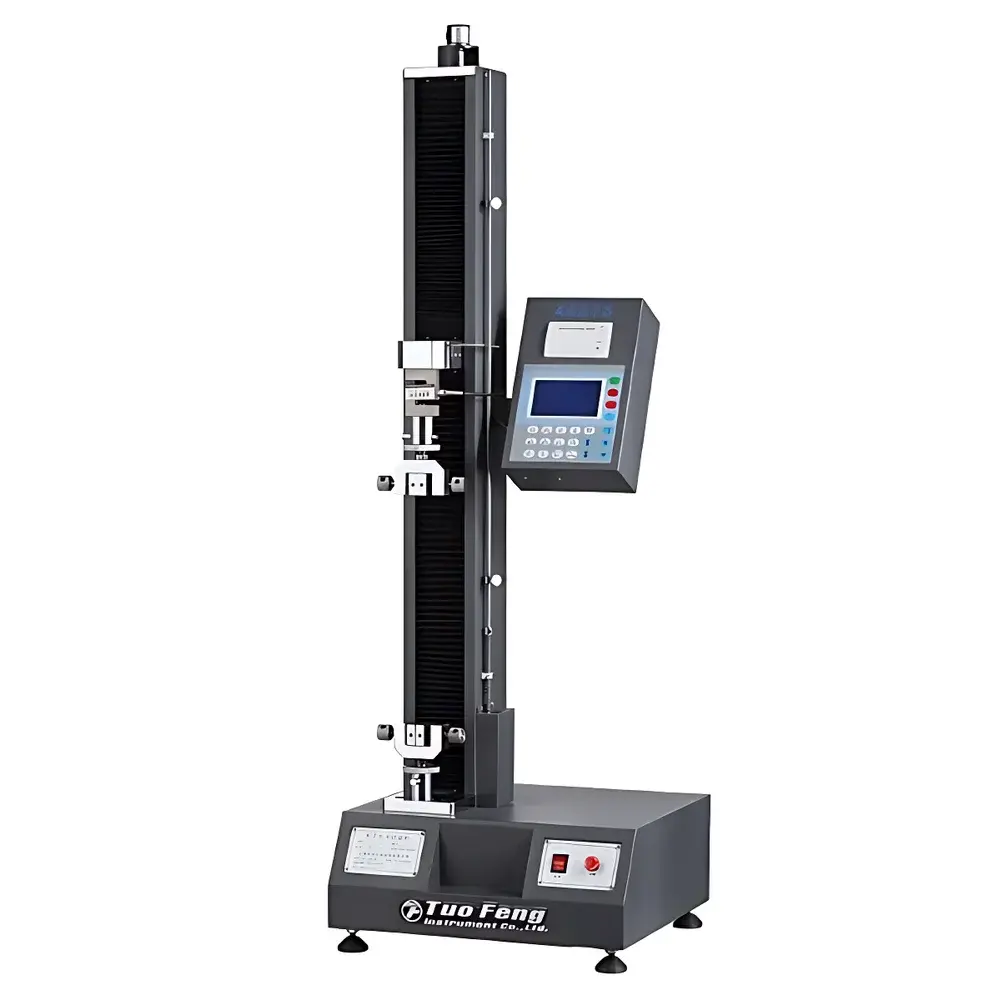
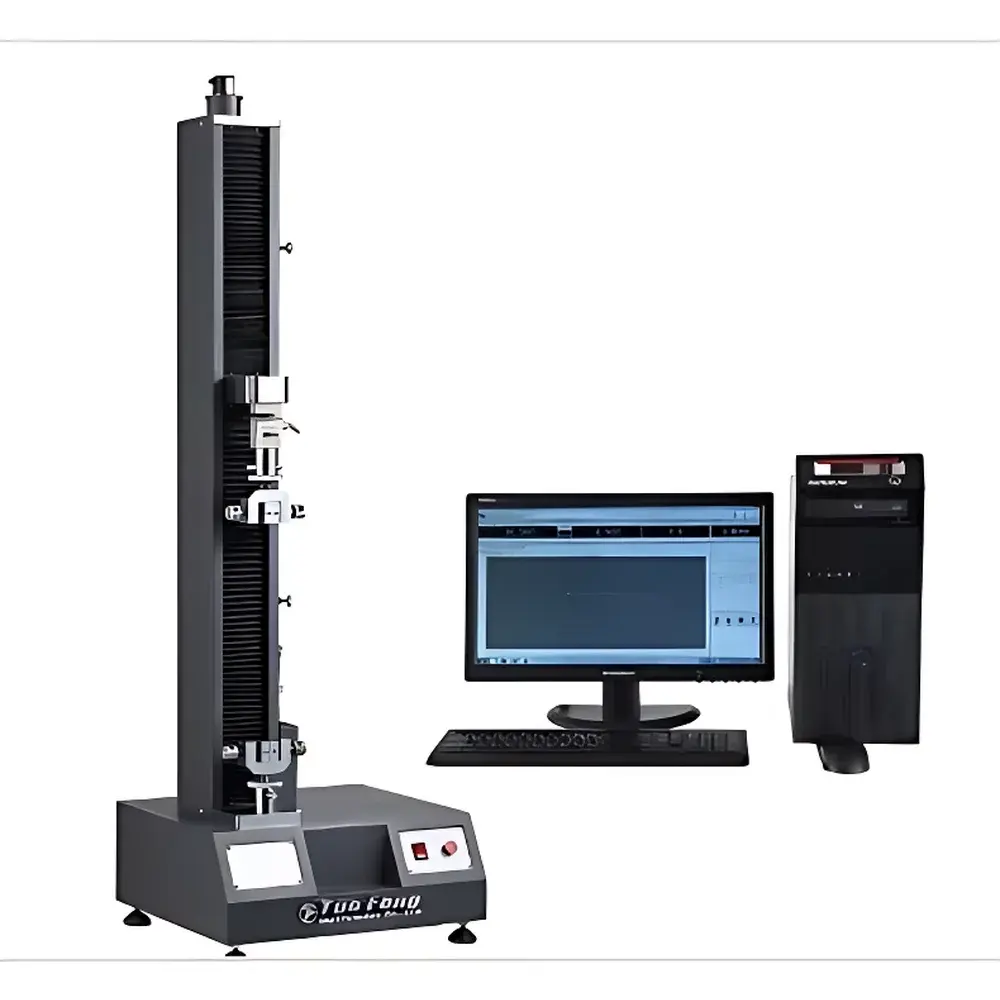
TuoFeng TFL-07 Desktop Digital Tensile Testing Machine
| Brand | TuoFeng |
|---|---|
| Origin | Shanghai, China |
| Manufacturer Type | Direct Manufacturer |
| Product Category | Domestic |
| Model | TFL-07 |
| Instrument Type | Electromechanical Tensile Testing Machine |
| Maximum Test Load | 0.1 kN (100 N) |
| Force Measurement Range | 1–3000 N |
| Force Accuracy | ±0.5% of reading |
| Crosshead Travel | 700 mm |
| Displacement Resolution | 0.0001 mm |
Overview
The TuoFeng TFL-07 Desktop Digital Tensile Testing Machine is an electromechanical universal testing system engineered for precision mechanical property evaluation of low-force specimens in research laboratories, quality control environments, and R&D facilities. Based on servo-controlled linear motion architecture and high-stability load cell transduction, it operates under the fundamental principles of uniaxial tensile, peel, tear, and flexural deformation analysis per ASTM E8/E8M, ISO 6892-1, GB/T 228.1, DIN 53455, and JIS Z 2241 standards. Its compact single-column design occupies minimal benchtop space while maintaining structural rigidity and thermal stability—critical for repeatable force-displacement data acquisition at sub-newton to kilonewton scales. The system delivers traceable force measurement across 0.4%–100% of full scale (FS), with no internal range switching, ensuring consistent resolution of 1 part in 300,000 codes throughout the entire load path.
Key Features
- High-resolution displacement sensing via optical encoder, delivering 0.0001 mm resolution and ±0.5% accuracy relative to indicated value
- Adjustable crosshead speed from 0.01 to 500 mm/min, continuously variable (stepless) via digital servo control
- Integrated electronic limit switches and emergency stop circuitry compliant with IEC 61800-5-2 functional safety requirements
- Three-speed motorized crosshead positioning (fast/medium/slow) with programmable jog and return-to-start functionality
- Overload protection triggered at 110% of maximum rated load (100 N), initiating immediate drive shutdown and mechanical lockout
- Modular fixture interface compatible with standardized wedge-action, pneumatic, or custom-designed grips for wires, films, adhesives, and biomedical specimens
- Thermally stable aluminum alloy frame with vibration-damping base mount to minimize environmental interference during micro-force measurements
Sample Compatibility & Compliance
The TFL-07 supports a broad spectrum of specimen geometries and material classes including metallic wires (diameters ≥0.05 mm), polymer films (thickness 12–250 µm), textile yarns, paperboard laminates, medical tubing, pressure-sensitive adhesives, and food packaging seal joints. It meets essential regulatory prerequisites for GLP-compliant mechanical testing workflows: audit-trail-enabled software logging, user-access-level controls, and data integrity safeguards aligned with FDA 21 CFR Part 11 Annex 11 expectations. All force calibration certificates are traceable to NIM (National Institute of Metrology, China) and internationally recognized SI-based reference standards. Test reports generated include metadata such as operator ID, timestamp, environmental conditions (optional sensor integration), and instrument serial number—enabling full chain-of-custody documentation.
Software & Data Management
The Windows-based TensilePro™ v3.2 software suite provides full control over test configuration, real-time monitoring, and post-processing analytics. It supports multi-language UI (English, Simplified/Traditional Chinese), customizable unit systems (N, lbf, MPa, psi, % elongation), and dynamic curve overlay for comparative material benchmarking. During testing, synchronized plots of load–time, load–displacement, stress–strain, and extension–time are rendered in real time. Automated calculations include tensile strength, yield point (offset method), modulus of elasticity, elongation at break, peel adhesion (90°/180°), and tear resistance (Trouser, Elmendorf). Raw ASCII data exports (.csv, .txt) and formatted PDF reports (with embedded graphs and statistical summaries) are fully scriptable. Software updates are delivered remotely with version-controlled release notes and backward-compatible data file handling.
Applications
This system is routinely deployed in electronics manufacturing for bonding strength validation of solder joints and flexible printed circuits; in packaging labs for seal integrity assessment of thermoformed trays and pouch laminates; in academic polymer science for characterizing hydrogel swelling mechanics and biodegradable film degradation kinetics; and in medical device QA for suture tensile performance verification per ISO 10993-12. Its 700 mm vertical travel accommodates extended elongation tests on elastomers and fiber-reinforced composites, while the 100 N capacity ensures optimal signal-to-noise ratio for delicate biological tissues and nanofiber mats. Optional extensometer integration enables true strain measurement per ASTM E83 Class B2 requirements.
FAQ
What standards does the TFL-07 support out of the box?
It natively implements test methods defined in ASTM D638, ISO 527-1, GB/T 1040.1, DIN EN ISO 1183, and JIS K 7113—with preloaded templates, pass/fail thresholds, and reporting formats aligned to each standard.
Can the system be integrated into a LIMS or MES environment?
Yes—via OPC UA server module (optional add-on) or direct ODBC-compliant database export, enabling bidirectional data exchange with laboratory information management systems and enterprise manufacturing execution platforms.
Is third-party calibration certification available?
TuoFeng provides ISO/IEC 17025-accredited calibration services through partner metrology labs, with documented uncertainty budgets and NIST-traceable reference standards.
What maintenance intervals are recommended?
Load cell zero drift verification every 3 months; encoder alignment check annually; lubrication of lead screw and guide rails every 6 months under continuous operation.
Does the machine support cyclic loading or fatigue testing?
Not in standard configuration—however, the controller firmware supports user-defined waveform profiles (e.g., sine, triangle, trapezoidal), and with optional closed-loop strain control hardware, it can perform low-cycle fatigue tests up to 5 Hz.



