
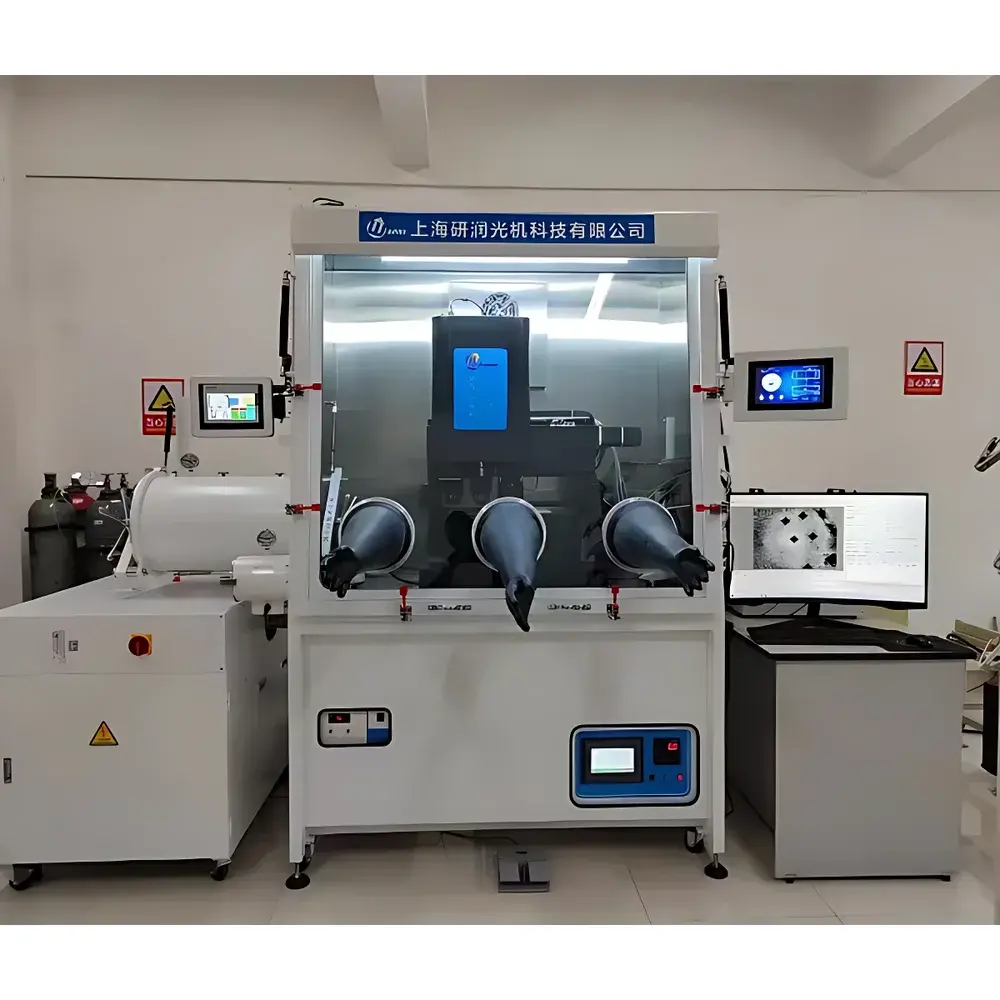
YANRUN IMAS-HT1300CM Full-Temperature-Field Dynamic High-Temperature Indentation Tester
| Brand | YANRUN |
|---|---|
| Origin | Shanghai, China |
| Manufacturer Type | Manufacturer |
| Country of Origin | China |
| Model | IMAS-HT1300CM |
| Instrument Type | Vickers Hardness Tester |
| Temperature Range | 200–1200 °C (furnace up to 1300 °C) |
| Load Range | 0.1–30 kg (optional up to 150 kg) |
| Optical Working Temp | ≤1200 °C (10× or 20× objective) |
| Displacement Resolution | 500 nm (optional down to >20 nm) |
| Holding Time | Up to 72 h |
| Thermal Uniformity | ≤±5 °C across 100×80×80 mm cavity |
| Temperature Control Accuracy | ±1 °C |
| Heating Rate | 1–40 °C/min |
| Max Sample Size | Ø30×30 mm |
| Indenter Max Temp | 1300 °C |
| In-situ Exchange Time | ≤50 s at 1200 °C |
| Multi-axis Control | Up to 9 axes |
| Image Magnification | 1000× (standard), 2000× (optional) |
| Objective Resolution | 1.44 µm (10×), 1.19 µm (20×) |
| Cooling | Dual-mode (water + inert gas), ≤5 s cooldown |
Overview
The YANRUN IMAS-HT1300CM is a full-temperature-field dynamic high-temperature indentation tester engineered for in-situ mechanical characterization of advanced materials under controlled thermal environments from 200 °C to 1200 °C. Unlike conventional hardness testers limited to ambient or low-temperature operation, the IMAS-HT1300CM integrates a vacuum-compatible high-temperature furnace, thermally stable optical imaging path, and real-time force–displacement–time acquisition architecture—enabling quantitative nano/micro-scale mechanical testing within a uniform, reproducible thermal field. Its core measurement principle is based on instrumented indentation mechanics, where load-controlled or displacement-controlled penetration by a geometrically defined indenter (e.g., Vickers pyramid, spherical, conical) yields hardness, elastic modulus, fracture toughness, creep compliance, and time-dependent deformation behavior—all while maintaining continuous thermal equilibrium between sample, indenter, and optics. The system supports ASTM E2546, ISO 14577, and USP compliant test protocols, with traceable calibration paths for both force (via high-temperature load cell) and displacement (via laser interferometry or capacitive sensor).
Key Features
- Full-temperature-field design: Maintains thermal homogeneity (≤±5 °C gradient) across 100×80×80 mm furnace cavity, enabling true in-situ testing without thermal lag or interfacial mismatch.
- High-temperature optical observation: 10× and optional 20× objectives rated for continuous operation at ≤1200 °C; delivers 1000× or 2000× system magnification with sub-micron resolution (1.44 µm or 1.19 µm).
- Dynamic loading & compensation: 0.1–30 kg load range (extendable to 150 kg); programmable loading modes (constant load, constant displacement, constant rate); real-time acquisition at ≥100 Hz sampling rate.
- In-situ rapid sample exchange: ≤50-second hot swap capability at 1200 °C via motorized XYZRZ multi-axis stage, preserving thermal history and minimizing experimental downtime.
- Extended dwell capability: Up to 72-hour uninterrupted hold at target load and temperature—critical for creep, stress relaxation, and diffusion-controlled deformation studies.
- Integrated thermal management: Dual cooling architecture (recirculating water chiller + inert-gas quenching) ensures component longevity and enables rapid cooldown (<5 s) between cycles.
- High-fidelity data synchronization: Simultaneous timestamped capture of force, displacement, temperature, image frames, and environmental parameters—fully aligned for post-test model fitting and constitutive analysis.
Sample Compatibility & Compliance
The IMAS-HT1300CM accommodates metallic alloys, ceramics, CMCs, refractory composites, and thin-film coatings with dimensions up to Ø30×30 mm. It operates in inert (Ar, N₂) or vacuum atmospheres—compatible with glovebox integration (H₂O/O₂ ≤1 ppm). All high-temperature subsystems—including indenter holder, load train, and optical coupler—are fabricated from SiC-reinforced ceramics and platinum-group alloys to prevent oxidation, creep, or thermal drift. The system complies with GLP/GMP documentation requirements, supporting FDA 21 CFR Part 11–compliant audit trails, electronic signatures, and version-controlled test method libraries. Calibration certificates are traceable to NIM (China National Institute of Metrology) and include uncertainty budgets per ISO/IEC 17025.
Software & Data Management
IMAS V7.0 software provides a unified interface for experiment design, real-time monitoring, and post-processing. Users define multi-step thermal–mechanical profiles (e.g., ramp-hold-indent-hold-cool), configure data acquisition triggers, and apply live filters (moving average, derivative smoothing). Raw datasets export in HDF5 and CSV formats, with built-in modules for Oliver–Pharr analysis, Sneddon-based modulus extraction, crack-length quantification (via image segmentation), and time–temperature–transformation (TTT) curve generation. All metadata—including furnace thermocouple readings (S-type Pt/Rh), environmental logs, and hardware configuration snapshots—is embedded in each dataset for full experimental reproducibility. Optional cloud-sync and API access enable integration with LIMS and enterprise data lakes.
Applications
- High-temperature hardness mapping of turbine blade coatings (MCrAlY, TBCs) across thermal gradients.
- Ceramic matrix composite (CMC) interfacial debonding kinetics under sustained load at 1100 °C.
- Creep–fatigue interaction modeling in Ni-based superalloys using synchronized load–displacement–temperature histories.
- Phase-transformation-induced modulus evolution in shape-memory alloys during heating/cooling cycles.
- Fracture toughness evaluation of ultra-high-temperature ceramics (UHTCs) via indentation cracking under inert atmosphere.
- Validation of thermomechanical finite element models using experimentally derived constitutive inputs (e.g., Norton power-law exponents, activation energies).
FAQ
What is the maximum usable temperature for the optical imaging system?
The 10× and 20× objectives are rated for continuous operation at ≤1200 °C; optical transmission remains stable for ≥50 hours at this temperature.
Can the system perform tests under vacuum or reactive gas environments?
Yes—the furnace chamber is vacuum-rated and compatible with glovebox integration; optional inert gas purge (Ar/N₂) or vacuum operation down to 10⁻³ Pa is supported.
Is the IMAS-HT1300CM suitable for ASTM E2546-compliant high-temperature indentation?
Yes—hardware specifications (thermal uniformity, load/displacement accuracy, temperature control stability) and software reporting templates fully align with ASTM E2546 Annex A3 for elevated-temperature instrumented indentation.
How is displacement calibrated at high temperature?
Displacement is measured via a high-stability laser interferometer (standard 500 nm resolution) or optionally a sub-20 nm resolution interferometric module, with in-situ thermal drift compensation using reference mirror tracking.
Does the system support automated multi-point grid testing across temperature ramps?
Yes—IMAS V7.0 includes scriptable thermal–spatial–mechanical sequencing, enabling unattended grid indentation (e.g., 5×5 points) at each of 10 user-defined temperatures from 200 °C to 1200 °C.



