
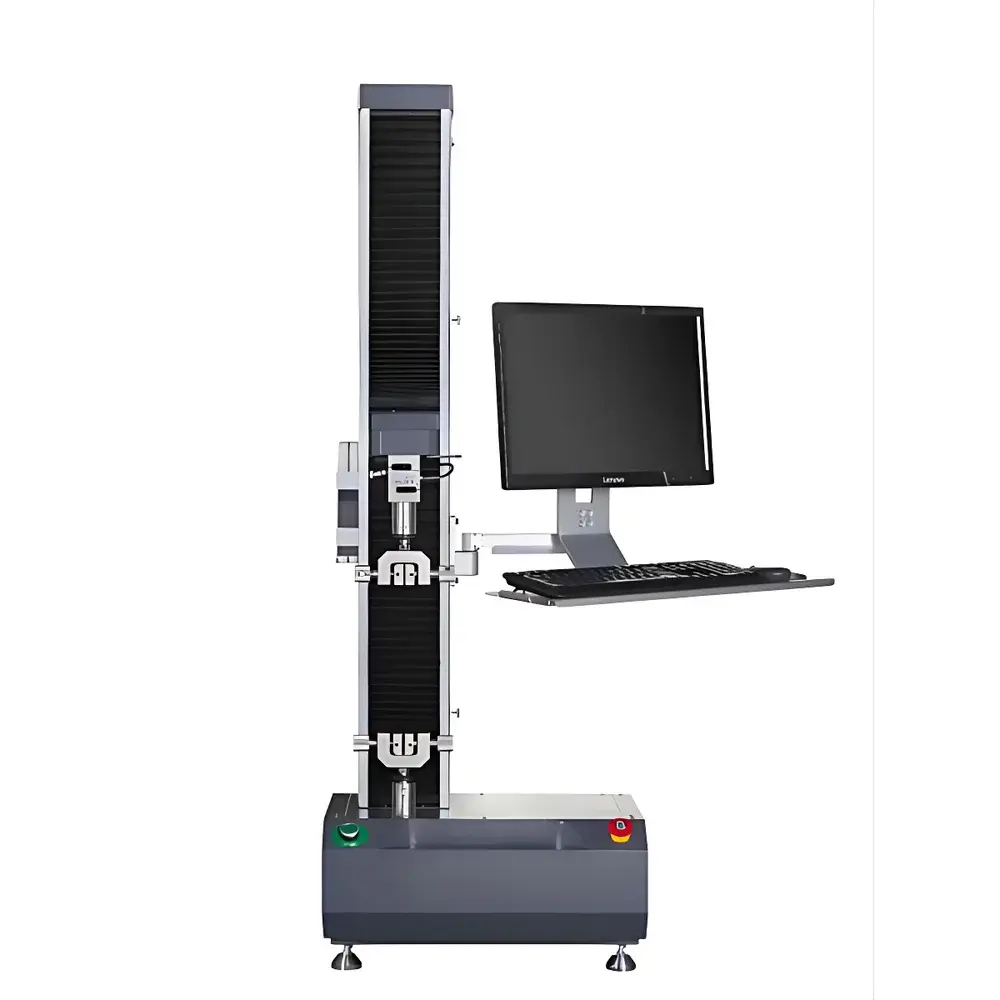
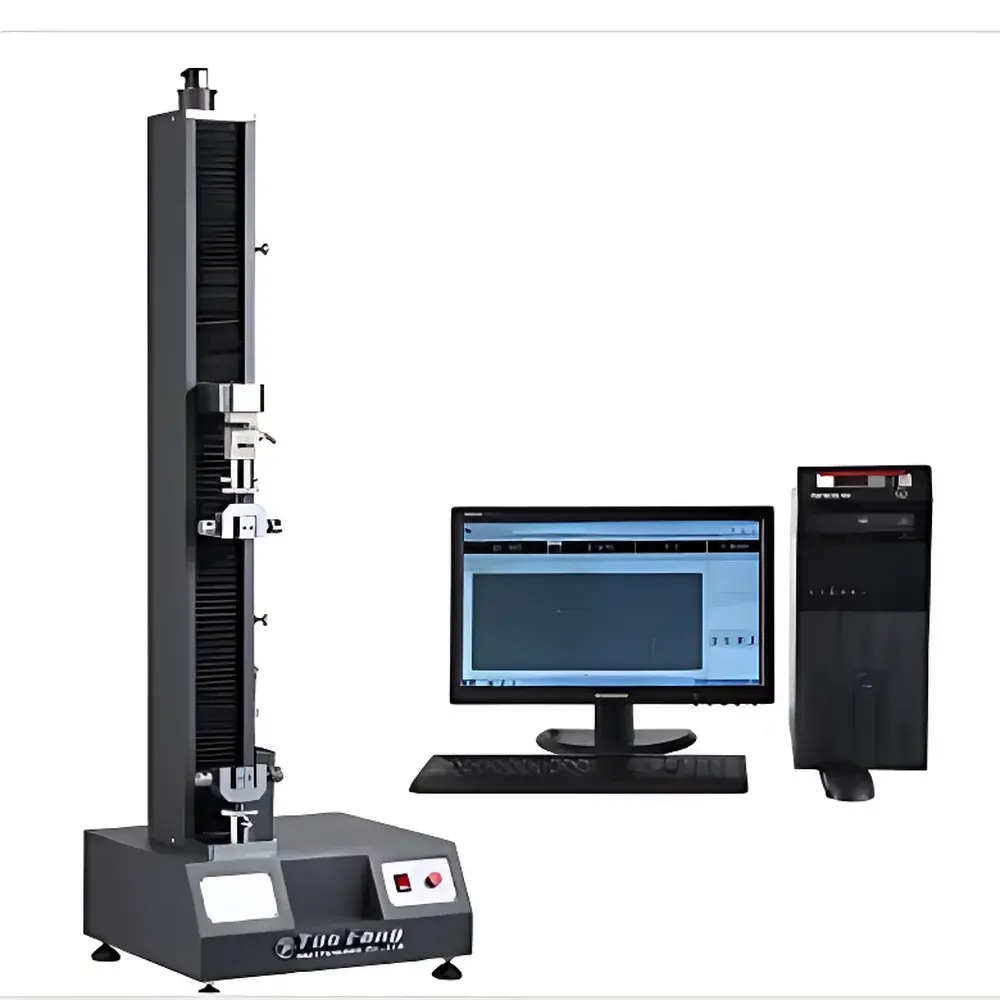
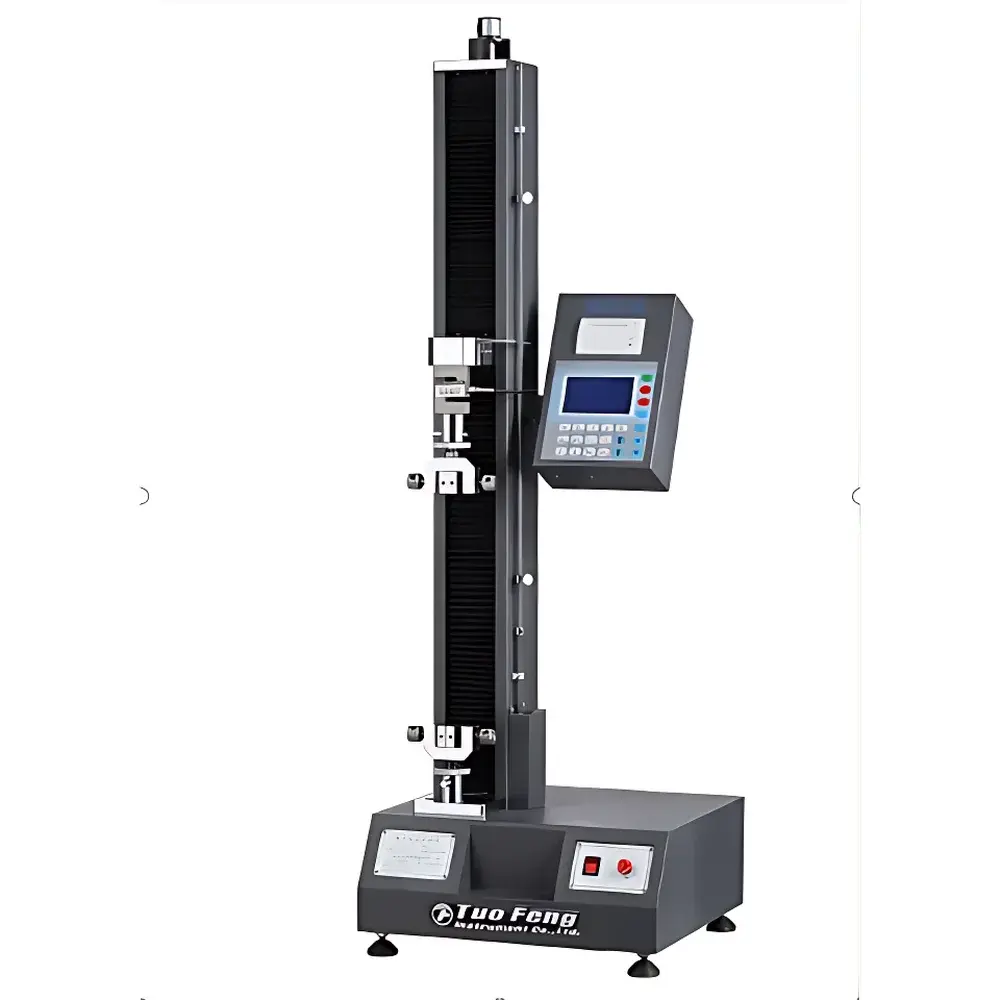
Tuofeng TFL-22S Computer-Controlled Electronic Tensile Testing Machine
| Brand | Tuofeng |
|---|---|
| Origin | Shanghai, China |
| Manufacturer Type | Direct Manufacturer |
| Model | TFL-22S |
| Instrument Type | Electronic Tensile Testing Machine |
| Maximum Test Load | 5 kN |
| Force Measurement Range | 0.4%–100% of Full Scale (FS) |
| Force Accuracy | ±0.5% of reading |
| Crosshead Travel | 700 mm |
| Displacement Resolution | ±0.5% of reading |
Overview
The Tuofeng TFL-22S is a microprocessor-driven, computer-controlled electronic tensile testing machine engineered for precision mechanical property evaluation of adhesives, tapes, films, fibers, foils, wires, and thin-section materials in quality control and R&D laboratories. It operates on the fundamental principle of uniaxial force application—applying controlled tensile, peel, tear, or shear loads to specimens while continuously measuring load, displacement, and time-derived mechanical responses. Designed to meet international standardization requirements, the system complies with ASTM D3330 (peel adhesion), ASTM D638/D882 (tensile properties of plastics and thin films), ISO 11339 (adhesive peel strength), ISO 527 (plastics tensile testing), GB/T 2790–1995 (adhesive peel strength), and JIS Z 0237 (pressure-sensitive adhesive tapes). Its rigid dual-column frame, high-resolution encoder-based displacement feedback, and low-noise load cell architecture ensure repeatable, traceable, and auditable test data—critical for GLP-compliant environments and ISO/IEC 17025-accredited labs.
Key Features
- High-accuracy 5 kN load cell with ±0.5% full-scale accuracy and 0.4–100% force measurement range—enabling precise quantification of low-force adhesive bond failures and high-strength substrate deformations within a single setup.
- Adjustable crosshead travel of 700 mm (extendable upon request), accommodating both short-gauge peel tests and long-travel elongation measurements for elastomeric or viscoelastic adhesives.
- Variable-speed drive system delivering smooth, programmable crosshead motion from 0.01 to 500 mm/min—supporting quasi-static peel rate standards (e.g., 300 mm/min per ASTM D3330) and slow-strain-rate creep or relaxation protocols.
- Dual-mode positioning: motorized fast/medium/slow speed control with manual jog function and programmable return-to-start—enhancing throughput during multi-specimen batch testing.
- Integrated hardware safety: electronic limit switches, emergency stop circuitry, overload protection at 110% of rated capacity, and real-time software interlocks prevent mechanical damage and operator risk.
- Modular fixture interface compatible with standardized pneumatic, wedge, and spring-loaded grips—including peel arms, 180°/90° peel fixtures, loop tack holders, and probe-type probes for gel or paste consistency assessment.
Sample Compatibility & Compliance
The TFL-22S accommodates diverse specimen geometries and material classes relevant to adhesive performance validation: pressure-sensitive tapes, structural epoxy bonds, hot-melt films, aqueous acrylic dispersions, silicone gels, laminated packaging substrates, and fiber-reinforced composites. Specimen widths up to 100 mm and thicknesses up to 10 mm are routinely tested. All mechanical outputs—including tensile strength (MPa), elongation at break (%), peel adhesion (N/25 mm), tack energy (mJ), and cohesive failure percentage—are calculated in accordance with ISO 25201, ASTM D1000, and EN 1979. The system supports audit-ready documentation required under FDA 21 CFR Part 11 when configured with user access controls, electronic signatures, and immutable audit trails—making it suitable for pharmaceutical packaging qualification and medical device adhesive validation.
Software & Data Management
The embedded Windows-based testing software provides deterministic control over test profiles and comprehensive post-processing capabilities. Users may define custom test methods using load-controlled, displacement-controlled, or time-controlled modes—essential for simulating real-world service conditions such as constant-load debonding or cyclic peel fatigue. Real-time plotting includes force–time, force–displacement, stress–strain, and displacement–time curves—with synchronized display of peak load, yield point, modulus (secant/tangent), and total elongation. Units are fully configurable (N/kN/lbf, mm/in, MPa/psi), and language support includes English, Simplified Chinese, Traditional Chinese, and German. Data export is native to CSV, Excel, and PDF formats; results are automatically timestamped, versioned, and stored with metadata (operator ID, calibration date, environmental conditions). Optional modules support statistical process control (SPC) charting, Weibull analysis for bond reliability prediction, and integration with LIMS via OPC UA or TCP/IP.
Applications
- Quantitative peel strength evaluation of PSA tapes across temperature and humidity gradients (e.g., 23°C/50% RH vs. 40°C/90% RH).
- Tensile lap-shear strength testing of two-part epoxies and polyurethanes per ASTM D1002.
- Loop tack and probe tack characterization of acrylic and rubber-based adhesives.
- Cohesive strength and failure mode analysis (adhesive vs. cohesive vs. substrate failure) in laminated food packaging structures.
- Creep compliance and stress relaxation profiling of thermoplastic hot melts under sustained load.
- Quality conformance screening of incoming raw materials—e.g., backing film tensile modulus, release liner剥离 force, or adhesive coat weight correlation studies.
FAQ
What standards does the TFL-22S support for adhesive testing?
It natively supports ASTM D3330, D638, D882, D1000, D1002; ISO 11339, 25201, 527; GB/T 2790, 7742; and JIS Z 0237.
Can the system perform creep or relaxation tests?
Yes—via programmable hold steps in displacement- or load-controlled modes, with duration up to 999 hours and automatic data logging at user-defined intervals.
Is the software compliant with 21 CFR Part 11?
When deployed with optional validation package (including role-based access, electronic signatures, and audit trail activation), it meets core technical requirements for regulated environments.
What is the calibration interval recommendation?
Annual calibration is recommended; internal verification routines allow daily performance checks using certified reference load cells and displacement standards.
Does the system support third-party fixture integration?
Yes—the universal T-slot base plate and digital I/O interface enable seamless connection of OEM or custom-designed fixtures, including environmental chambers and video extensometers.



