
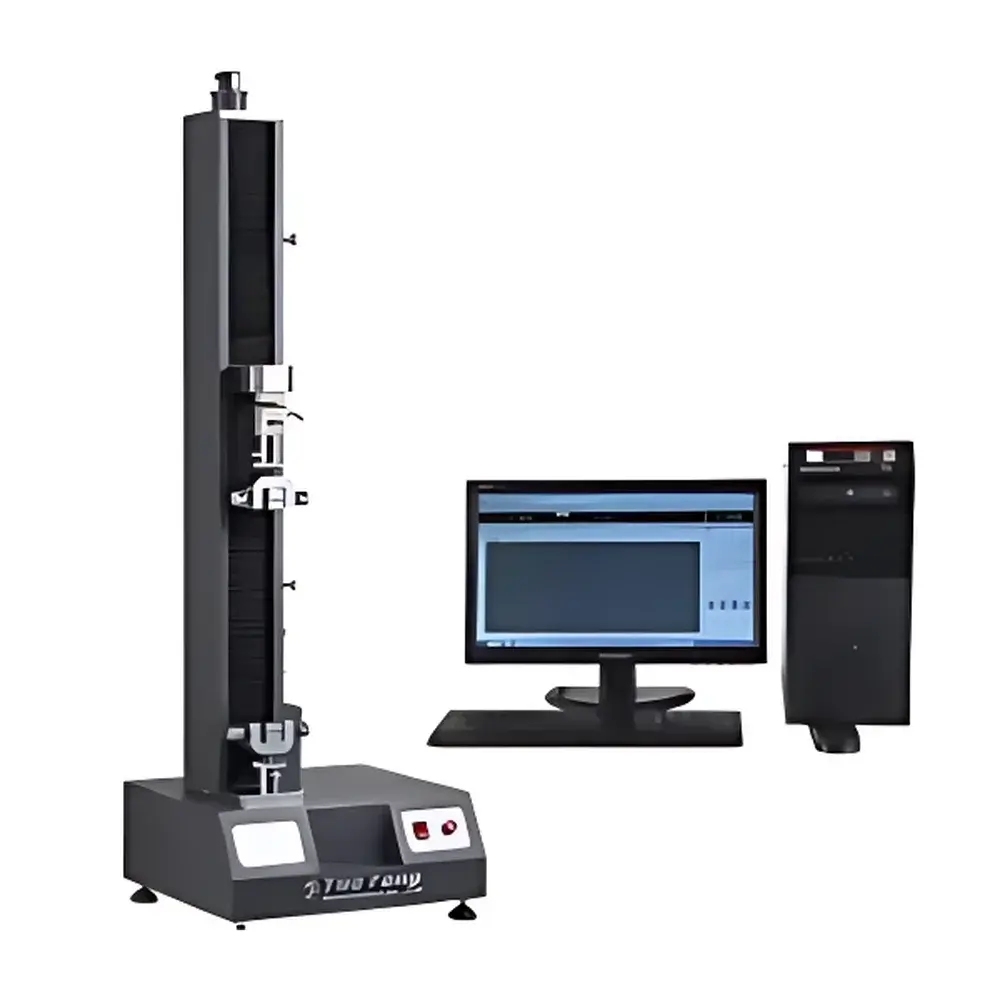
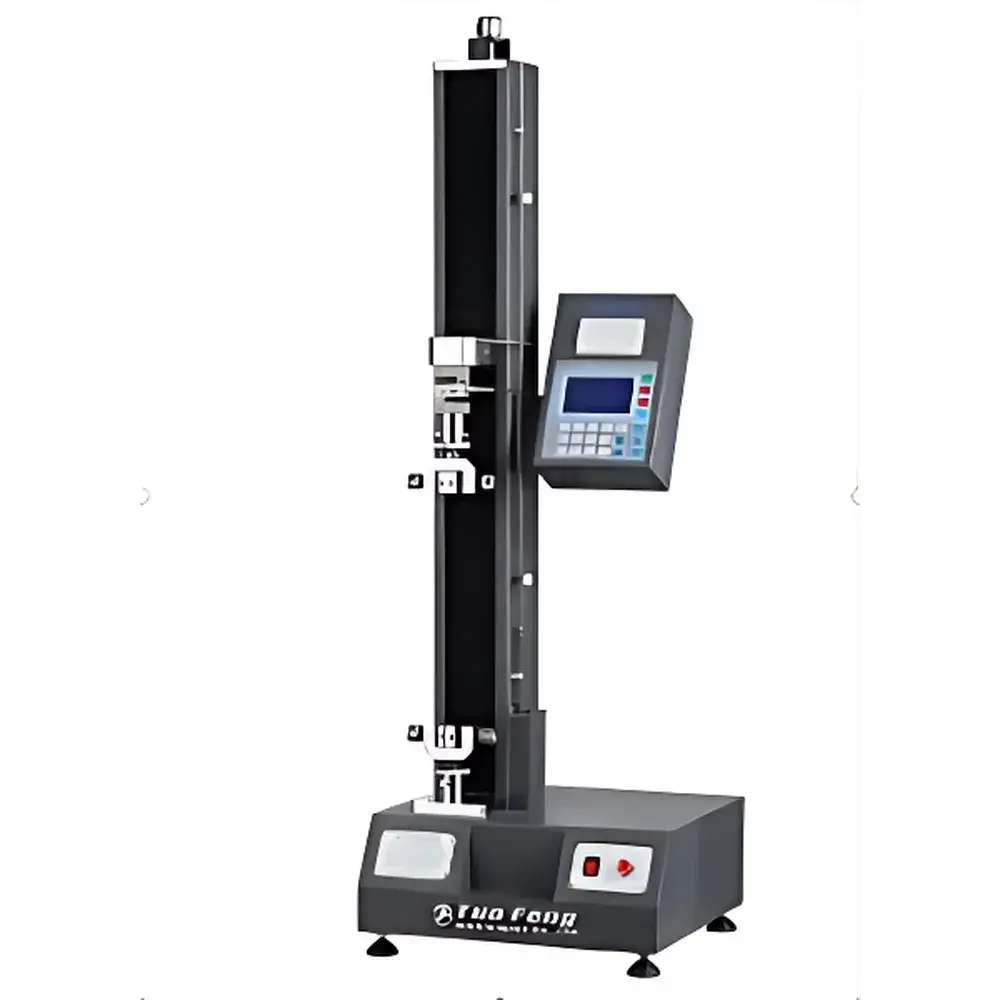
Tuofeng TFL-5S Computer-Controlled Universal Tensile Testing Machine
| Brand | Tuofeng |
|---|---|
| Origin | Shanghai, China |
| Manufacturer Type | Direct Manufacturer |
| Model | TFL-5S |
| Maximum Test Load | 5 kN |
| Force Measurement Range | 0.4%–100% of Full Scale |
| Force Accuracy | ±0.5% of reading |
| Crosshead Travel | 700 mm |
| Displacement Resolution | ±0.5% of reading |
| Test Speed Range | 0.01–500 mm/min (infinitely variable) |
| Position Sensing | Optical Encoder |
| Load Cell Resolution | 1 part in 300,000 full-scale counts (single-range, no auto-ranging) |
| Protection Features | Electronic limit switches, emergency stop, overload protection at 110% of rated load |
| Power Supply | 220 V AC, 50 Hz, 400 W |
| Dimensions (W×D×H) | ≈460×460×1500 mm |
| Weight | ≈120 kg |
Overview
The Tuofeng TFL-5S Computer-Controlled Universal Tensile Testing Machine is a precision-engineered electromechanical system designed for static mechanical property evaluation of solid materials under uniaxial loading conditions. Based on servo-controlled motor actuation and high-fidelity load cell transduction, it implements standardized force-displacement measurement according to the fundamental principles of Hooke’s law and engineering stress–strain analysis. The system complies with core mechanical testing paradigms defined in ISO 6892-1 (metallic materials), ASTM E8/E8M (tension testing of metallic materials), ASTM D638 (plastics), ASTM D882 (thin plastic sheeting), ISO 1798 (flexible cellular materials), and GB/T 228.1 (Chinese national standard for metallic materials). Its rigid C-frame architecture, thermally stable load train, and real-time digital signal acquisition ensure high reproducibility across repeated tests—critical for quality control laboratories, R&D centers, and third-party certification facilities operating under GLP or ISO/IEC 17025 frameworks.
Key Features
- High-resolution dual-channel data acquisition: simultaneous capture of load (±0.5% FS accuracy) and displacement (±0.5% reading accuracy) with 300,000-count internal resolution, eliminating range-switching artifacts.
- Infinitely variable crosshead speed control from 0.01 to 500 mm/min, enabling precise strain-rate selection per material class—from quasi-static ductile metal tensile tests to high-speed peel or tear evaluations.
- Integrated electronic safety architecture: programmable upper/lower travel limits, hardware-based emergency stop circuitry, and automatic overload cutoff at 110% of full-scale capacity (5 kN).
- Modular fixture interface compatible with standardized wedge-action, pneumatic, hydraulic, and custom-designed grips for wires, films, textiles, adhesives, and biomedical specimens.
- Thermally compensated load cell with temperature drift <0.02% FS/°C over 10–40°C ambient range, ensuring metrological stability during extended test sessions.
- Motorized crosshead with three-speed jog mode (fast/medium/slow) and programmable return-to-start functionality—reducing operator intervention and improving throughput consistency.
Sample Compatibility & Compliance
The TFL-5S accommodates specimens ranging from fine-diameter metallic filaments (≥0.1 mm) to laminated composites and multi-layer packaging substrates. Standard configurations support tensile, peel (90° and 180°), tear (Trouser, Elmendorf), puncture, and compression testing per ISO 8510-2, ASTM D3330, ISO 6383-2, and ASTM F1160. Optional extensometer integration enables true strain measurement for modulus determination in compliance with ASTM E111 and ISO 527-2. All test protocols adhere to audit-ready documentation requirements aligned with FDA 21 CFR Part 11 (electronic records/signatures), where software validation packages—including IQ/OQ documentation templates—are available upon request. Calibration traceability is maintained to NIM (National Institute of Metrology, China) or internationally recognized NMIs via optional accredited calibration certificates.
Software & Data Management
The embedded Windows-based testing software (compatible with Windows 10/11 LTS versions) supports six primary control modes: constant rate of extension (CRE), constant rate of loading (CRL), constant force hold, constant displacement hold, ramp-to-break, and cyclic loading (with user-defined dwell periods). Real-time visualization includes synchronized plots of load vs. time, load vs. displacement, stress vs. strain, and displacement vs. time—with dynamic switching between views during active testing. Automated calculations include tensile strength, yield strength (offset method), elongation at break, Young’s modulus, peel adhesion energy (J/m²), and tear resistance (N/mm). Raw data export is supported in CSV, XLSX, and universal XML formats; all test files embed metadata (operator ID, timestamp, environmental conditions, calibration status). Audit trails log every parameter change, test initiation, result modification, and report generation—meeting GLP/GMP data integrity expectations. Software updates are delivered remotely with version-controlled release notes and backward-compatible file handling.
Applications
- Quality assurance of copper/aluminum wire and cable insulation integrity per IEC 60811-501.
- Mechanical validation of medical device components—including suture tensile strength (ISO 10993-12) and catheter shaft torque resistance.
- Adhesive bond strength assessment for automotive interior trim (ASTM D1002) and flexible electronics lamination.
- Food packaging film performance benchmarking: seal strength (ASTM F88), puncture resistance (ASTM F1306), and delamination onset.
- R&D characterization of biodegradable polymers (PLA, PHA) and fiber-reinforced composites under controlled humidity and temperature environments.
- Educational use in materials science laboratories for undergraduate and graduate-level mechanics of materials experiments.
FAQ
What standards does the TFL-5S support out-of-the-box?
The system ships with preconfigured test methods for ISO 6892-1, ASTM E8, ASTM D638, GB/T 228.1, and JIS Z2241. Additional standards can be added via software configuration modules.
Can the machine perform compression testing?
Yes—equipped with a bottom platen and flat compression plates, it supports axial compression per ASTM E9 and ISO 13314 when used with appropriate fixtures and alignment jigs.
Is third-party calibration certification included?
Factory calibration is performed using NIST-traceable deadweight standards. Accredited calibration certificates (CNAS or A2LA) are available as an optional add-on service.
How is data security managed in regulated environments?
Role-based user accounts, electronic signature workflows, and immutable audit logs comply with 21 CFR Part 11 requirements. Optional hardware security keys enable two-factor authentication.
What maintenance intervals are recommended?
Load cell verification every 6 months; lubrication of lead screws and guide rails every 12 months; annual full-system verification including encoder linearity and motor encoder synchronization.



