
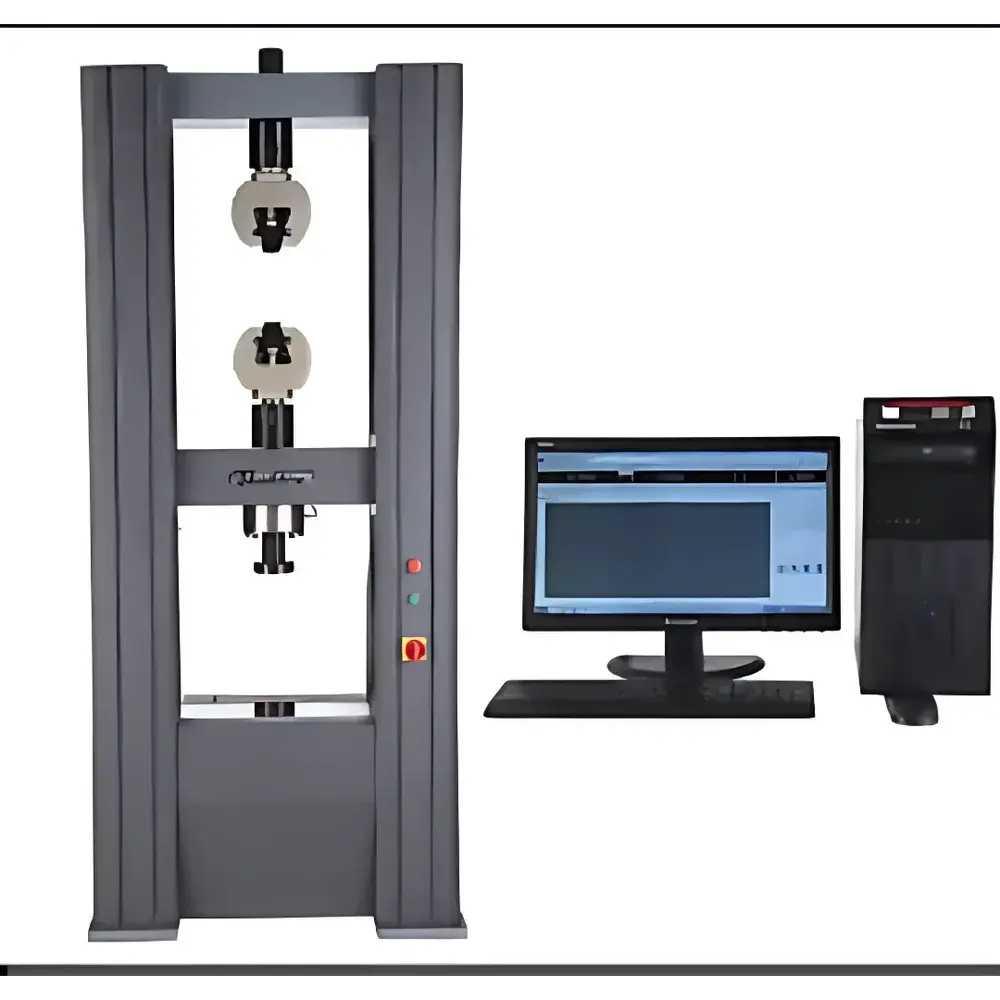
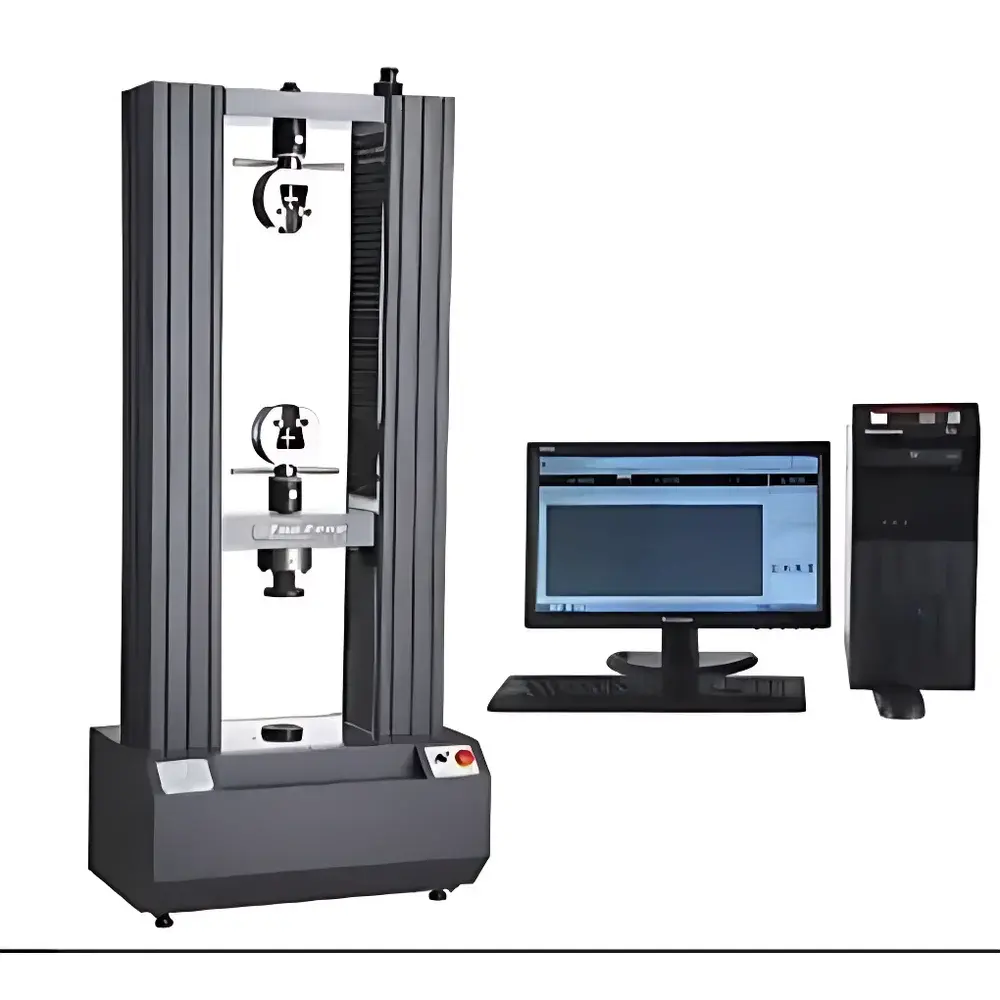
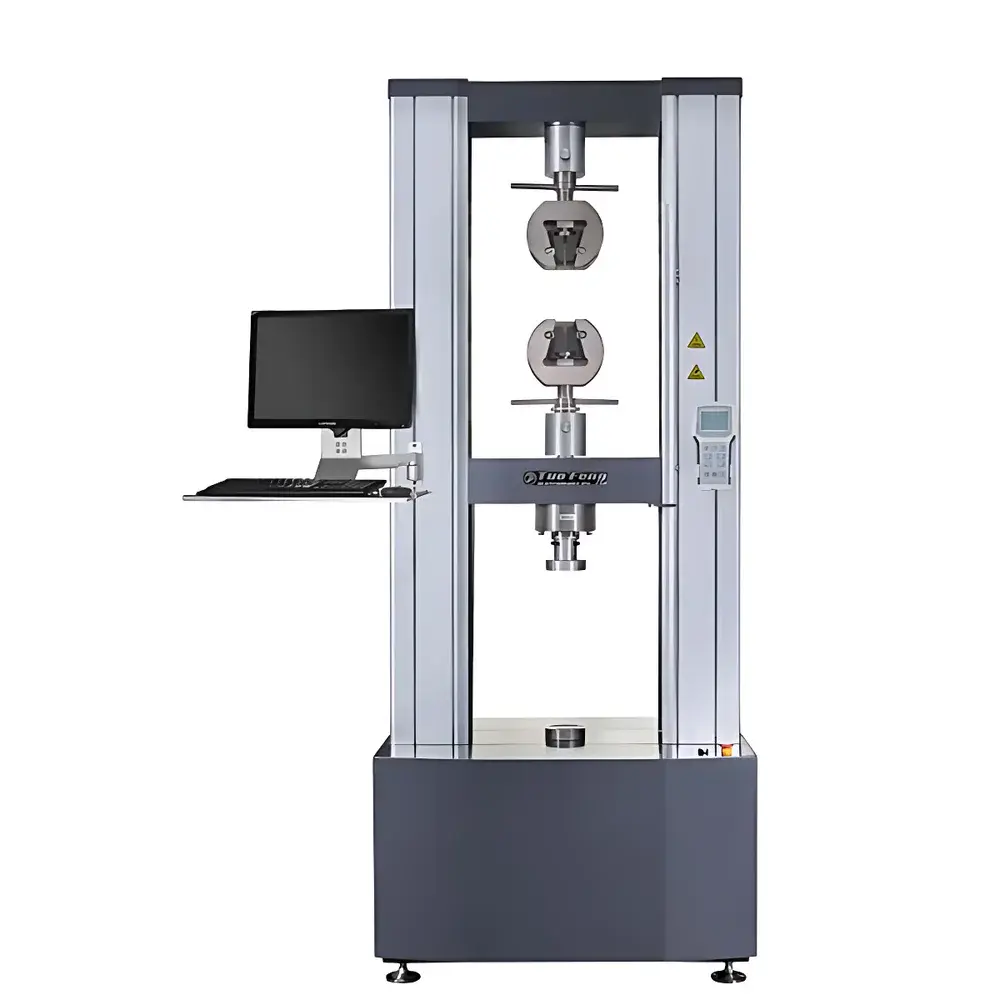
Tuofeng TFW-126 Microcomputer-Controlled Electromechanical Universal Testing Machine
| Brand | Tuofeng |
|---|---|
| Origin | Shanghai, China |
| Manufacturer Type | Direct Manufacturer |
| Product Category | Domestic |
| Model | TFW-126 |
| Instrument Type | Electromechanical Tensile Testing Machine |
| Maximum Test Load | 200 kN |
| Force Measurement Range | 0.2%–100% of Full Scale (FS) |
| Force Accuracy | ±0.5% of reading |
| Crosshead Travel | 1000 mm |
| Displacement Resolution | 0.001 mm |
| Control System | PC-based microcomputer with servo motor drive |
| Precision Class | Grade 0.5 per GB/T 16491-2008 |
| Force Resolution | 1 part in ±500,000 full-scale codes, single-range, constant resolution throughout |
| Speed Range | 0.001–500 mm/min (infinitely variable) |
| Displacement Measurement Accuracy | ±0.005% of reading |
| Strain Measurement | Optional extensometer or large-deformation sensor (±0.005% accuracy) |
| Safety Protection | Electronic limit switches, emergency stop, overload protection (10% above rated capacity) |
| Test Width | 600 mm (customizable) |
| Power Supply | 220 V AC, 3.0 kW |
| Net Weight | ~1500 kg |
| Compliance | GB/T 16491-2008, JJG 475-2008, ASTM E4, ASTM E8, ISO 6892-1, ISO 7500-1, DIN 51221, JIS Z 2241, BS EN ISO 6892-1 |
Overview
The Tuofeng TFW-126 Microcomputer-Controlled Electromechanical Universal Testing Machine is a high-precision, dual-column electromechanical system engineered for static mechanical property characterization of metallic, polymeric, composite, and ceramic materials. It operates on the principle of controlled displacement actuation via a precision ball-screw-driven crosshead, coupled with closed-loop servo control to maintain prescribed load, displacement, or strain rates during testing. Designed in strict accordance with GB/T 16491-2008 (equivalent to ISO 7500-1 Class 0.5) and verified per JJG 475-2008 metrological verification requirements, the TFW-126 delivers traceable force measurement across its full 200 kN capacity with ±0.5% accuracy and a minimum measurable force of 0.2% FS — enabling reliable evaluation of both high-strength structural alloys and low-force elastomeric specimens within a single platform.
Key Features
- Grade 0.5 force measurement accuracy certified per ISO 7500-1 and GB/T 16491-2008, with 1:500,000 internal force resolution and no range switching required
- High-rigidity dual-column frame with 600 mm effective test width and 1000 mm vertical travel, supporting standardized specimen geometries up to ASTM E8/E21 dimensions
- Imported AC servo motor paired with precision worm-gear reducer and preloaded ground ball screw for smooth, backlash-free motion control
- Multi-mode closed-loop control: force-controlled, displacement-controlled, and strain-controlled (with optional extensometer feedback)
- Dual-speed automatic crosshead positioning (fast/slow modes), programmable return-to-start, and integrated emergency stop with hardware-level cut-off
- Comprehensive safety architecture including electronic upper/lower limit switches, real-time overload monitoring (>110% FS), and mechanical torque-limiting protection
Sample Compatibility & Compliance
The TFW-126 accommodates tensile, compression, flexure, shear, tear, peel, and puncture testing through interchangeable fixtures — including wedge-action grips, compression platens, three- and four-point bending assemblies, and pneumatic or hydraulic clamping options (custom-configurable). It supports standard specimen geometries per ASTM E8 (tensile bars), ASTM D638 (plastics), ISO 6892-1 (metallic tensile), ISO 178 (flexural), ISO 37 (rubber tear), and ISO 8510-2 (peel adhesion). All test protocols are fully compliant with GLP-aligned data integrity requirements: audit trails, user access levels, electronic signatures, and 21 CFR Part 11–ready software architecture ensure suitability for regulated QA/QC environments in aerospace, medical device manufacturing, and automotive Tier-1 supply chains.
Software & Data Management
The embedded Windows-based testing software provides ISO/IEC 17025–compatible test sequence definition, real-time multi-curve visualization (load-time, load-displacement, stress-strain, strain-time), and automated parameter extraction — including ultimate tensile strength (UTS), yield strength (Rp0.2), Young’s modulus, elongation at break, compressive yield, flexural modulus, tear initiation/propagation forces, and peel adhesion energy. Units are freely convertible between SI, imperial, and metric systems; language support includes English, Simplified Chinese, Traditional Chinese, and German. Data export conforms to ASTM E1434 and ISO/IEC 17025 Annex A3: CSV, XML, and PDF report generation with embedded metadata (operator ID, timestamp, calibration certificate ID, environmental conditions). All raw data and analysis logs are stored with immutable timestamps and version-controlled backups.
Applications
This system serves as a primary mechanical characterization tool in R&D laboratories and production QA departments across sectors requiring standardized mechanical validation. In aerospace, it validates aluminum-lithium sheet formability and titanium alloy fastener tensile integrity per AMS specifications. In polymer processing, it quantifies melt strength of thermoplastic olefins under ASTM D1709 impact-tensile hybrid protocols. Automotive suppliers use it for crash-relevant component testing — e.g., seatbelt webbing elongation under dynamic preload, battery module housing compression per UN ECE R100. In construction materials, it performs concrete cylinder compression (ASTM C39), rebar tensile (ASTM A615), and geotextile grab tensile (ASTM D4632). Universities employ it for fundamental viscoelastic modeling using time-temperature superposition techniques enabled by precise low-speed creep testing (0.001 mm/min).
FAQ
What international standards does the TFW-126 support out-of-the-box?
It natively implements test methods per ASTM E4, E8, D638, D790, D412, ISO 6892-1, ISO 7500-1, ISO 178, ISO 37, and GB/T 228.1 — with configurable parameters matching each standard’s rate, tolerance, and reporting requirements.
Can the system be integrated into an existing LIMS or MES environment?
Yes — the software supports OPC UA and TCP/IP-based API interfaces for bidirectional data exchange with laboratory information management systems (LIMS) and manufacturing execution systems (MES), including sample ID synchronization and result auto-posting.
Is third-party calibration certification available?
Tuofeng provides factory calibration certificates traceable to NIM (National Institute of Metrology, China) and offers optional UKAS-accredited calibration services through authorized partners in EU and North America.
What is the warranty coverage and service response time?
Standard warranty is 24 months parts-and-labor, extendable to 60 months with annual maintenance contracts. On-site technical support is guaranteed within 72 business hours for critical failures in APAC, EMEA, and NAFTA regions.
Does the system meet FDA or ISO 13485 requirements for medical device testing?
Yes — when configured with 21 CFR Part 11–compliant software modules, electronic audit trail, role-based access control, and validated calibration procedures, it satisfies design verification and process validation requirements under ISO 13485:2016 and FDA QSR 820.



