
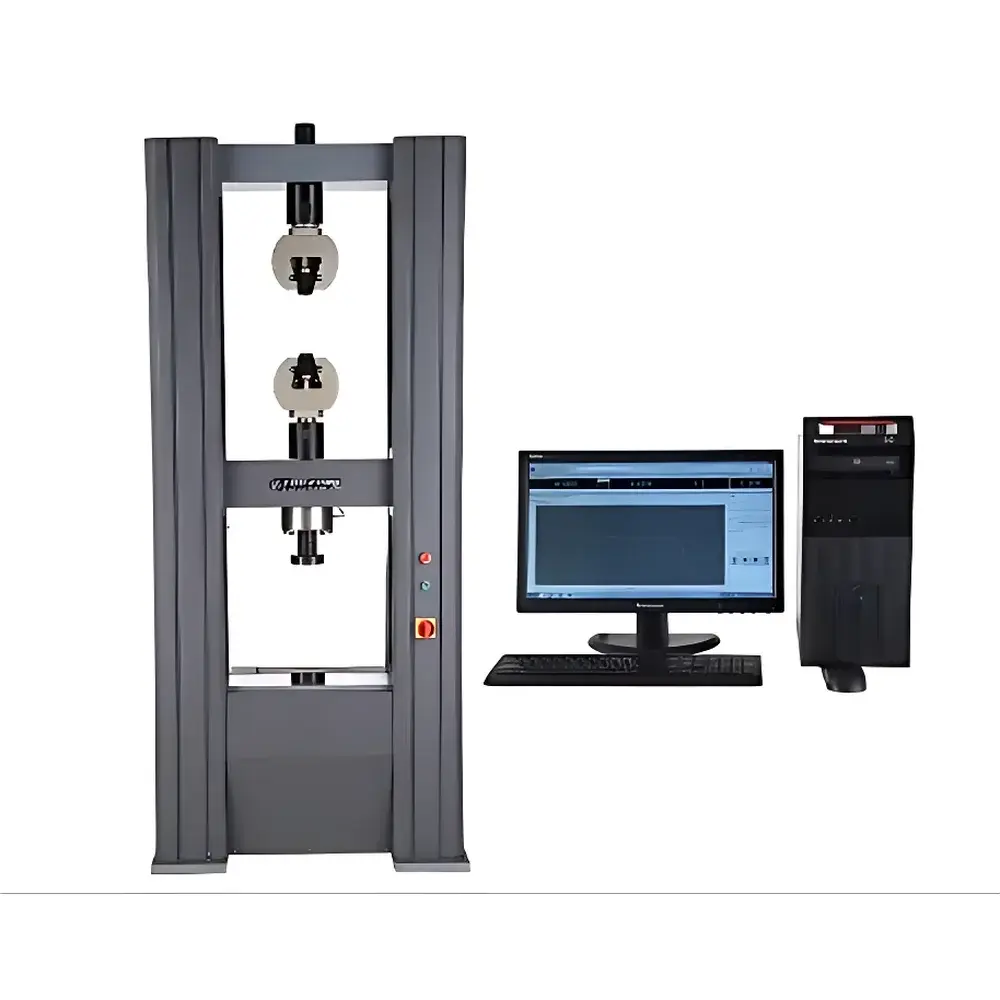
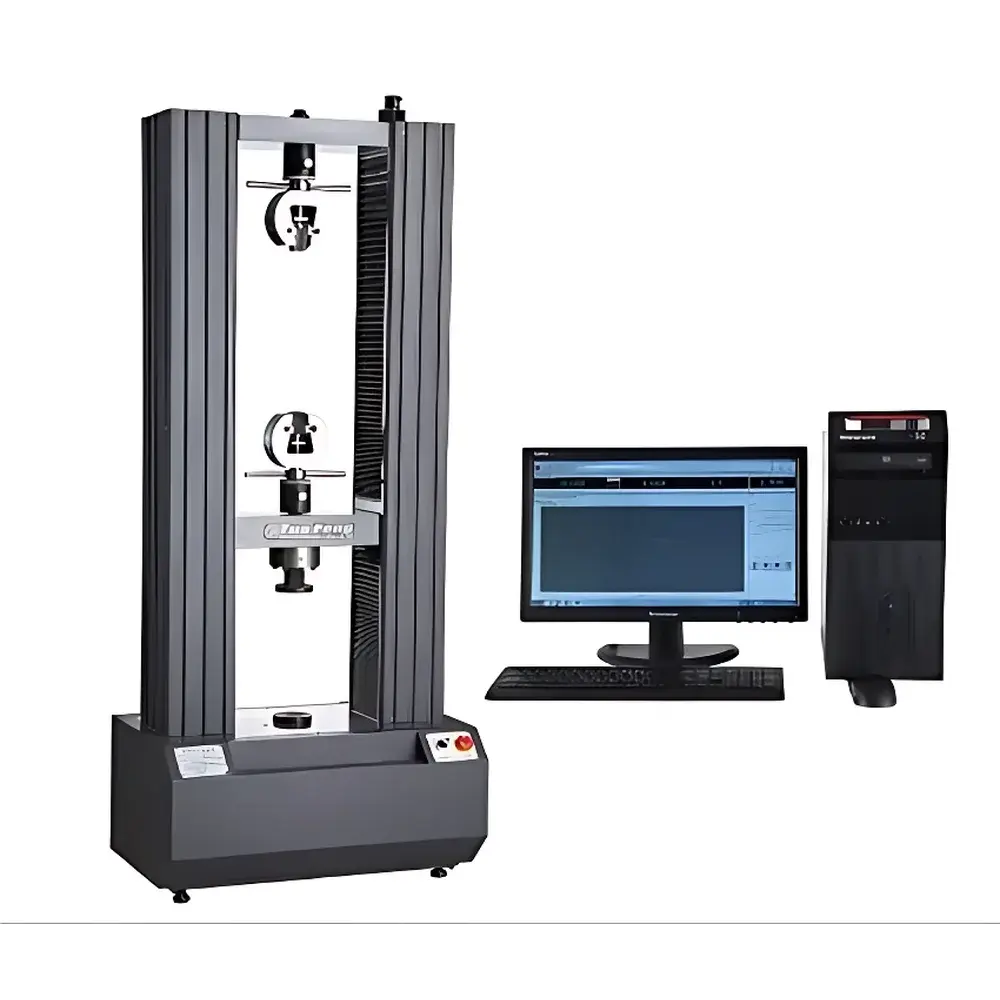
Tuofeng TFW-18 Dual-Column Microcomputer-Controlled Electronic Universal Testing Machine
| Brand | Tuofeng |
|---|---|
| Origin | Shanghai, China |
| Manufacturer Type | Direct Manufacturer |
| Model | TFW-18 |
| Instrument Type | Electromechanical Universal Testing Machine |
| Standards Compliance | GB/T 16491–2008, JJG 475–2008, ASTM E4, ISO 7500-1, DIN 51221, JIS B 7721 |
| Max Test Load | 18 kN |
| Accuracy Class | 0.5 |
| Effective Force Range | 0.2%–100% of Full Scale |
| Force Measurement Accuracy | ±0.005% of reading |
| Load Cell Resolution | 1 part in ±500,000 full-scale codes (single-range, no switching) |
| Drive System | Imported servo motor with precision worm-gear reducer |
| Lead Screw | High-precision preloaded ball screw |
| Effective Test Width | 400 mm (customizable up to 600 mm) |
| Stroke | 800 mm (extendable) |
| Speed Range | 0.001–500 mm/min (infinitely variable, closed-loop controlled) |
| Displacement Measurement | Optical encoder |
| Displacement Accuracy | ±0.005% of reading |
| Strain Measurement | Optional extensometer (clip-on or video-based) or large-deformation sensor |
| Strain Accuracy | ±0.005% of reading |
| Safety Protection | Dual electronic limit switches, emergency stop button, overload cutoff (>110% FS), mechanical crash prevention |
| Crosshead Control | Dual-speed (fast/slow) motorized adjustment with jog function |
| Return Function | Programmable high-speed return to initial position post-test |
| Fixture Customization | Application-specific grips and fixtures available for tensile, compression, bend, shear, tear, peel, burst, and adhesion testing |
| Power Supply | 220 V AC, 1.0 kW |
| Dimensions (W×D×H) | 780 × 680 × 1780 mm |
| Weight | ~300 kg |
Overview
The Tuofeng TFW-18 is a dual-column, microcomputer-controlled electromechanical universal testing machine engineered for high-precision static mechanical property evaluation of metallic, polymeric, composite, and ceramic materials. Based on the fundamental principle of controlled uniaxial force application via servo-driven displacement actuation, the system delivers traceable, repeatable load–displacement data under ISO 7500-1 and ASTM E4-compliant calibration protocols. Its rigid frame architecture—featuring preloaded ball screws, low-backlash gear reduction, and real-time closed-loop PID control—ensures minimal compliance error and exceptional stability across the full speed range (0.001–500 mm/min). Designed to meet the structural integrity verification requirements of R&D laboratories, quality control departments, and third-party certification bodies, the TFW-18 supports full-cycle mechanical characterization including tensile, compressive, flexural, shear, tear, peel, and puncture testing—all within a single platform.
Key Features
- Dual-column steel frame with reinforced base and crosshead for torsional rigidity and long-term dimensional stability
- 0.5-class accuracy per GB/T 16491–2008 and ISO 7500-1, validated by certified load cell calibration certificates
- Single-range, high-resolution load measurement (1:500,000 internal resolution) eliminating range-switching artifacts
- Optical encoder-based displacement feedback with ±0.005% linearity error, independent of screw pitch or thermal drift
- Programmable dual-speed crosshead movement (jog + auto-return) with configurable acceleration/deceleration profiles
- Integrated safety suite: hardware-limit switches, emergency stop circuitry, real-time overload detection (>110% FS), and software-enforced test boundaries
- Modular fixture interface accommodating standardized wedge-action grips, compression platens, bend fixtures, and custom-designed tooling
Sample Compatibility & Compliance
The TFW-18 accommodates specimens ranging from thin polymer films (≥0.05 mm thick) to structural metal coupons (up to 25 mm thick × 40 mm wide), with optional extended-width frames supporting composites and laminates. It fully supports standardized specimen geometries per ASTM D638 (tensile plastics), ASTM D3039 (composite tension), ISO 6892-1 (metal tensile), ASTM C39 (concrete compression), and ISO 179 (impact-modified flexure). All hardware and firmware comply with GB/T 16491–2008 manufacturing standards and JJG 475–2008 metrological verification requirements. The system is designed for GLP-aligned environments: audit trails, user-level access control, electronic signatures, and raw data immutability are supported through optional 21 CFR Part 11–compliant software modules.
Software & Data Management
The Windows-native testing software provides deterministic real-time control over six primary test modes: constant rate of extension (CRE), constant load ramp, constant strain rate, load hold, displacement hold, and stress relaxation. Multi-curve overlay, differential analysis, and statistical comparison (max/min/mean/std dev) are natively supported. Data export is compliant with ASTM E1434 (tab-delimited ASCII) and ISO/IEC 17025 traceability requirements. All raw analog inputs (load, displacement, extensometer voltage) are time-stamped at ≥1 kHz sampling and stored losslessly. The software supports multi-language UI (English, Simplified/Traditional Chinese), unit conversion (N/kN/lbf, mm/in, MPa/psi), and customizable report templates—including PDF generation with embedded digital signatures and calibration metadata. Firmware and software updates are delivered via secure HTTPS channel with SHA-256 integrity verification.
Applications
- Mechanical validation of aerospace-grade aluminum alloys (e.g., 7075-T6) per AMS 4027 and MIL-HDBK-5J
- Tensile property mapping of thermoplastic elastomers used in medical tubing (ISO 5840-3, USP )
- Compression testing of sintered powder metallurgy components per MPIF Standard 35
- Peel strength assessment of pressure-sensitive adhesives per ASTM D903 and PSTC-107
- Bend modulus determination of fiber-reinforced polymer laminates (ASTM D7264)
- Quality conformance testing of extruded PVC profiles per ASTM D638 and EN 1027
- Research-grade cyclic loading studies with programmable dwell periods and reversal points
FAQ
Does the TFW-18 support ASTM E8/E8M metallic tensile testing?
Yes—the system meets all geometric, alignment, and control requirements specified in ASTM E8/E8M when equipped with appropriate grips and extensometry.
Can I integrate an external environmental chamber?
Yes—standardized mounting interfaces and analog/digital I/O ports enable seamless synchronization with temperature/humidity chambers (−70°C to +300°C) and corrosion test enclosures.
Is raw data export compatible with MATLAB or Python analysis workflows?
Yes—ASCII (.txt) and CSV exports include time-synchronized columns for load, displacement, strain, and user-defined channels; native Python libraries (e.g., pandas, numpy) are routinely used for post-processing.
What documentation is provided for regulatory audits?
Each unit ships with Factory Calibration Certificate (traceable to NIM China), Installation Qualification (IQ) checklist, Operational Qualification (OQ) protocol, and a complete software validation package upon request.
How often does the system require recalibration?
Per ISO/IEC 17025 recommendations, annual verification against certified reference standards is advised; load cell and encoder calibration intervals may be extended based on usage logs and intermediate checks.



