
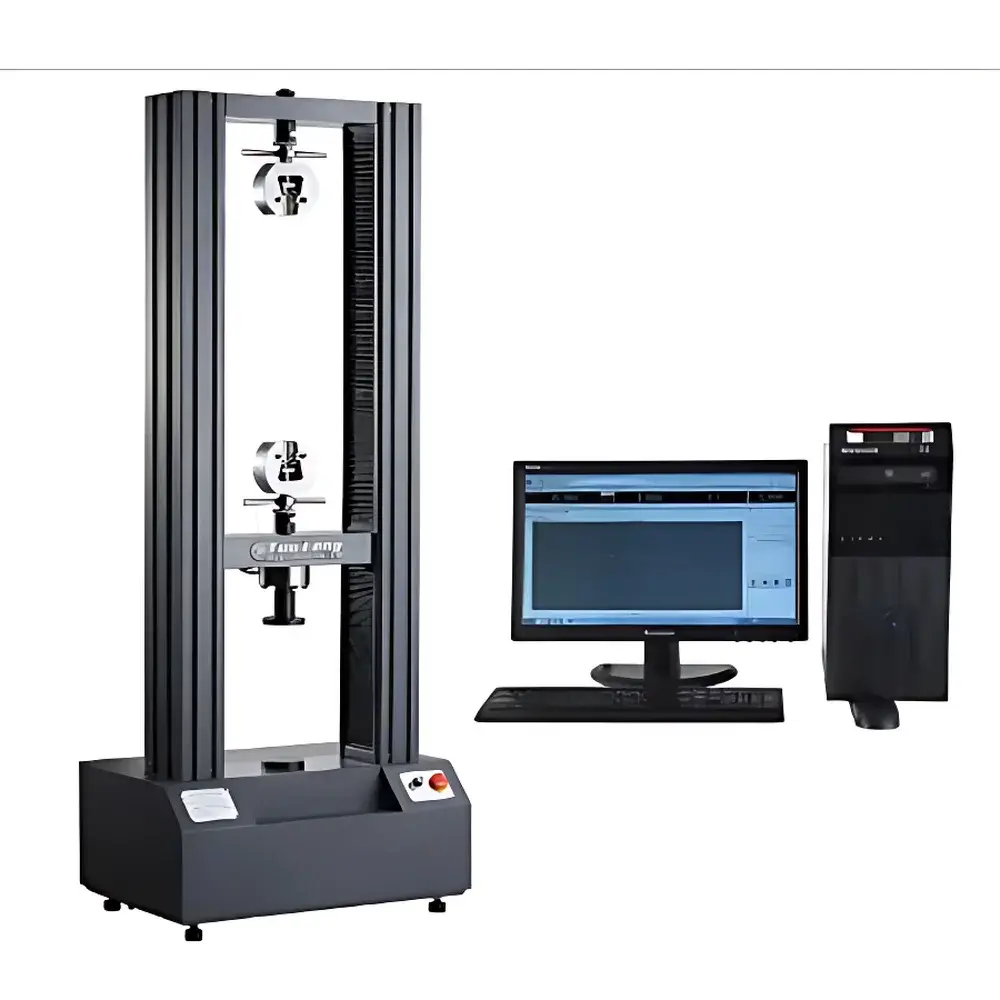
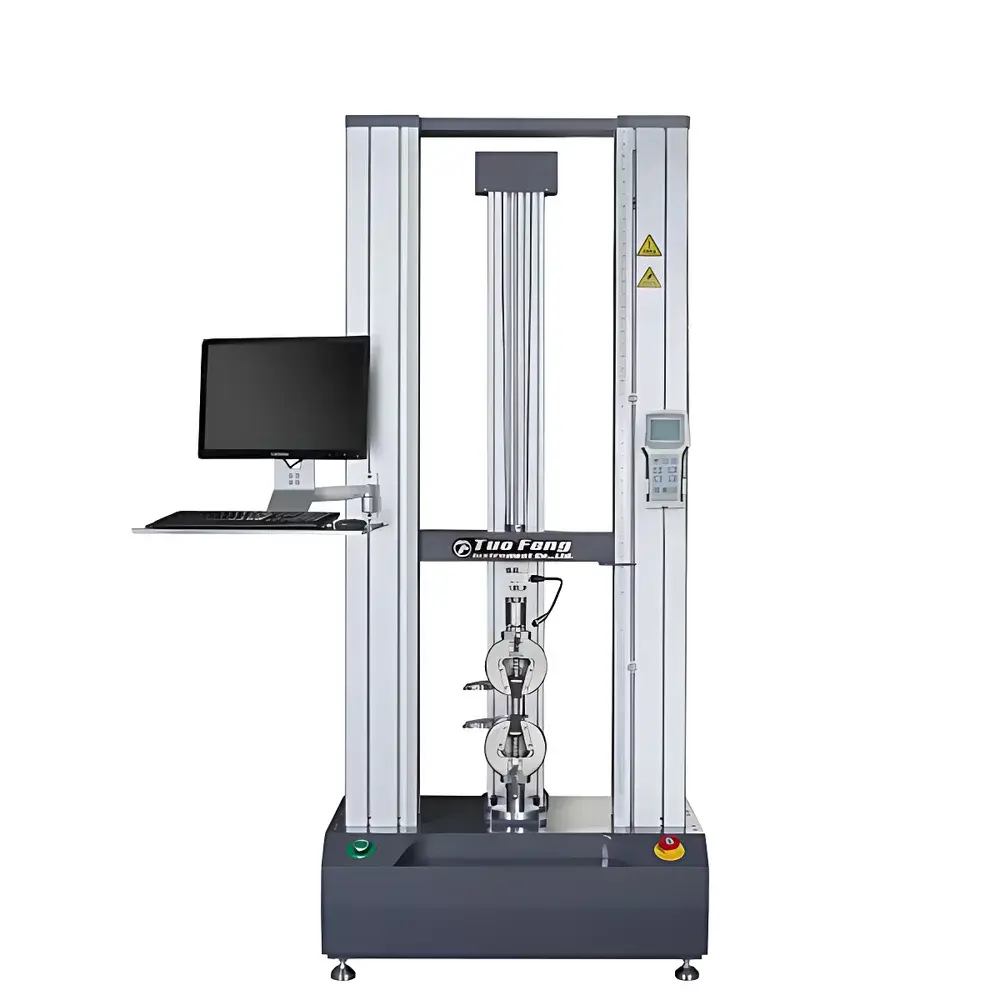
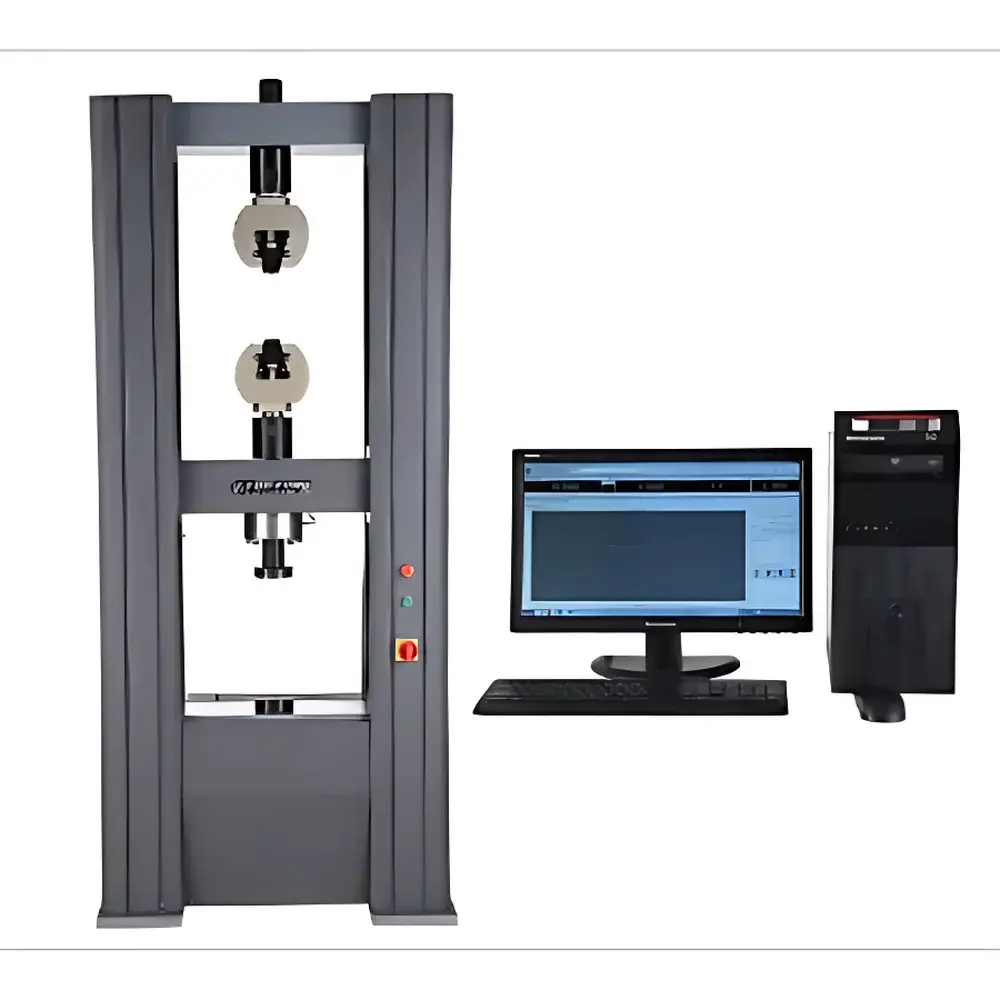
Tuofeng TFW-184 Microcomputer-Controlled Electronic Universal Testing Machine
| Brand | Tuofeng |
|---|---|
| Origin | Shanghai, China |
| Manufacturer Type | Direct Manufacturer |
| Instrument Type | Electronic Universal Testing Machine |
| Model | TFW-184 |
| Compliance | GB/T 16491-2008, JJG 475-2008, ASTM E4, ISO 7500-1, DIN 51221, JIS B 7721 |
| Max Test Load | 184 kN (customizable from 5 kN to 200 kN) |
| Accuracy Class | 0.5 |
| Effective Force Range | 0.2–100% of full scale |
| Force Measurement Uncertainty | ±0.005% of reading |
| Resolution | 1 part in 500,000 full-scale codes (fixed resolution, no range switching) |
| Drive System | Imported servo motor with precision worm-gear reducer |
| Lead Screw | High-precision preloaded ball screw |
| Effective Test Width | 600 mm (expandable) |
| Stroke | 800 mm (extendable) |
| Speed Range | 0.001–500 mm/min (infinitely variable, closed-loop controlled) |
| Displacement Measurement | Optical encoder, accuracy ±0.005% of reading |
| Strain Measurement | Optional extensometer (clip-on or non-contact) or large-deformation system, accuracy ±0.005% of reading |
| Safety Protection | Dual electronic limit switches, emergency stop button, overload protection (>110% FS), automatic return on test completion |
| Crosshead Control | Dual-speed (fast/slow) motorized adjustment with jog functionality |
| Software | Windows-based, multi-language (English/Chinese Traditional/Simplified), compliant with FDA 21 CFR Part 11 audit trail and electronic signature requirements for GLP/GMP environments |
| Data Output | Real-time stress–strain, load–displacement, load–time, displacement–time curves |
Overview
The Tuofeng TFW-184 Microcomputer-Controlled Electronic Universal Testing Machine is a high-precision, dual-column electromechanical system engineered for static mechanical property characterization of metallic, polymeric, ceramic, composite, and elastomeric materials. Based on the fundamental principles of uniaxial force application and displacement-controlled loading, the system adheres to standardized test methodologies defined in ISO 7500-1 (static calibration), ASTM E4 (force verification), and GB/T 16491-2008 (Chinese national standard for electronic UTM design and performance). Its rigid frame architecture—constructed from high-stiffness steel alloys with optimized column geometry—minimizes parasitic deflection and ensures axial alignment within ±0.01 mm over full stroke. The integrated servo-driven actuation system delivers repeatable load application across the full dynamic range, enabling reliable measurement of both quasi-static and low-rate dynamic mechanical responses under controlled environmental conditions.
Key Features
- Class 0.5 force accuracy per ISO 7500-1, verified traceably to national metrological standards
- Fixed-resolution load cell with 500,000-count internal ADC—no range switching required, eliminating zero drift and hysteresis errors during multi-range testing
- Precision preloaded ball screw transmission with <0.005 mm backlash, coupled to an imported industrial servo motor and low-backlash worm-gear reducer for smooth, silent operation and long-term repeatability
- Dual-speed crosshead positioning (fast approach + fine-adjustment jog mode) with programmable return-to-start function post-test
- Comprehensive safety architecture: hardware-based emergency stop circuit, dual independent electronic travel limits, mechanical overload cutoff (>110% FS), and software-enforced operational boundaries
- Modular extensometry support—including ASTM E83-compliant clip-on extensometers and non-contact video-based strain systems—for accurate strain measurement across small- and large-deformation regimes
Sample Compatibility & Compliance
The TFW-184 accommodates specimens ranging from thin films (<0.1 mm thick) to structural beams (up to 200 mm wide × 800 mm long), with customizable fixtures for tension, compression, three/four-point bending, shear, peel, tear, and puncture testing. Standard configurations include wedge-action tensile grips, compression platens, and bend supports; specialized tooling (e.g., ISO 6892-1 dog-bone fixtures, ASTM D638 Type I dumbbells, or ISO 179 Charpy impact adapters) is available upon request. All test procedures are fully compatible with international regulatory frameworks: data integrity meets FDA 21 CFR Part 11 requirements via time-stamped audit trails, user authentication, and immutable electronic signatures; routine calibration and verification align with JJG 475-2008 (China) and ISO 9513 (extensometer calibration); reporting templates support direct export to LIMS and ERP systems.
Software & Data Management
Tuofeng TestSuite™ v5.2 is a Windows-native, 64-bit application supporting real-time control and post-processing under GLP/GMP-compliant workflows. It enables multiple control modes—including load-controlled, displacement-controlled, strain-controlled, and hold-step sequencing—with user-defined ramp rates, dwell times, and conditional triggers. Raw data streams (load, displacement, strain) are acquired at ≥1 kHz sampling rate and stored in vendor-neutral .csv and .tdms formats. Curve overlay analysis allows comparative evaluation of up to 32 datasets; statistical summaries (mean, SD, CV%, min/max) are auto-generated per batch. Reports comply with ISO/IEC 17025 documentation standards and include instrument ID, operator ID, calibration dates, environmental metadata, and uncertainty budgets. Remote diagnostics and firmware updates are supported via secure TLS-encrypted connection.
Applications
This system serves as a primary mechanical characterization platform across R&D, QA/QC, and certification laboratories. In aerospace, it validates titanium alloy tensile ductility per AMS 2304 and composite interlaminar shear strength per ASTM D2344. In medical device manufacturing, it performs ISO 5832-3-compliant fatigue pre-screening of orthopedic implant materials. Automotive suppliers use it for rubber compound tear resistance (ISO 34-1), brake pad compressibility (SAE J661), and battery electrode binder adhesion (ASTM D4541). Academic users apply it to novel hydrogel mechanics (dynamic swelling–loading coupling), while construction labs assess rebar yield behavior (GB/T 1499.2) and geosynthetic tensile capacity (ISO 10319). Its modularity supports emerging needs such as thermomechanical cycling (with environmental chamber integration) and digital image correlation (DIC) synchronization.
FAQ
What international standards does the TFW-184 support out-of-the-box?
The system includes preconfigured test methods for ASTM E8/E9/E21, ISO 6892-1/15630-1/527-1, GB/T 228.1, DIN 50125, and JIS Z 2241, with editable parameters to accommodate lab-specific deviations.
Is the software validated for regulated environments?
Yes—TestSuite™ v5.2 is delivered with IQ/OQ documentation packages, 21 CFR Part 11 configuration files, and a built-in electronic signature workflow compliant with Annex 11 and ALCOA+ data integrity principles.
Can the machine be integrated with third-party environmental chambers or DIC systems?
Absolutely—the controller provides TTL-level trigger I/O, analog voltage outputs (±10 V), and Ethernet-based API access for synchronized multi-sensor acquisition and closed-loop thermal–mechanical testing.
What maintenance intervals are recommended for long-term accuracy retention?
Force sensor recalibration every 12 months (or after 10,000 cycles), ball screw lubrication every 6 months, and annual mechanical alignment verification using certified gauge blocks and optical alignment tools.
Does Tuofeng provide installation qualification (IQ) and operational qualification (OQ) services?
Yes—factory-trained field engineers perform on-site IQ/OQ with NIST-traceable standards, deliver signed reports, and train designated lab personnel on SOP execution and deviation handling protocols.
Related Products



