
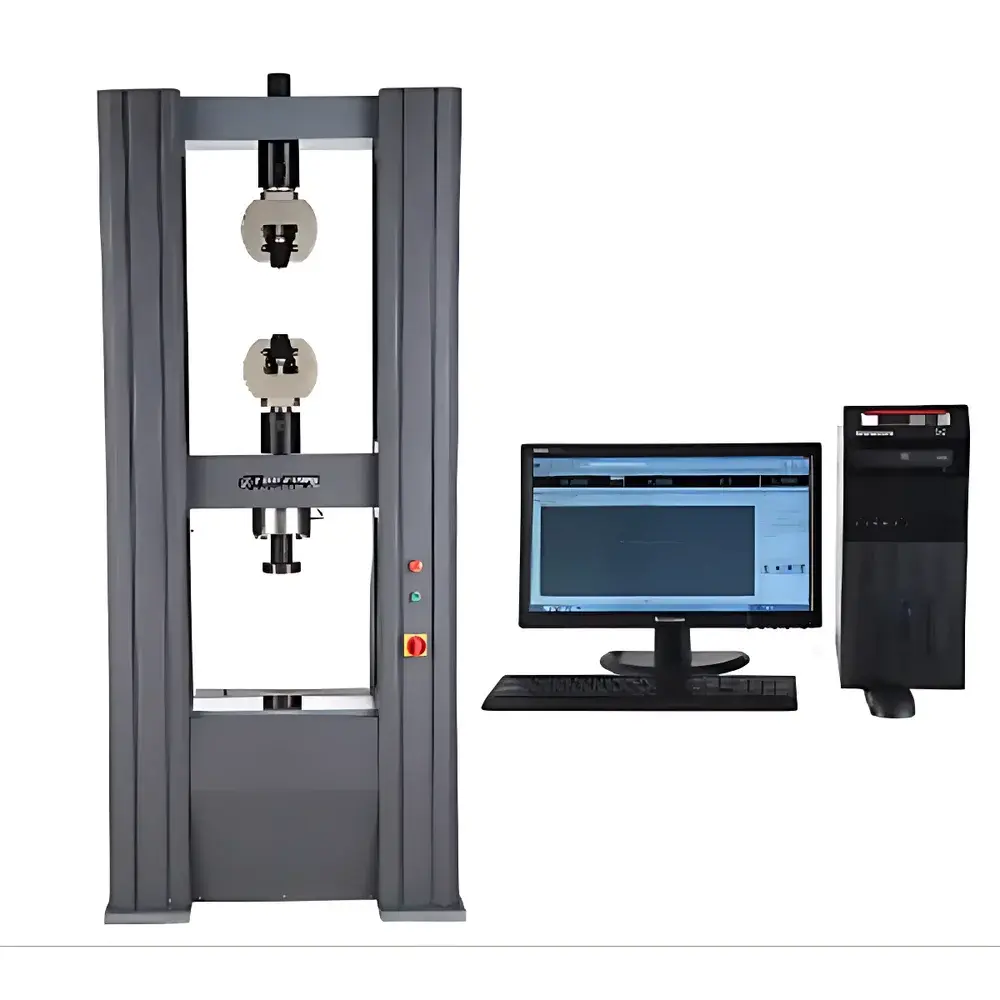
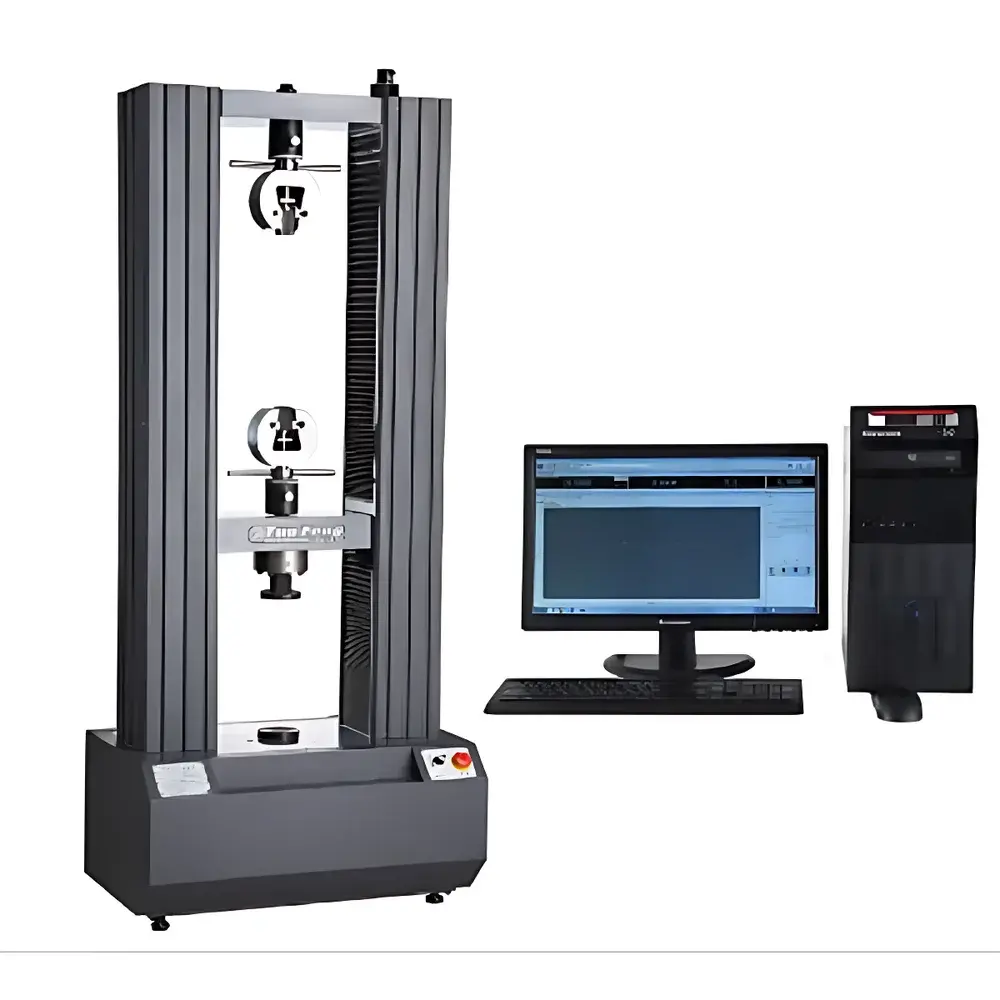
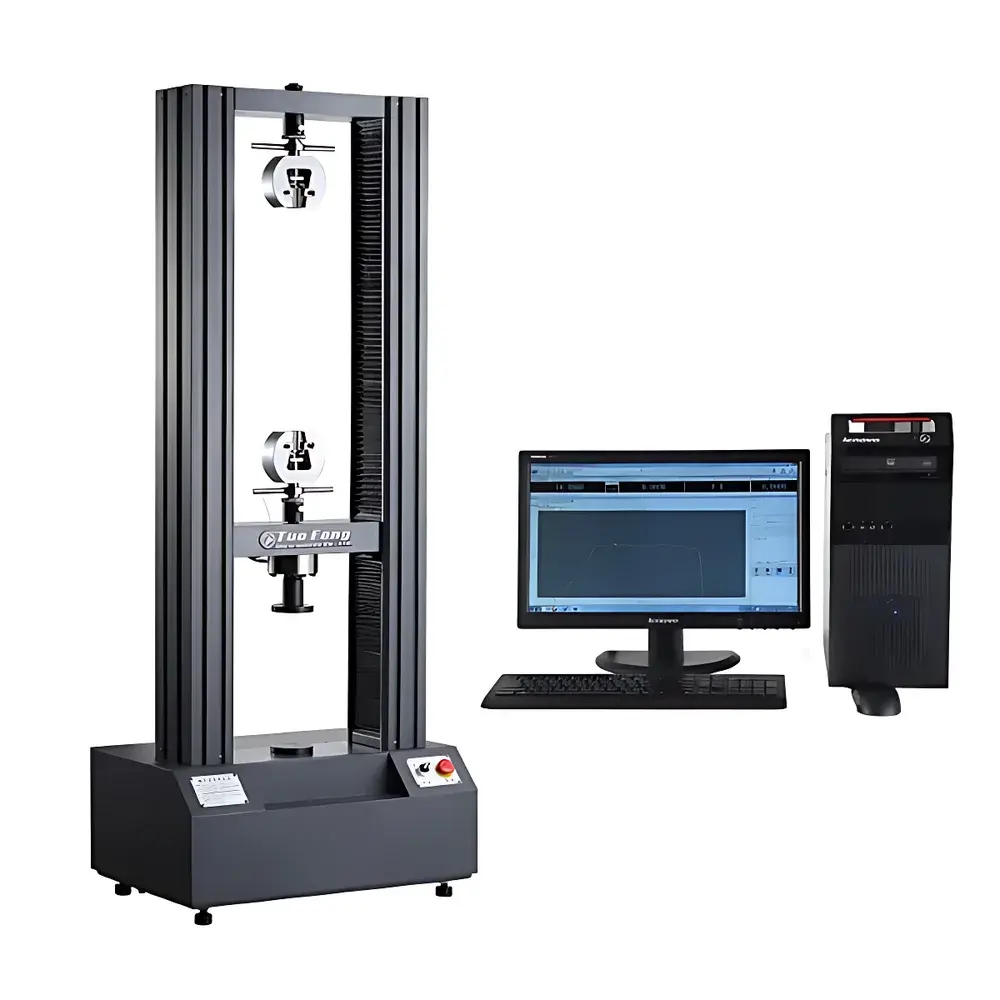
Tuofeng TFW-227 Microcomputer-Controlled Universal Testing Machine for Solder Joint Pull and Shear Strength Testing
| Brand | Tuofeng |
|---|---|
| Origin | Shanghai, China |
| Manufacturer Type | Direct Manufacturer |
| Instrument Type | Electromechanical Universal Testing Machine |
| Model | TFW-227 |
| Max Test Load | 20 kN |
| Accuracy Class | 0.5 |
| Effective Force Range | 0.2–100% of Full Scale |
| Force Measurement Accuracy | ±0.005% of Reading |
| Force Resolution | 1/500,000 Full Scale (Fixed, No Range Switching) |
| Drive System | Imported Servo Motor with Worm Gear Reducer |
| Lead Screw | High-Precision Ball Screw |
| Effective Test Width | 600 mm (Customizable) |
| Stroke | 800 mm (Extendable) |
| Speed Range | 0.001–500 mm/min (Infinitely Variable) |
| Displacement Measurement | Optical Encoder |
| Displacement Accuracy | ±0.005% of Reading |
| Strain Measurement | Optional Extensometer or Large-Deformation Gauge |
| Safety Protection | Electronic Limit Switches, Emergency Stop, Overload Protection (110% FS), Dual-Speed Motorized Crosshead Control |
| Power Supply | 220 V, 1.0 kW |
| Approx. Weight | 450 kg |
| Compliance | GB/T 16491–2008, JJG 475–2008, ASTM E4, ISO 7500-1, DIN 51221 |
Overview
The Tuofeng TFW-227 is a high-precision, microcomputer-controlled electromechanical universal testing machine engineered specifically for quantitative mechanical evaluation of solder joints in electronic interconnects, printed circuit board assemblies (PCBAs), and microelectronic packaging. It operates on the principle of controlled axial force application—either tensile (pull) or shear (lateral)—to measure bond integrity, interfacial strength, and failure mode characteristics under standardized loading conditions. Unlike general-purpose tensile testers, the TFW-227 integrates dedicated fixturing, sub-millimeter crosshead positioning repeatability, and real-time load-displacement synchronization to meet the stringent metrological requirements of IPC-J-STD-001, IPC-9701, JEDEC JESD22-B116 (solder bump shear), and MIL-STD-883 Method 2011. Its rigid C-frame architecture, zero-backlash ball screw transmission, and closed-loop servo control ensure minimal compliance error and high reproducibility across repeated cycles—even at low-force ranges critical for fine-pitch (<0.4 mm pitch) solder joint assessment.
Key Features
- 0.5-class accuracy certified per GB/T 16491–2008 and ISO 7500-1, validated by national metrology institutes
- Force resolution of 1 part in 500,000 full scale, enabling reliable measurement down to 0.04 N at 20 kN capacity
- Dual-speed motorized crosshead with programmable acceleration/deceleration profiles for precise approach-to-contact control
- Integrated overload protection system that halts motion at 110% of rated load and logs event timestamp and peak force
- Modular fixture interface compatible with ISO 26203-compliant solder joint test jigs—including wedge-type pull hooks, shear rams, and chip-level lift fixtures
- Real-time digital filtering and anti-aliasing algorithms applied to load and displacement signals prior to A/D conversion
- Self-calibrating load cell with temperature-compensated strain gauge bridge and factory traceable calibration certificate
Sample Compatibility & Compliance
The TFW-227 supports mechanical testing of solder joints on diverse substrates including FR-4 PCBs, ceramic packages (e.g., QFN, BGA, CSP), flex circuits, and wire-bonded die. Standard configurations accommodate joint diameters from 50 µm to 1.2 mm and standoff heights up to 250 µm. The system complies with international standards governing solder reliability validation: IPC-TM-650 2.4.42 (ball shear), IPC-TM-650 2.4.43 (chip pull), JEDEC JESD22-B117 (board-level drop test preconditioning), and ASTM F1767 (microelectronics package pull testing). All hardware and firmware conform to electromagnetic compatibility (EMC) requirements per IEC 61326-1 and safety directives under IEC 61010-1. Calibration documentation satisfies GLP/GMP audit trails per FDA 21 CFR Part 11 when paired with optional electronic signature and audit log modules.
Software & Data Management
The Windows-based Tuofeng TestSuite v4.2 provides full traceability and regulatory readiness. It supports ASTM E4-compliant test method templates, automatic calculation of shear strength (MPa), pull strength (cN), and failure classification (cohesive, adhesive, intermetallic fracture). Raw data streams are recorded at ≥1 kHz sampling rate with synchronized timestamps, and all parameters—including environmental temperature (via optional sensor input), crosshead position, and load—are stored in HDF5 format for long-term archival. The software includes built-in statistical process control (SPC) tools: X-bar/R charts, Cp/Cpk analysis, and Weibull distribution fitting for life prediction modeling. Export options include CSV, XML, PDF reports with embedded digital signatures, and direct integration with LIMS via ODBC. Audit trails record user login, parameter changes, calibration events, and report generation—all compliant with ISO/IEC 17025 clause 7.7.
Applications
- Qualification and process monitoring of reflow soldering profiles for lead-free (SAC305, SN100C) and high-reliability (AuSn, InAg) alloys
- Failure analysis of thermally cycled or mechanically shocked assemblies per JEDEC JESD22-A104
- Validation of underfill adhesion strength in flip-chip and 2.5D/3D IC packaging
- Comparative evaluation of solder paste rheology impact on joint formation integrity
- Research into intermetallic compound (IMC) growth kinetics using accelerated aging + mechanical interrogation
- Supplier qualification per automotive AEC-Q200 and aerospace AS9100 requirements
FAQ
Does the TFW-227 support automated batch testing for high-volume production environments?
Yes—via script-driven test sequences, barcode-triggered sample ID logging, and pass/fail threshold auto-judgment with configurable tolerance bands.
Can the system be integrated with existing MES or ERP platforms?
Yes—through RESTful API endpoints and OPC UA server support for bidirectional data exchange with Siemens Opcenter, Rockwell FactoryTalk, or custom manufacturing execution systems.
Is third-party calibration certification available?
Yes—Tuofeng partners with CNAS-accredited laboratories (e.g., SGS, BV, TÜV Rheinland) to provide ISO/IEC 17025-compliant calibration certificates with uncertainty budgets.
What is the recommended maintenance interval for the servo drive and load cell?
Annual verification of load cell linearity and crosshead alignment is advised; preventive maintenance includes grease replenishment of ball screws every 2,000 operating hours.
Are custom fixtures for non-standard package types (e.g., wafer-level CSP) supported?
Yes—Tuofeng’s engineering team provides CAD-based fixture design services and rapid prototyping using CNC-machined aluminum and hardened steel components.



