
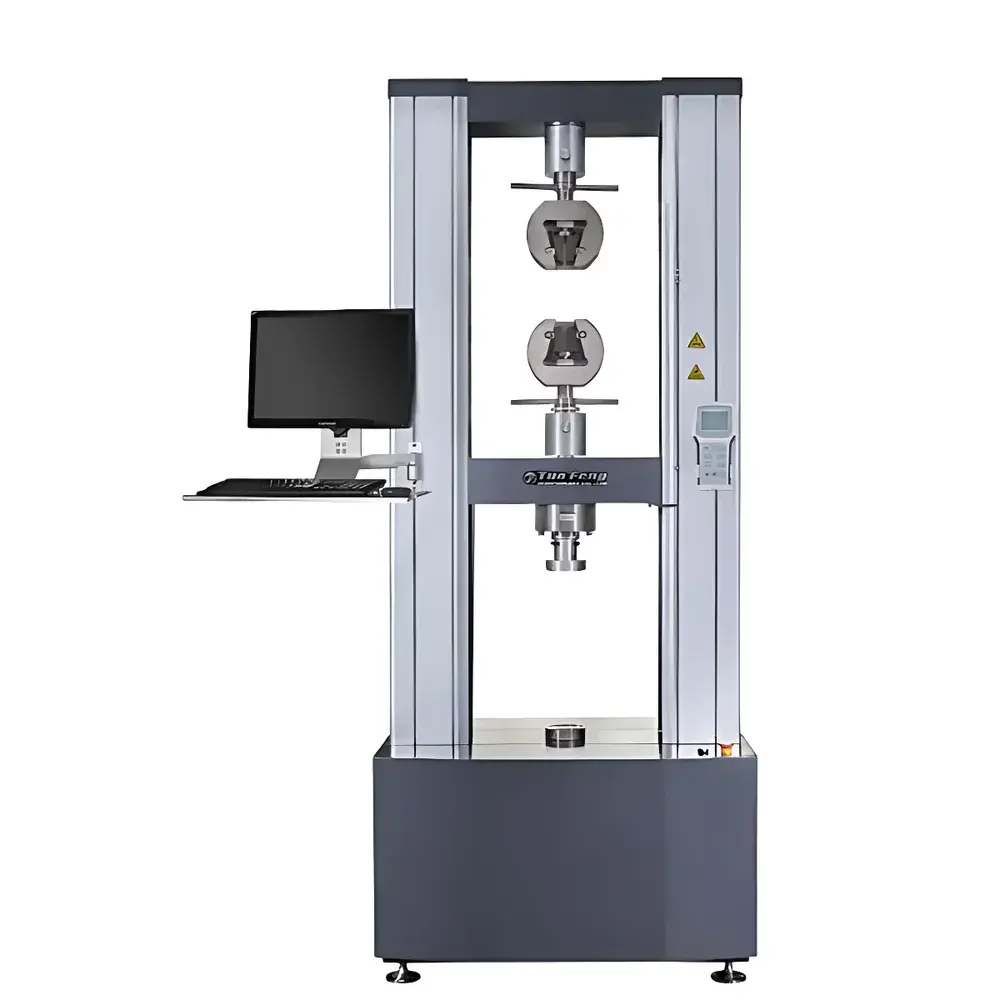
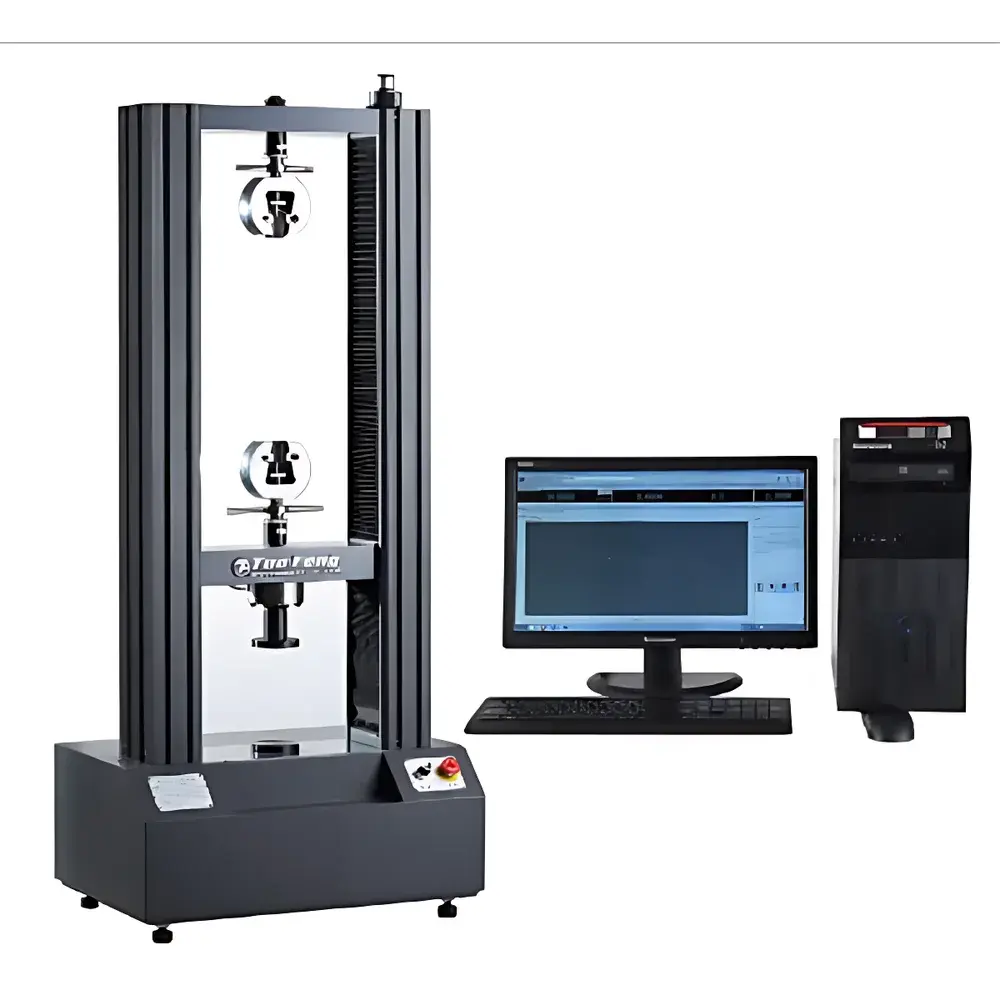
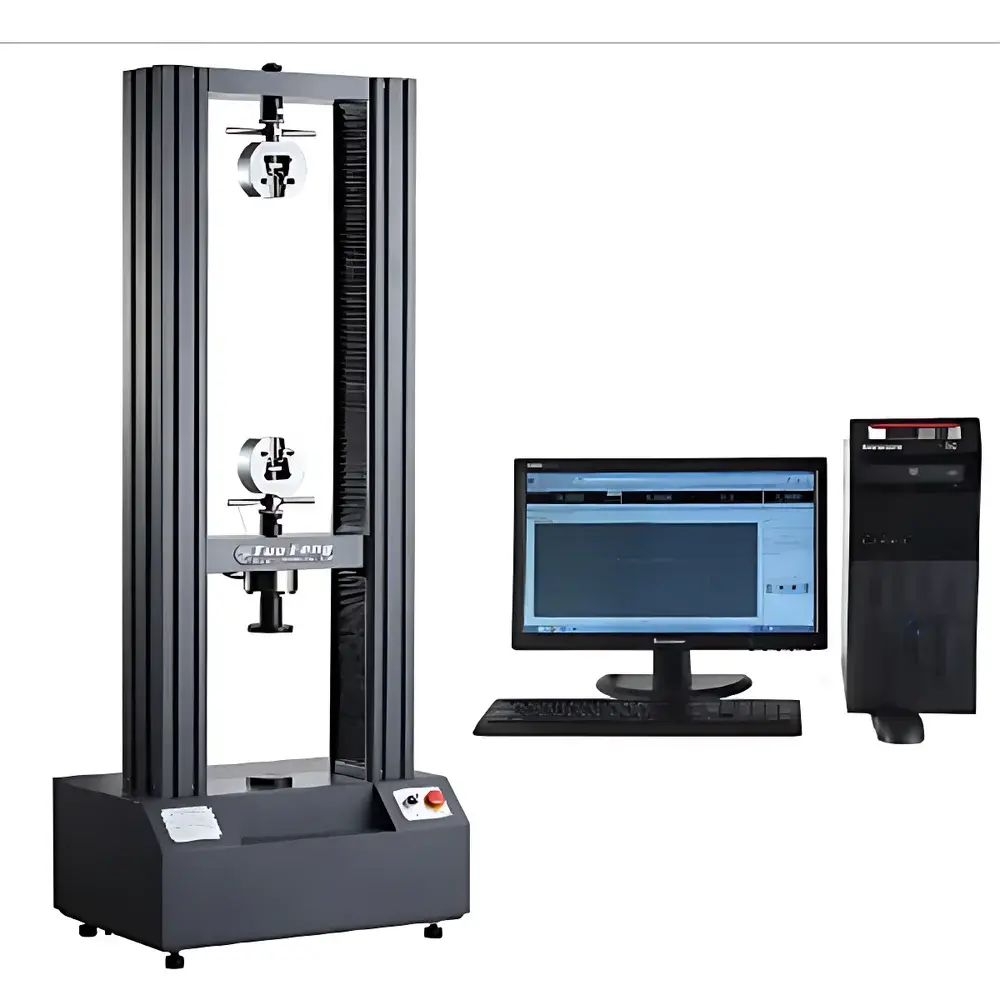
Tuofeng TFW-299 Advanced Microcomputer-Controlled Universal Testing Machine
| Brand | Tuofeng |
|---|---|
| Origin | Shanghai, China |
| Manufacturer Type | Direct Manufacturer |
| Instrument Type | Electromechanical Universal Testing Machine |
| Maximum Load Capacity | 300 kN |
| Load Accuracy | ±0.5% |
| Force Measurement Range | 0.2–100% of full scale |
| Force Resolution | 1 part in 500,000 (full-scale, unsegmented) |
| Test Speed Range | 0.001–500 mm/min (infinitely variable) |
| Crosshead Travel | 800 mm (customizable) |
| Effective Test Width | 400–600 mm (configurable) |
| Displacement Accuracy | ±0.005% of reading |
| Strain Measurement | Optional extensometer or large-deformation sensor (±0.005% accuracy) |
| Compliance | GB/T 16491-2008, JJG 475-2008, ASTM E4, ASTM E8, ISO 6892-1, ISO 7500-1, DIN 51221, JIS Z2241, BS EN 10002-1 |
Overview
The Tuofeng TFW-299 is a high-precision, microcomputer-controlled electromechanical universal testing machine engineered for static mechanical property characterization of metallic, polymeric, ceramic, composite, and elastomeric materials. It operates on the principle of controlled axial force application via a servo-driven ball-screw actuation system, enabling precise displacement- and load-controlled test modes under closed-loop feedback. Designed to meet international metrological and structural integrity requirements, the system delivers traceable force measurement with Class 0.5 accuracy per ISO 7500-1 and GB/T 16491-2008, ensuring data reliability for R&D validation, quality assurance, and regulatory submissions. Its modular architecture supports standardized tensile, compression, flexure, shear, tear, peel, and puncture testing—making it suitable for both routine QC environments and advanced material science laboratories requiring repeatable, auditable mechanical data.
Key Features
- High-stiffness dual-column frame with precision-ground ball screws and imported servo motor + worm-gear reduction drive for smooth, low-noise operation and minimal thermal drift
- Full-scale force resolution of 1:500,000 without range switching—maintaining consistent resolution across the entire 300 kN capacity
- Dual-speed crosshead control (fast jog + fine positioning) with programmable return-to-start functionality post-test
- Integrated safety architecture: electronic limit switches, emergency stop circuitry, overload protection (110% FS cutoff), and real-time load monitoring
- Modular transducer interface supporting ASTM E83-compliant extensometers and large-deformation sensors for strain measurement down to ±0.005% accuracy
- Adjustable test width (400–600 mm) and extendable stroke (up to 800 mm) to accommodate diverse specimen geometries and industry-specific fixtures
Sample Compatibility & Compliance
The TFW-299 accommodates specimens ranging from thin films (<0.1 mm) to structural steel coupons (≥50 mm thick), with fixture customization available for ASTM D638, ISO 527, ISO 604, ISO 178, ASTM D790, ASTM D1876, ASTM D3330, and GB/T 2567 standards. It is certified compliant with national and international calibration and performance verification protocols—including JJG 475-2008 (China National Verification Regulation), ISO 7500-1:2018 (static calibration), and ASTM E4-22 (load verification). For regulated environments, the system supports audit-ready data logging with user-access-level controls, timestamped test records, and optional 21 CFR Part 11-compliant electronic signatures when integrated with validated software modules.
Software & Data Management
The Windows-based testing software provides multi-mode control (constant load, constant displacement, constant strain rate, hold, cyclic ramping) and real-time visualization of up to four synchronized curves: load–time, load–displacement, stress–strain, and displacement–time. Units are freely convertible between SI, imperial, and legacy systems (e.g., MPa/kN/mm, psi/lbf/in). All raw data—including peak load, yield point, modulus, elongation at break, and energy absorption—are auto-calculated using user-defined cross-sectional area and gauge length inputs. Curve overlay comparison, statistical reporting (mean/min/max), batch export (CSV, PDF, XML), and automated report generation (with customizable templates) ensure seamless integration into LIMS and QA documentation workflows. The platform supports multilingual UI (English, Simplified/Traditional Chinese) and offers open API access for third-party lab automation systems.
Applications
This system serves as a primary mechanical characterization tool across aerospace (composite layup validation), automotive (crash-absorber material qualification), construction (rebar and concrete tensile strength), medical device manufacturing (polymer suture tensile integrity), rubber and plastics (cure-state-dependent modulus mapping), and powder metallurgy (green strength and sintered density correlation). It is routinely deployed in GLP-compliant contract testing labs, university materials engineering departments, and OEM supplier qualification programs where adherence to ASTM, ISO, and GB standards is mandatory for certification or technical dossier submission.
FAQ
What standards does the TFW-299 support out-of-the-box?
It natively supports test method execution per ASTM E8/E9/E21, ISO 6892-1/7500-1/178/604, GB/T 228.1–2021, and JIS Z2241, with preloaded test templates and calculation logic aligned to each standard’s latest revision.
Can the system be integrated into an existing laboratory network?
Yes—the software supports TCP/IP communication, OPC UA server configuration, and database connectivity (ODBC/SQL) for centralized data aggregation and remote monitoring.
Is calibration traceability provided with delivery?
Each unit ships with a factory calibration certificate traceable to NIM (National Institute of Metrology, China) or equivalent national metrology institute, including as-found/as-left data and uncertainty budgets.
What maintenance intervals are recommended?
Preventive maintenance is advised every 12 months or after 5,000 test cycles, covering ball-screw lubrication, encoder alignment verification, load cell zero-drift assessment, and safety circuit functional testing.
Does the system support cyclic or fatigue testing?
While optimized for quasi-static tests, the TFW-299 can perform low-cycle fatigue (LCF) up to 5 Hz with optional high-speed controller upgrade and dedicated waveform generator module.



