
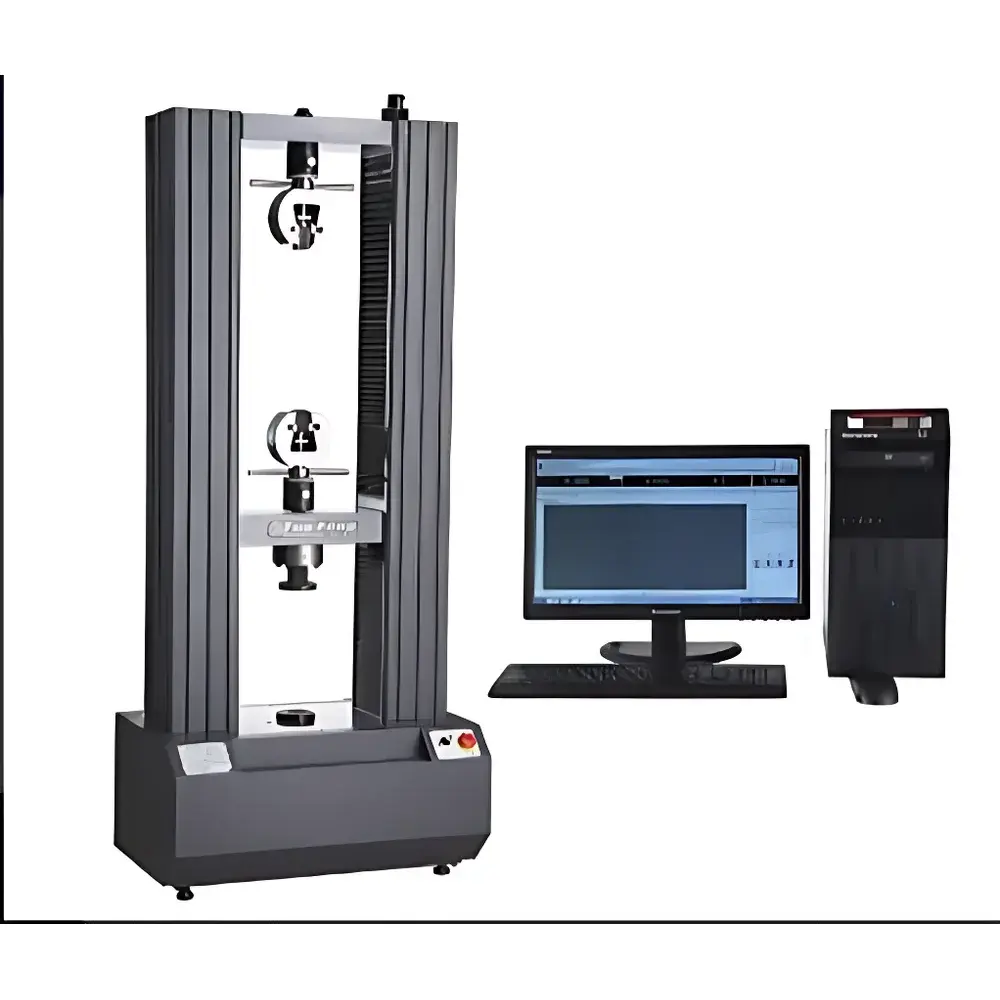
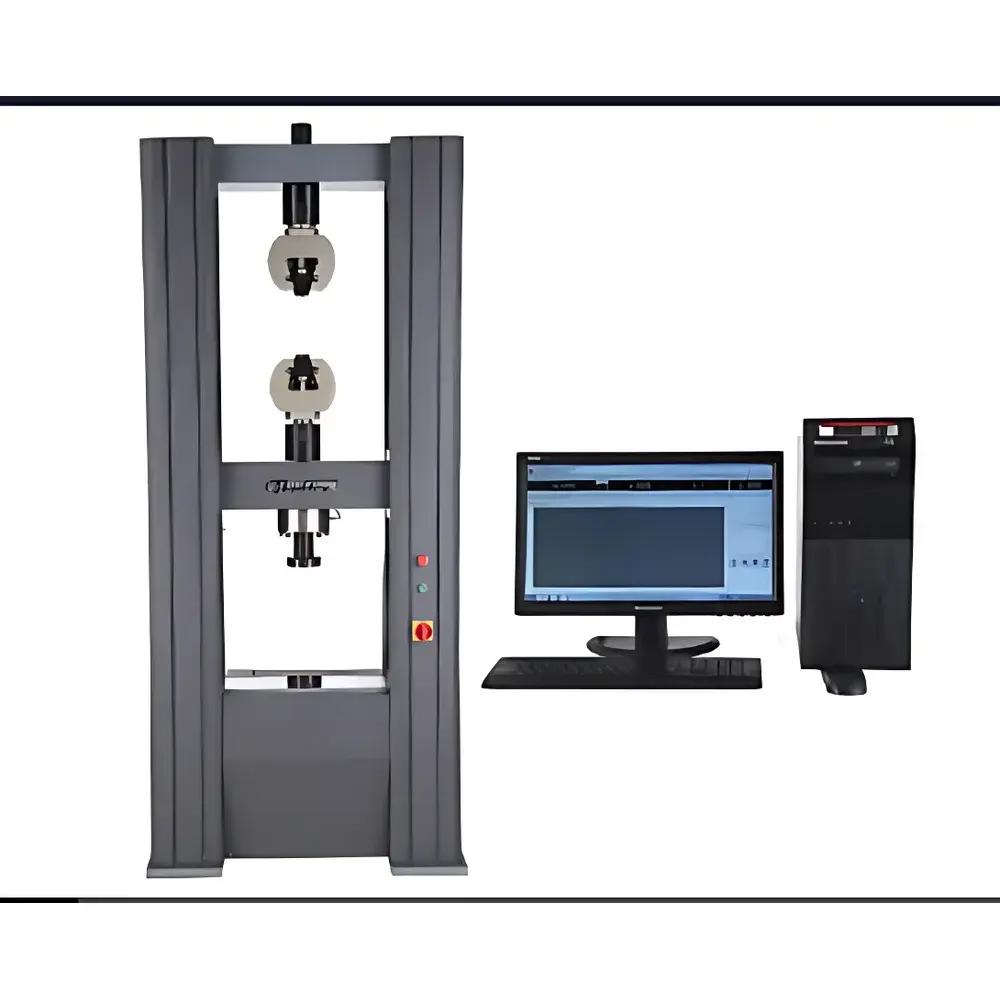
Tuofeng TFW-63 Fiber Optic Cable Tensile Testing Machine
| Brand | Tuofeng |
|---|---|
| Origin | Shanghai, China |
| Manufacturer Type | OEM Manufacturer |
| Instrument Type | Electromechanical Tensile Testing Machine |
| Maximum Test Load | 100 kN |
| Force Measurement Range | 1 kg to 100 kN (0.2%–100% of full scale) |
| Force Accuracy | ±0.5% of reading |
| Crosshead Travel | 1000 mm |
| Displacement Resolution | 0.001 mm |
| Control System | PC-based with Windows OS |
| Compliance | GB/T 16491-2008, JJG 475-2008, ASTM E4, ISO 7500-1, DIN 51221 |
Overview
The Tuofeng TFW-63 Fiber Optic Cable Tensile Testing Machine is a high-precision electromechanical universal testing system engineered for the mechanical characterization of optical fiber cables, strength members, buffer tubes, and related composite structures under controlled uniaxial loading. Based on servo-controlled electromechanical actuation and high-resolution load-cell transduction, the system implements standardized tensile protocols per ISO/IEC 17025-accredited test methods—including cable elongation at break, proof load verification, tensile modulus determination, and residual strain assessment after load release. Its rigid C-frame architecture, precision-ground ball-screw drive, and dual-speed crosshead positioning ensure repeatable force application across low-force (e.g., 1 kg pre-tensioning of loose-tube fibers) and high-force regimes (up to 100 kN for armored or aerial cable qualification). Designed for integration into QC laboratories and R&D centers, the TFW-63 meets structural integrity requirements defined in ITU-T G.650.1, IEC 60794-1-2, and Telcordia GR-20-CORE for fiber optic cable mechanical performance validation.
Key Features
- High-stiffness C-frame construction with reinforced base plate and vertical guide columns to minimize deflection during high-load testing (≤0.02 mm deformation at 100 kN)
- Imported AC servo motor coupled with planetary gear reducer and preloaded recirculating ball screw—enabling smooth, backlash-free motion across the full speed range of 0.001–500 mm/min
- Load cell with dual-range calibration (1 kg–10 kN and 10 kN–100 kN), traceable to national metrology standards, delivering ±0.5% force accuracy per ISO 7500-1 Class 0.5
- Optical encoder-based displacement measurement system with 0.001 mm resolution and ±0.005% linearity error over 1000 mm travel
- Dual-mode safety architecture: hardware-level electronic limit switches, emergency stop circuitry, and software-enforced overload cutoff (>110% FS triggers immediate motor halt)
- Motorized crosshead with independent fast/slow speed control and programmable return-to-start functionality for batch testing efficiency
Sample Compatibility & Compliance
The TFW-63 accommodates a broad spectrum of fiber optic cable configurations—including tight-buffered, loose-tube, ribbon, armored, and aerial self-supporting designs—via interchangeable jaw systems (pneumatic, wedge, and custom-fitted fixtures). Standard clamping solutions prevent slippage and localized crushing during tensile ramping, critical for maintaining valid stress distribution in polymeric coatings and aramid yarn reinforcement layers. The instrument conforms to mechanical test requirements specified in IEC 60794-1-2 (E1–E11 series), Telcordia GR-20-CORE Section 4.4, and ITU-T G.650.1 Annex A. Calibration and verification procedures align with ISO/IEC 17025 technical competence criteria, while data acquisition and reporting support audit readiness for GLP and GMP environments under FDA 21 CFR Part 11-compliant software configuration.
Software & Data Management
The embedded Windows-based testing software provides multi-modal control logic—including force-controlled ramp-hold, displacement-controlled creep, and strain-rate-regulated extension—with real-time feedback loops for closed-loop stability. All test parameters (load, displacement, time, stress, strain) are sampled at ≥1 kHz and stored with timestamped metadata. The interface supports dynamic curve overlays (load vs. time, stress vs. strain, displacement vs. time), automatic calculation of tensile strength, elongation at break, Young’s modulus, yield point (if applicable), and proof load compliance. Reports are exportable in PDF, Excel, and XML formats; raw data files retain full resolution for third-party reanalysis. Audit trails log all user actions, parameter changes, and calibration events—fully compliant with FDA 21 CFR Part 11 when configured with electronic signatures and role-based access controls.
Applications
- Proof testing of fiber optic cables per IEC 60794-1-2 E1 (tensile load application without permanent deformation)
- Evaluation of tensile strain limits for bend-insensitive fibers (ITU-T G.657.A1/A2/B2/B3)
- Characterization of jacket adhesion strength in ribbon cables using peel and shear fixtures
- Mechanical qualification of dielectric strength members (e.g., FRP rods) under sustained load conditions
- Accelerated aging studies combining thermal cycling and tensile stress to assess long-term cable reliability
- Comparative analysis of splice closure housing materials under axial pull-out forces
FAQ
What standards does the TFW-63 support for fiber optic cable testing?
It fully supports IEC 60794-1-2 (E1–E11), Telcordia GR-20-CORE, ITU-T G.650.1, and ASTM D412/D638 for constituent materials.
Can the system perform creep or relaxation tests?
Yes—via programmable hold segments in force- or displacement-control mode, with configurable dwell times up to 999 hours.
Is the software validated for regulated environments?
When deployed with 21 CFR Part 11 add-on modules (electronic signatures, audit trail, user permissions), it meets FDA and EU Annex 11 requirements.
What is the recommended maintenance interval?
Biannual calibration verification is advised; annual load cell and encoder recalibration is required for ISO/IEC 17025 compliance.
Does the machine support custom fixture design?
Yes—Tuofeng provides engineering consultation and CAD-supported development of application-specific grips and adapters.
Related Products



