
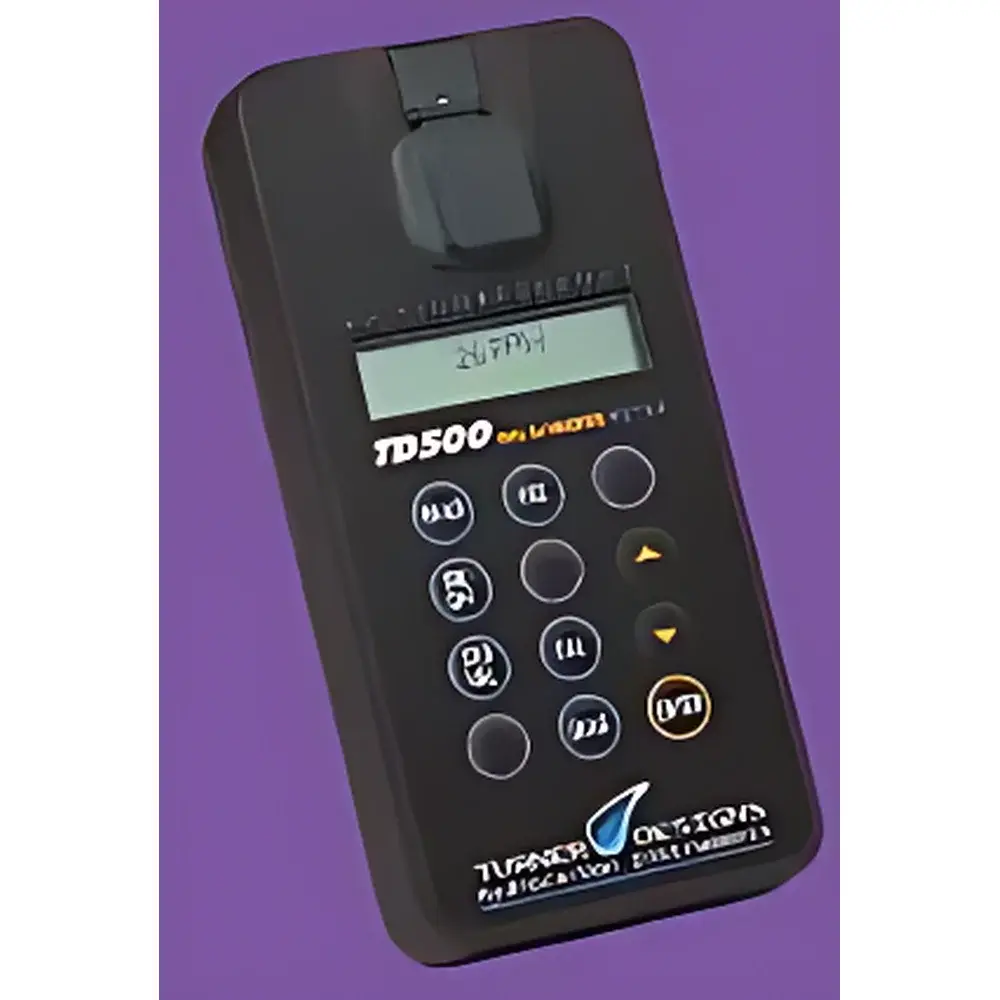
Turner Designs TD500D Portable Oil-in-Water Analyzer
| Brand | Turner Designs |
|---|---|
| Origin | USA |
| Model | TD500D |
| Instrument Type | Portable |
| Measurement Principle | UV Fluorescence Spectrophotometry |
| Detection Range (Channel A) | 0.05–50 ppm |
| Detection Range (Channel B) | 0–1000 ppm |
| LOD (Channel A) | <50 ppb |
| LOD (Channel B) | <1 ppm |
| Accuracy | ±2% of full scale |
| Repeatability | ±2% of full scale |
| Sensitivity | <1 ppm for most hydrocarbons |
| Calibration | Single-point + blank |
| Warm-up Time | 5 s |
| Response Time | 5 s |
| Measurement Time | <4 min per sample |
| Dimensions | 4.45 × 8.9 × 18.4 cm |
| Weight | 0.4 kg |
| Enclosure Material | Non-metallic |
| IP Rating | IP67 |
| Operating Temperature | 5–40 °C |
| Compatible Solvents | n-Hexane, Vertrel XF, AK-225, Xylene, Freon, Horiba solvents |
| Sample Vessels | Micro-cuvettes (API gravity <45) or 8-mm tubes (API gravity >45) |
| Power Supply | 4 × AAA batteries (>1000 measurements per set) |
| Auto-power-off | After 3 min idle |
| Display | LCD with status indicators |
| Alarms | Low battery, circuit fault, high blank |
| Compliance | ISO 9001:2000, CE-marked |
Overview
The Turner Designs TD500D Portable Oil-in-Water Analyzer is a field-deployable, dual-channel handheld fluorometer engineered for rapid, quantitative measurement of petroleum hydrocarbons—including crude oil, condensate, diesel, lubricating oils, hydraulic fluids, and refined fuels—in aqueous matrices and soil extracts. It operates on the principle of ultraviolet (UV) fluorescence spectroscopy: hydrocarbon molecules absorb UV light (typically at 254 nm or 365 nm, depending on excitation configuration) and re-emit energy at longer wavelengths; the intensity of this emitted fluorescence is directly proportional to analyte concentration. Unlike infrared (IR) or gravimetric methods, UV fluorescence delivers superior selectivity for aromatic and unsaturated hydrocarbons, minimal interference from alcohols (e.g., methanol), and immunity to solvent evaporation artifacts during analysis. The TD500D is not a screening tool—it is a quantitative field instrument validated against laboratory reference methods including EPA Method 1664A and ASTM D7066, and designed to meet data quality objectives required for regulatory reporting, spill response verification, and process water monitoring.
Key Features
- Dual-channel optical architecture: Channel A optimized for low-concentration, highly fluorescent compounds (e.g., condensates, refined fuels; LOD <50 ppb); Channel B calibrated for broad-range crude oil quantification (0–1000 ppm) without dilution.
- Field-validated precision: ±2% full-scale accuracy and repeatability across operational temperature range (5–40 °C), verified per ISO/IEC 17025-aligned internal protocols.
- Solvent-agnostic design: Fully compatible with EPA-approved extraction solvents (n-hexane, Vertrel XF, AK-225) and emerging non-halogenated alternatives—no recalibration required when switching media.
- Minimalist workflow: Four-step procedure (extraction → transfer → insert → read) completes in under 4 minutes; no solvent evaporation, no cuvette cleaning, no warm-up delay beyond 5 seconds.
- Ruggedized field hardware: IP67-rated enclosure, non-metallic corrosion-resistant housing, and shock-absorbing geometry ensure reliable operation in offshore platforms, drilling rigs, wastewater lift stations, and emergency response vehicles.
- Self-verification capability: Integrated CheckPOINT calibration verification standard enables traceable field recalibration without liquid reference standards—critical for GLP-compliant remote deployments.
Sample Compatibility & Compliance
The TD500D quantifies extractable petroleum hydrocarbons in water, sediment pore water, and soil leachates. It detects dissolved, dispersed, and emulsified fractions of hydrocarbons with API gravity <45 (using micro-cuvettes) or ≥45 (using 8-mm glass or quartz tubes). Its fluorescence response correlates linearly with certified oil-in-water standards traceable to NIST SRM 2781 (crude oil) and SRM 1648a (urban particulate matter). The instrument complies with ISO 9001:2000 manufacturing standards and bears CE marking for EMC and safety (2014/30/EU, 2014/35/EU). While not inherently 21 CFR Part 11 compliant (lacking electronic signature or audit trail), its output supports ALCOA+ data integrity principles when used within documented SOPs—making it suitable for pre-release environmental QA/QC in pharmaceutical manufacturing water systems, power plant cooling circuits, and offshore produced water management.
Software & Data Management
The TD500D operates as a standalone instrument with embedded firmware (v3.2+). All measurement parameters—including channel selection, blank subtraction mode, unit preference (ppm, ppb, mg/L), and alarm thresholds—are configurable via intuitive LCD menu navigation. Results are displayed in real time with status flags for high blank, low signal-to-noise, or battery depletion. No proprietary software or USB connection is required; however, optional RS-232 output (via accessory cable) enables integration into SCADA or LIMS environments using ASCII protocol. Raw fluorescence intensity values (arbitrary units) and concentration results are stored in non-volatile memory for up to 1,000 readings, exportable via manual transcription or third-party serial loggers. Audit-ready documentation is supported through printed field logs referencing instrument ID, operator ID, sample ID, solvent batch, and CheckPOINT verification timestamp.
Applications
- Offshore oil & gas: Produced water compliance monitoring (e.g., OSPAR, MARPOL Annex I), bilge water certification, and desalter effluent verification.
- Industrial water stewardship: Cooling tower blowdown, refinery wastewater streams, metalworking fluid carryover, and landfill leachate screening.
- Environmental emergency response: Real-time delineation of oil plumes in surface water, groundwater monitoring wells, and soil core extracts during spill remediation.
- Maritime operations: Ballast water treatment validation, cargo tank washwater testing, and port state control inspections.
- Power generation: Condensate polishers, turbine lube oil contamination checks, and hydroelectric intake water quality assurance.
- Regulatory field labs: EPA Region-certified field measurements supporting Tier 1/2 site assessments under ASTM E1527-21.
FAQ
Does the TD500D require daily calibration?
No—single-point calibration with a stable oil standard and blank correction suffices for routine use. CheckPOINT verification should be performed before each sampling campaign or after transport-induced shock.
Can it measure biodegraded or weathered oil?
Yes, though sensitivity decreases proportionally to aromatic loss; Channel B remains effective for total extractable hydrocarbons down to ~20% weathering extent per ASTM D7066 Annex A.
Is method validation support available?
Turner Designs provides application notes aligned with EPA 1664A, ISO 9377-2, and ASTM D7066, including spike recovery data, inter-laboratory comparison summaries, and uncertainty budget templates.
What maintenance does the optical path require?
None—the sealed excitation/emission optics are factory-aligned and warrantied for 5 years; only routine external wipe-down with isopropyl alcohol is recommended.
How does it compare to infrared-based field analyzers?
UV fluorescence offers 5–10× lower detection limits for aromatic-rich oils, eliminates solvent evaporation drift, and avoids IR spectral overlap with humic substances or chlorophyll—a known source of false positives in natural waters.
Related Products







