
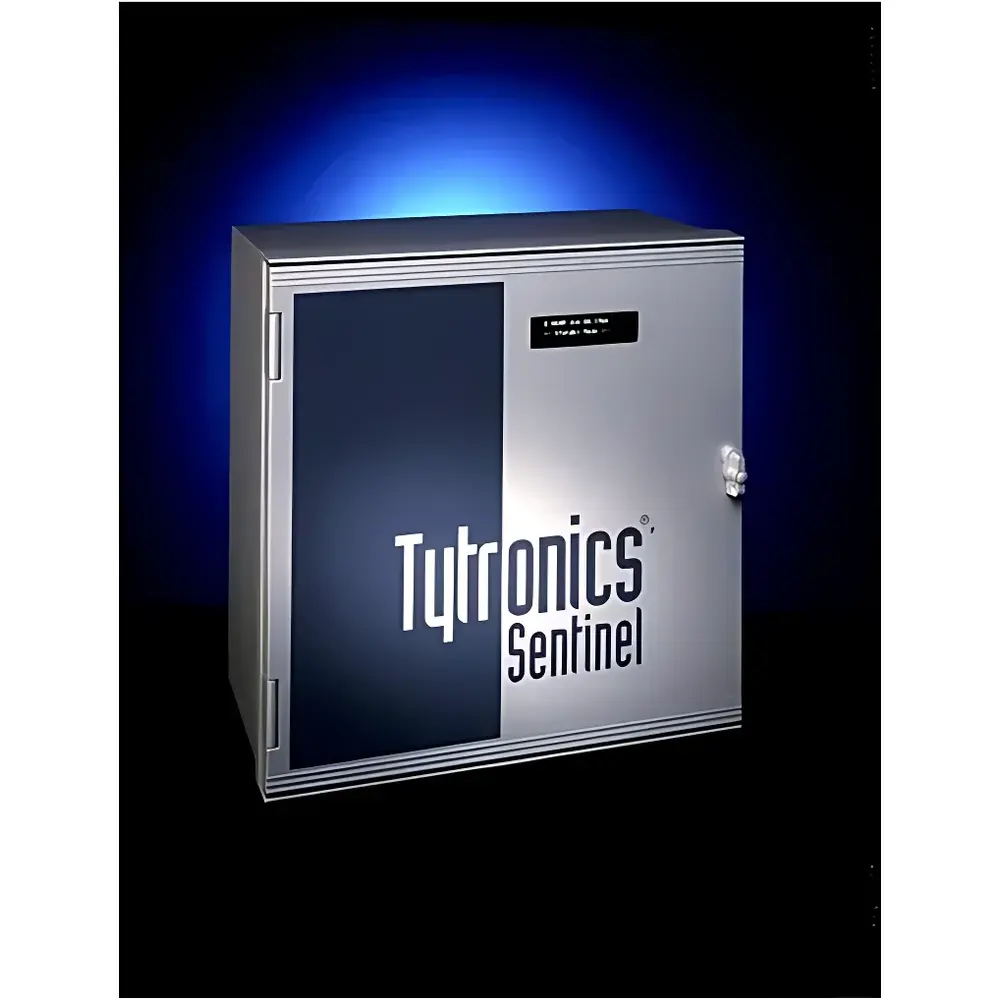
Tytronics Sentinel Nitrate Online Monitor
| Origin | USA |
|---|---|
| Manufacturer Type | Authorized Distributor |
| Origin Category | Imported |
| Model | Sentinel Nitrate Online Monitor |
| Instrument Type | Nitrate Ion (NO₃⁻) Analyzer |
| Measurement Principle | Ion-Selective Electrode (ISE) |
| Range Options | 0–10 ppm, 0–50 ppm, 0–100 ppm |
| Accuracy | ±5% of reading or full scale |
| Resolution | 0.001 ppm |
| Repeatability | ±5% of reading or full scale |
| Cycle Time | 2 minutes |
| Sample Flow Rate | 50–900 mL/min |
| Sample Inlet | 1/4″ compression fitting |
| Sample Temperature | 5–70 °C |
| Max Suspended Solids | 2% w/w, max particle size 1.27 mm (0.05″) |
| Sample Pressure | 0–50 psig |
| Waste Outlet | 3/4″ NPT male, atmospheric discharge |
| Alarm Outputs | User-programmable digital outputs |
| Analog Output | 4–20 mA, fully configurable |
| Power Supply | 100–240 VAC, 50/60 Hz |
| Enclosure Rating | NEMA 4X (IP65) |
| Dimensions (W×H×D) | 610 × 640 × 330 mm |
| Weight | ~36 kg (fully assembled) |
| Mounting | Wall-mounted with included hardware |
| Certifications | CE compliant |
Overview
The Tytronics Sentinel Nitrate Online Monitor is a robust, industrial-grade ion-selective electrode (ISE)-based analyzer engineered for continuous, real-time quantification of nitrate (NO₃⁻) concentration in aqueous matrices. Designed for unattended operation in demanding environmental and process water applications, it delivers high reproducibility and low maintenance burden across diverse sample types—including raw surface water, treated drinking water, municipal wastewater effluent, activated sludge basin influent/effluent, and industrial process streams. Its measurement principle relies on a solid-state, potentiometric ISE sensor paired with a reference electrode and integrated temperature compensation, enabling stable potential response proportional to logarithmic nitrate activity. Unlike optical methods, the ISE platform is inherently insensitive to sample color, turbidity, or suspended solids up to 2% w/w—eliminating the need for filtration or pretreatment in many field deployments. The system operates on a discrete sample introduction principle with automated reagent conditioning, ensuring minimal carryover and no memory effect between measurements.
Key Features
- Patented large-bore fluidic architecture minimizes clogging risk and supports reliable analysis of high-solids or viscous samples without external prefiltration.
- Programmable method library supporting up to 10 distinct analytical protocols and 3 independent calibration routines—enabling site-specific optimization for varying matrix interferences.
- Comprehensive self-diagnostic suite monitors critical operational states: sample presence, reagent level, electrode response stability, flow integrity, and temperature deviation—with configurable digital alarm outputs.
- Fully automated sequence: auto-calibration, reagent replenishment, cell flushing, and electrode conditioning—reducing operator dependency and ensuring long-term measurement consistency.
- Low reagent consumption design extends service intervals and lowers total cost of ownership; typical reagent usage is ≤1.2 L per month under standard 2-minute cycle operation.
- Modular architecture supports expansion to 6 independent sample streams via optional multi-port selector valve—ideal for multi-point monitoring in treatment plants or distributed watershed networks.
- Wall-mountable NEMA 4X (IP65) enclosure ensures protection against dust ingress, hose-directed water, and corrosive ambient conditions typical in pump stations and outdoor kiosks.
Sample Compatibility & Compliance
The Sentinel is validated for use with natural and anthropogenically impacted waters meeting the following physicochemical constraints: pH 4.0–9.0, conductivity < 5 mS/cm, chloride < 1000 mg/L, and absence of strong complexing agents (e.g., EDTA) at concentrations exceeding 1 mg/L. It complies with CE marking requirements per Directive 2014/30/EU (EMC) and 2014/35/EU (LVD). While not certified to ISO 5667-3 or ASTM D3370 for grab sampling, its continuous ISE output meets data quality objectives outlined in EPA Method 300.0 (Revision 2.0) for nitrate determination when deployed within defined operational limits. The system supports audit-ready operation through timestamped event logging and configurable analog output scaling—facilitating integration into SCADA systems compliant with IEC 62443-3-3 security profiles.
Software & Data Management
Local configuration and diagnostics are performed via an embedded web interface accessible over Ethernet (TCP/IP), requiring no proprietary software installation. All method parameters, calibration history, alarm logs, and diagnostic timestamps are stored internally with non-volatile memory retention (>10,000 entries). The 4–20 mA analog output is fully scalable per user-defined range (e.g., 0–50 ppm → 4–20 mA) and includes HART® v7.5 support for digital configuration and diagnostics via compatible field communicators. Data export is supported via CSV download over HTTP or Modbus TCP (function codes 03/04/16) for seamless ingestion into LIMS, historian platforms (e.g., OSIsoft PI, Ignition), or cloud-based dashboards. Firmware updates are delivered as signed binary packages to ensure integrity and traceability—aligned with GLP-aligned change control practices.
Applications
- Real-time monitoring of nitrate concentration in activated sludge aeration and denitrification basins to optimize carbon dosing and dissolved oxygen setpoints.
- Regulatory compliance tracking at drinking water intake points and distribution system endpoints per WHO Guideline Values (50 mg/L NO₃⁻) and EU Drinking Water Directive (98/83/EC).
- Process control in fertilizer manufacturing, semiconductor rinse water loops, and pharmaceutical purified water systems where nitrate serves as a key indicator of microbial contamination or resin exhaustion.
- Long-term trend analysis in watershed management programs—integrated with telemetry for remote reporting to state environmental agencies (e.g., USGS NWIS, UK EA WISKI).
- Early warning detection of agricultural runoff events in surface water bodies adjacent to intensive farming zones.
FAQ
What sample pretreatment is required prior to analysis?
No filtration or chemical conditioning is necessary for samples meeting the specified suspended solids (≤2% w/w, ≤1.27 mm particles) and chloride (<1000 mg/L) limits. A dedicated sample pump and pressure regulator are recommended for installations with variable source pressure.
Can the instrument be calibrated using standard solutions only—or is field validation required?
Factory calibration with NIST-traceable nitrate standards (e.g., 10, 50, and 100 ppm KNO₃ in deionized water) establishes baseline accuracy. Field validation using matrix-matched standards is advised after initial commissioning and following major maintenance events.
Is the system compatible with existing SCADA infrastructure?
Yes—via native Modbus TCP (Ethernet) or isolated 4–20 mA analog output with HART digital overlay. Configuration files for common RTU/PLC platforms (Siemens S7, Rockwell ControlLogix, Schneider EcoStruxure) are available upon request.
How often does the ISE sensor require replacement?
Typical electrode service life exceeds 12 months under continuous operation in municipal wastewater applications. Replacement intervals are extended in low-chloride, low-oxidant environments such as finished drinking water.
Does the system support remote firmware updates and diagnostics?
Yes—secure HTTPS-based firmware uploads with SHA-256 signature verification, plus real-time remote access to live sensor diagnostics, flow status, and calibration history via authenticated web session.
Related Products







