
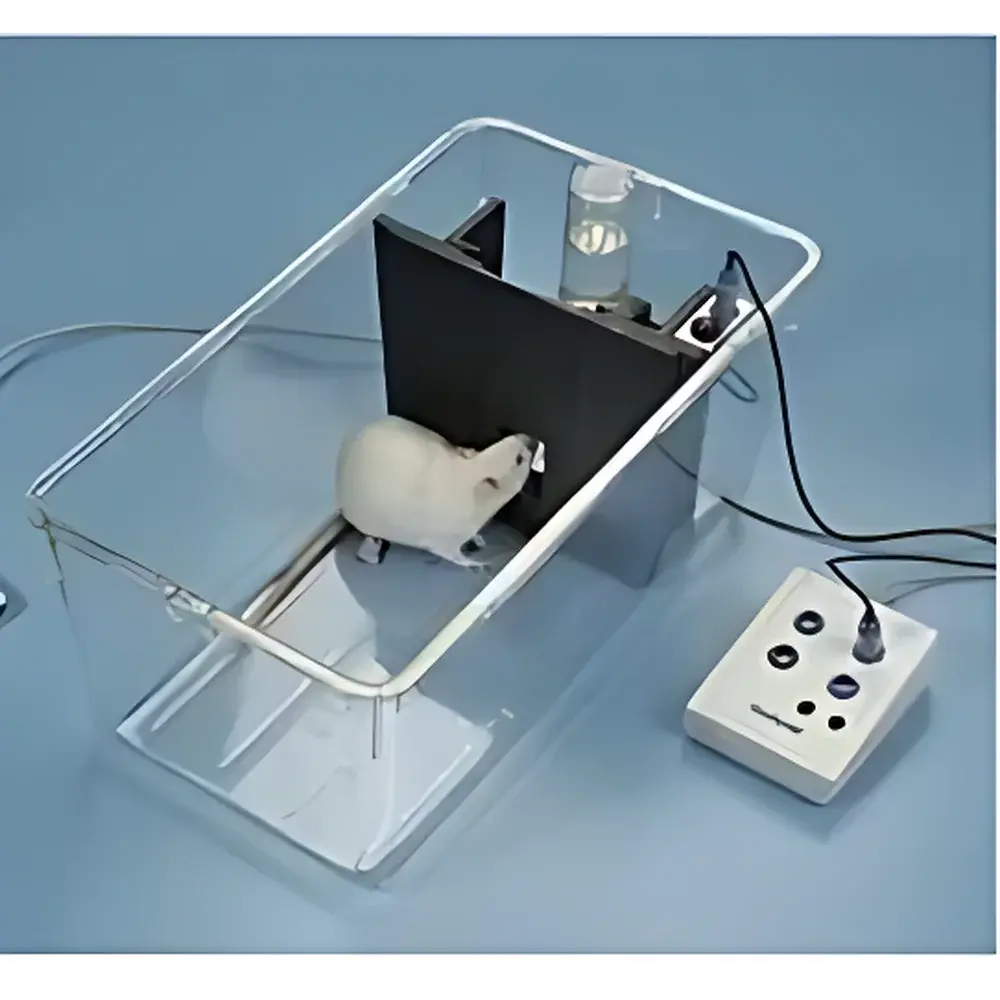
UGO 31300 Facial Nociception Analyzer for Mice and Rats (with Integrated Software)
| Origin | Italy |
|---|---|
| Manufacturer Type | Authorized Distributor |
| Origin Category | Imported Instrument |
| Model | 31300 (for Mice and Rats, Includes Control & Analysis Software) |
| Pricing | Available Upon Request |
Overview
The UGO 31300 Facial Nociception Analyzer is a purpose-built, non-invasive behavioral assessment platform engineered for quantitative evaluation of orofacial nociception in murine models. It implements an operant conflict paradigm—where animals must balance motivation to access a food reward against aversive thermal or mechanical stimuli applied to the vibrissal pad region—to generate ethologically relevant, functionally integrated pain readouts. Unlike reflex-based assays (e.g., von Frey or Hargreaves), this system captures voluntary behavioral decisions under controlled sensory challenge, thereby reflecting higher-order neural processing associated with affective and motivational dimensions of pain. The device is validated for use in C57BL/6, BALB/c, CD-1, and other standard laboratory mouse and rat strains, supporting both acute and chronic orofacial pain modeling, including trigeminal neuralgia, migraine-related allodynia, and inflammatory or neuropathic conditions affecting the maxillary division of the trigeminal nerve.
Key Features
- Integrated dual-modality stimulation: Precisely calibrated thermal ramping (22–70 °C, ±0.2 °C stability) and graded mechanical force delivery (5 discrete levels, 0.5–8.0 gF, traceable to NIST standards) applied directly to the mystacial pad without whisker plucking or restraint-induced stress.
- Operant feeding chamber design: Each test arena features a standardized food pellet dispenser, infrared beam interruption sensors, and synchronized stimulus timing logic to measure latency to first bite, total feeding duration (min/max/mean), and number of feeding attempts per session.
- High-throughput parallel recording: Supports up to 16 independent cages simultaneously via modular sensor arrays and time-synchronized data acquisition; each channel logs timestamped stimulus onset, beam-break events, and behavioral state transitions at 100 Hz resolution.
- Dedicated firmware and software suite: UGO Nociception Suite v3.2 provides real-time monitoring, automated event annotation, customizable protocol scripting (e.g., randomized stimulus order, inter-trial intervals), and export-ready datasets compliant with MIAME and FAIR data principles.
- Robust mechanical architecture: Stainless-steel stimulus probes, IP54-rated enclosure, and ESD-safe electronics ensure long-term reproducibility across multi-week longitudinal studies and shared-core facility environments.
Sample Compatibility & Compliance
The 31300 analyzer is optimized for adult mice (18–35 g) and rats (200–300 g), accommodating standard caging dimensions (e.g., Tecniplast Sealsafe Plus, Allentown A-100). Its non-invasive protocol eliminates the need for surgical implantation or pharmacological sedation, aligning with the 3Rs principles (Replacement, Reduction, Refinement) as endorsed by the European Directive 2010/63/EU and NIH OLAW guidelines. Data output formats (CSV, HDF5) support integration into institutional ELN systems and are compatible with GLP-compliant audit trails when deployed with user-access controls and electronic signature modules. The system meets CE marking requirements for Class I medical devices used in preclinical research and conforms to IEC 61000-6-3 (EMC) and IEC 61010-1 (safety).
Software & Data Management
UGO Nociception Suite includes a validated Windows-based application with role-based access control, encrypted local database storage, and configurable reporting templates. All experimental sessions are automatically assigned unique identifiers linked to animal ID, protocol version, operator credentials, and instrument calibration log entries. Raw data streams include millisecond-accurate timestamps for stimulus delivery, beam-break detection, and behavioral state flags (e.g., “approach”, “contact”, “withdrawal”, “consumption”). Batch analysis tools compute derived metrics such as % inhibition relative to baseline, area-under-curve for feeding suppression, and stimulus-response curves fitted using logistic regression. Audit logs record every parameter change, file export, and user login—fully satisfying FDA 21 CFR Part 11 requirements for electronic records and signatures in regulated preclinical studies.
Applications
- Pharmacodynamic profiling of novel TRPV1, ASIC, or Nav1.7 antagonists in trigeminal pain models.
- Evaluation of central sensitization following infraorbital nerve chronic constriction injury (IoN-CCI) or spared nerve injury (SNI).
- Genetic screening of transgenic lines with altered orofacial nociceptive thresholds (e.g., Cav3.2 KO, BDNF overexpressors).
- Longitudinal assessment of analgesic tolerance development during repeated opioid administration.
- Validation of biomarker candidates via correlation between behavioral endpoints and ex vivo tissue analyses (e.g., pERK immunoreactivity in Vc subnucleus).
FAQ
Is the 31300 compatible with existing vivarium cage racks and ventilation systems?
Yes—the base unit mounts on standard IVC rack shelves (depth ≤60 cm), and all cabling is routed through rear-panel grommets to maintain airflow integrity.
Can stimulus parameters be modified during an ongoing experiment?
No—protocols are locked at session initiation to ensure blinding and reproducibility; parameter changes require new session setup and re-randomization.
Does the system support integration with third-party electrophysiology or imaging platforms?
Yes—via TTL trigger outputs and UDP packet streaming, enabling synchronization with patch-clamp rigs, fiber photometry systems, or high-speed videography setups.
What calibration documentation is provided?
Each unit ships with a factory calibration certificate traceable to national metrology institutes (INRIM, Italy), including thermal probe linearity verification and force transducer hysteresis testing reports.
Is remote monitoring supported for multi-site collaborative studies?
Yes—secure HTTPS-based web dashboard access (optional add-on license) allows real-time viewing of active sessions and centralized dataset aggregation across geographically distributed labs.





