
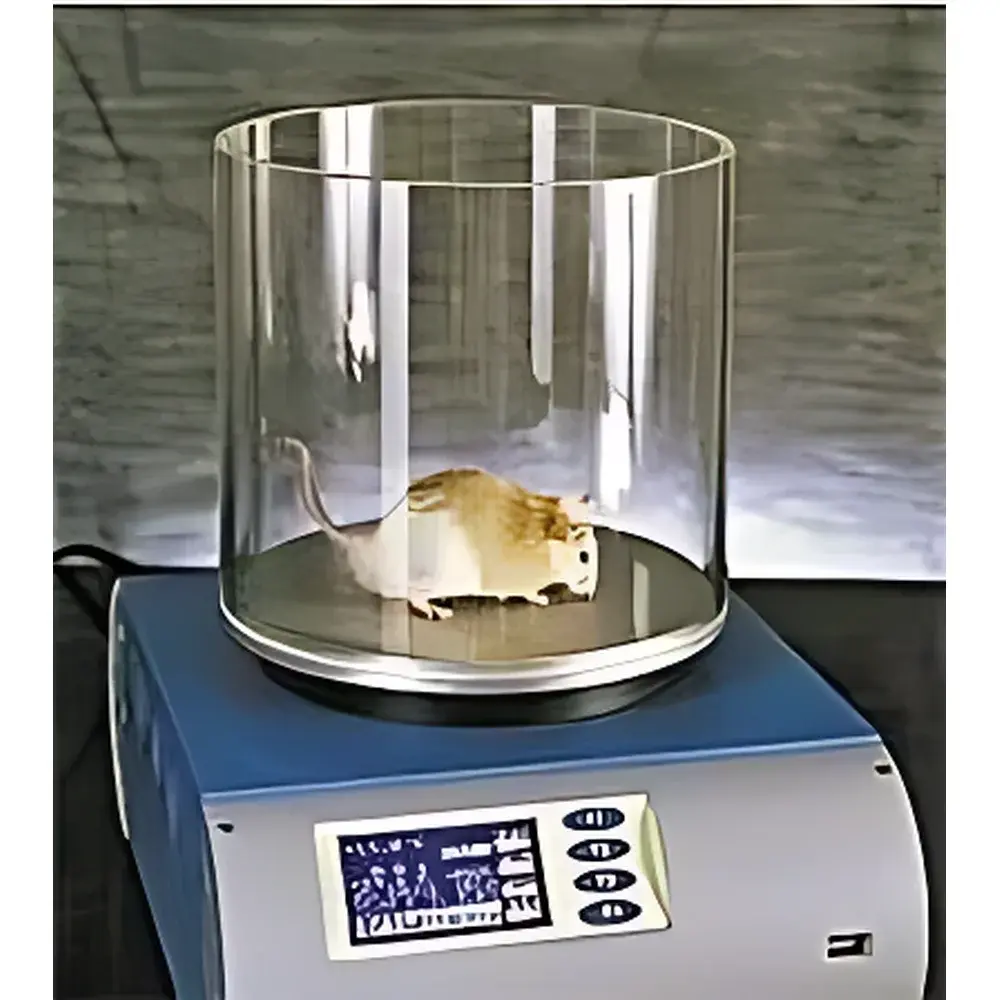
Ugo Basile Model 35100 Cold/Hot Nociception Analyzer
| Brand | Ugo Basile |
|---|---|
| Origin | Italy |
| Model | 35100 |
| Temperature Range | 2–66 °C |
| Temperature Resolution | 0.1 °C |
| Response Time | 0.1 s |
| Data Output | USB interface, included software & USB flash drive |
| Optional Accessories | Dual-plate module, thermal escape chamber kit (with custom glass enclosure) |
Overview
The Ugo Basile Model 35100 Cold/Hot Nociception Analyzer is a precision-controlled thermosensory stimulation platform engineered for quantitative assessment of nociceptive thresholds in rodent models. It operates on the principle of dynamic thermal ramping—applying controlled, linear temperature gradients across a calibrated contact surface—to elicit and measure behavioral withdrawal responses (e.g., paw lift, lick, or jump) under standardized conditions. Unlike static hot-plate assays limited to single-point thermal stimuli and prolonged cooldown cycles, the Model 35100 enables bidirectional thermal profiling: from cold-hyperalgesia induction at 2 °C to heat-evoked nocifensive behavior up to 66 °C, with programmable ramp rates (°C/min), dwell times, and endpoint triggers. This capability supports mechanistic studies of transient receptor potential (TRP) channel function—including TRPM8 (cold-sensing) and TRPV1 (heat-sensing)—and facilitates longitudinal evaluation of pharmacological modulation in models of neuropathic, inflammatory, or chemotherapy-induced pain.
Key Features
- Wide operational temperature range: 2 °C to 66 °C, adjustable in 0.1 °C increments with real-time digital display and closed-loop PID temperature control
- Programmable thermal protocols: user-defined linear ramps (ascending/descending), step-and-hold sequences, and multi-phase thermal profiles
- Sub-second system response time (≤0.1 s) ensures precise temporal alignment between stimulus onset and behavioral event capture
- Integrated USB interface enables direct data export to PC or portable USB flash drive (included); no external DAQ hardware required
- Comprehensive acquisition software (Ugo Basile Nociception Suite v3.x) provides timestamped event logging, latency calculation, and protocol replication with audit trail support
- Optional dual-plate configuration allows simultaneous bilateral testing of two rodents under identical thermal conditions, improving throughput and inter-animal comparability
- Thermal escape chamber compatibility via accessory kit (includes thermostatically regulated dual-zone plate and optically transparent acrylic/glass enclosure), enabling preference-based thermotaxis assays aligned with ISO 10993-10 and ICH S5(R3) guidelines for sensory irritation assessment
Sample Compatibility & Compliance
The Model 35100 is validated for use with adult Sprague-Dawley and Wistar rats (150–300 g) and C57BL/6 and CD-1 mice (20–35 g). Footpad contact area, weight distribution, and ambient humidity are standardized per OECD TG 403 and AAALAC International recommendations. All thermal protocols comply with GLP principles for preclinical analgesic development, supporting traceable data generation required for regulatory submissions (FDA IND/CTA, EMA CHMP). The device meets CE marking requirements under Directive 2014/30/EU (EMC) and 2014/35/EU (LVD), and its software architecture incorporates configurable user access levels and electronic signature support consistent with FDA 21 CFR Part 11 Annex 11 expectations for audit-ready data integrity.
Software & Data Management
The bundled Nociception Suite software runs on Windows 10/11 (64-bit) and supports experimental design import/export (XML), automated latency threshold detection (configurable latency cutoff: 0.5–30 s), and batch statistical reporting (mean ± SEM, ANOVA with post-hoc Tukey). Raw thermal and behavioral timestamps are stored in .csv and .nix formats for third-party analysis (e.g., MATLAB, GraphPad Prism). Audit logs record operator ID, session start/end times, parameter modifications, and export events—retained for ≥2 years per internal SOPs. Software updates are distributed via secure vendor portal with version-controlled release notes and validation documentation.
Applications
- Pharmacodynamic profiling of opioid, NSAID, and novel TRP-channel modulators in acute and chronic pain models
- Characterization of cold allodynia in oxaliplatin- or paclitaxel-induced peripheral neuropathy (PAIN 147:165–174)
- Validation of CGRP antagonists in inflammatory hyperalgesia (Eur J Pharmacol 347:275–282)
- Thermotactic preference mapping in transgenic lines (e.g., TRPM8-KO, TRPV1-KO) under gradient exposure
- Preclinical safety assessment of topical analgesics per ISO 16128 and OECD TG 439
- Method qualification for ICH M10-compliant bioanalytical assay development in CNS drug programs
FAQ
What is the minimum temperature resolution supported by the Model 35100?
The system resolves temperature changes at 0.1 °C increments, verified by NIST-traceable PT100 sensor calibration.
Can the device be integrated into an existing laboratory LIMS or ELN infrastructure?
Yes—via CSV/JSON export and optional API extension package (available under separate license agreement) supporting HL7 and ASTM E1467 standards.
Is validation documentation provided for GxP environments?
Ugo Basile supplies IQ/OQ templates, sensor calibration certificates, and software verification reports compliant with ASTM E2500-13 and EU GMP Annex 11.
How is animal welfare addressed during thermal ramping protocols?
Built-in safety cutoffs terminate heating/cooling if no response is detected within user-defined latency limits (default: 30 s), and plate surface temperature is continuously monitored to prevent tissue damage per ARRIVE 2.0 guidelines.
Does the dual-plate option require recalibration?
No—the dual-plate module undergoes factory parallelism and thermal uniformity validation; individual zone calibration is retained in firmware and accessible via service mode.





