
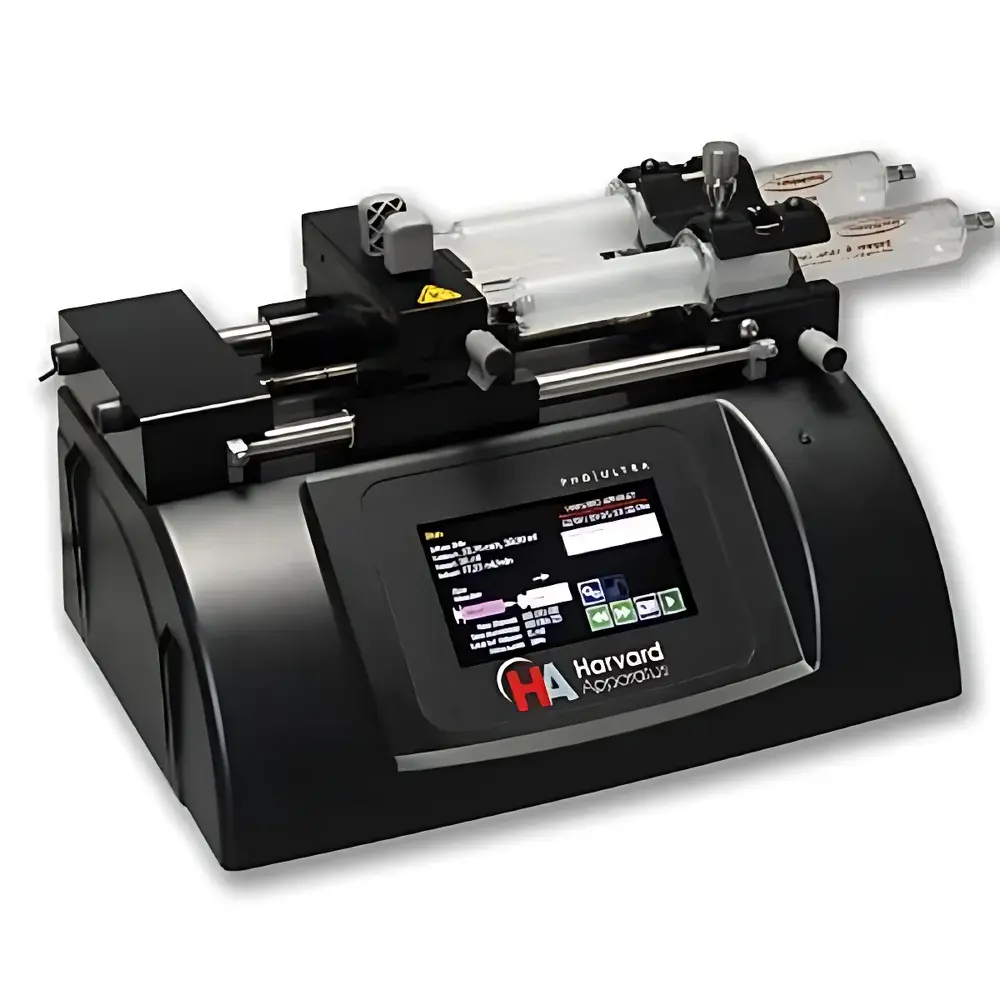
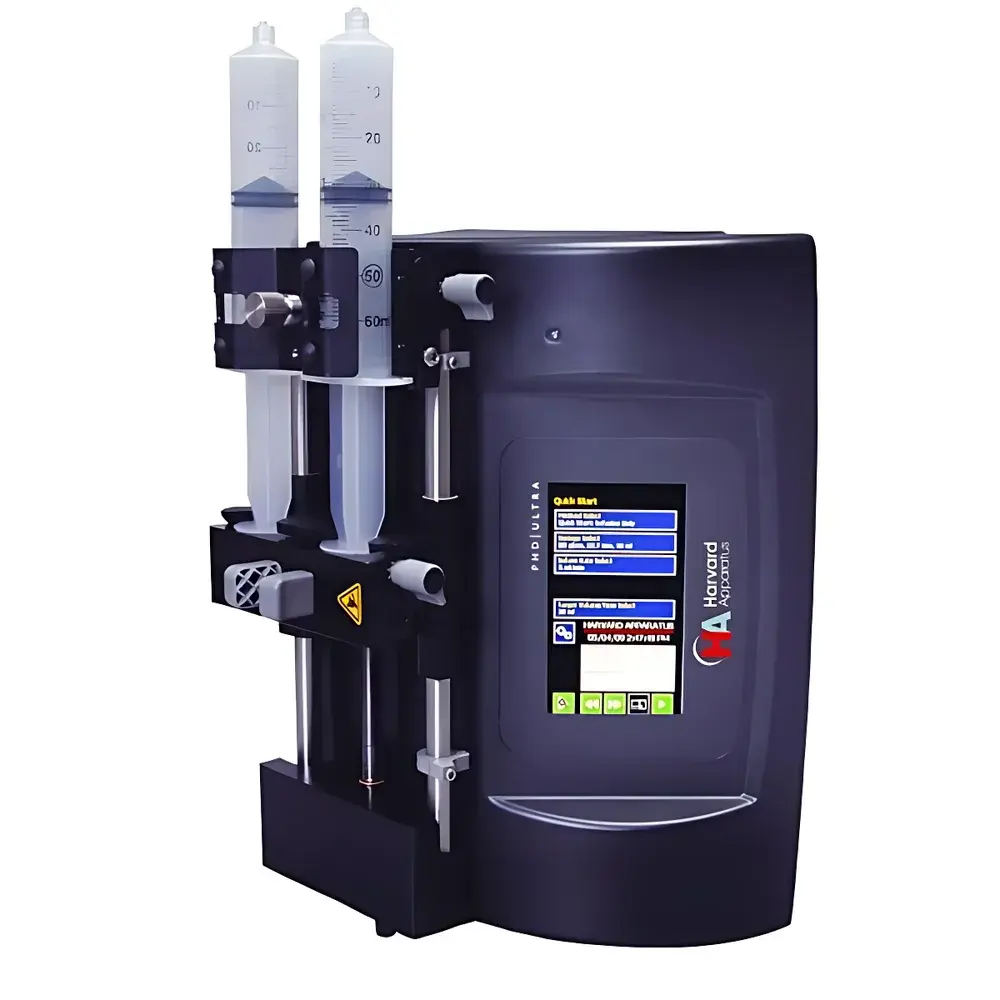
Harvard Apparatus PHD ULTRA Precision Syringe Pump
| Brand | Harvard Apparatus |
|---|---|
| Origin | USA |
| Model | PHD ULTRA |
| Flow Rate | 1.5 pL/min – 216 mL/min |
| Accuracy | ±0.25% |
| Repeatability | 0.05% |
| Display | 4.3" WQVGA TFT color touchscreen |
| Dimensions (L×D×H) | 12.0 × 8.5 × 7.25 in (30.48 × 21.59 × 18.42 cm) |
| Weight | 10 lb (4.5 kg) |
| Certifications | CE, UL, CSA, CB Scheme, RoHS compliant |
| Power Input | 50 W, 0.5 A fuse |
| Microstep Resolution | 12,800 microsteps per lead screw revolution |
| Minimum Plunger Speed | 0.18 µm/min |
| Maximum Plunger Speed | 190.8 mm/min |
| I/O Interface | 15-pin D-Sub TTL/RS-232/RS-485 capable |
| Non-volatile Memory | Yes |
| Syringe Capacity Range | 0.5 µL to 140 mL |
| Operating Humidity | 20–80% RH, non-condensing |
Overview
The Harvard Apparatus PHD ULTRA Precision Syringe Pump is an advanced, microprocessor-controlled fluid delivery system engineered for high-fidelity, low-volume, and high-throughput applications across analytical, preclinical, and process-critical laboratory environments. Based on Harvard Apparatus’ proprietary pending fluidic drive architecture, the PHD ULTRA employs a high-resolution 1/16 microstepping motor control system coupled with precision-machined mechanical transmission components to minimize pulsatility and maximize flow linearity. Its operational principle relies on closed-loop plunger displacement control—where each microstep corresponds to a defined linear actuation of the syringe plunger—enabling traceable, repeatable volumetric delivery over six orders of magnitude in flow range (1.5 pL/min to 216 mL/min). This architecture meets the stringent requirements of quantitative infusion protocols in regulated workflows, including those governed by GLP, GMP, and FDA 21 CFR Part 11-compliant data integrity frameworks.
Key Features
- Ultra-wide dynamic flow range: 1.5 pL/min (with 0.5 µL Hamilton syringes) to 216 mL/min (with 140 mL glass or plastic syringes), supporting both nanoliter-scale microinjection and milliliter-scale calibration or perfusion.
- High metrological performance: ±0.25% accuracy and ≤0.05% repeatability under ISO 8536-4 and ASTM D3418 verification conditions—validated across syringe sizes and viscosity ranges up to 10,000 cP.
- 4.3-inch WQVGA color touchscreen interface with intuitive EZ Pro GUI: enables full method programming—including multi-segment ramps, pauses, triggers, and conditional logic—without external PC connectivity.
- Modular mechanical design: supports standard dual-syringe mounting, remote pump head configuration, and optional accessory frames (e.g., 6/10-syringe rack, 4×140 mL rack, 4×microsyringe rack) for parallelized or spatially distributed delivery.
- Robust I/O architecture: integrated 15-pin D-sub TTL/RS-232/RS-485 ports for hardware synchronization with mass spectrometers, chromatography systems, electrophysiology rigs, or PLC-based automation platforms.
- Non-volatile memory retention: all user-defined methods, calibration offsets, and system configurations persist through power cycles and firmware updates.
Sample Compatibility & Compliance
The PHD ULTRA accommodates a broad spectrum of syringe materials and geometries—including borosilicate glass (e.g., Hamilton 1700 series), polypropylene, PTFE-lined, and stainless-steel syringes—ensuring chemical compatibility with aqueous buffers, organic solvents, viscous polymers, and biological suspensions. Its mechanical syringe clamping mechanism applies consistent, non-deforming force across diameters from 2.5 mm to 35 mm, minimizing slippage and seal degradation during extended operation. The system conforms to CE, UL 61010-1, CSA C22.2 No. 61010-1, and IEC 61000-6-3 EMC standards. RoHS compliance ensures restricted substance management in accordance with EU Directive 2011/65/EU. For regulated laboratories, audit trails, electronic signatures, and parameter lockout modes can be implemented via optional EZ Pro software extensions aligned with 21 CFR Part 11 Annex 11 requirements.
Software & Data Management
While fully functional as a standalone instrument, the PHD ULTRA integrates seamlessly with Harvard Apparatus’ EZ Pro software suite for Windows-based method development, real-time monitoring, and raw data export (CSV, XML). The software supports time-stamped event logging, automated calibration curve generation, and batch protocol deployment across multiple pumps. All communication layers—including USB virtual COM port, RS-232 ASCII command set, and TTL trigger signals—are documented in the publicly available Programmer’s Manual (Rev. 3.2+), facilitating integration into LabVIEW, Python (pySerial), MATLAB, or custom SCADA environments. Data files include metadata such as syringe ID, plunger position timestamp, commanded vs. actual step count, and environmental ambient readings where applicable.
Applications
- Neuroscience & electrophysiology: stereotactic microinfusion of tracers, viral vectors, or pharmacological agents into rodent brain tissue with sub-nanoliter precision.
- Mass spectrometry sample introduction: stable, pulse-free nanoflow LC-MS coupling using 50–100 µm ID capillaries and <100 nL/min flow rates.
- HPLC/UHPLC calibration and standard preparation: gravimetrically verified dilution series generation with ≤0.1% RSD across 10–1000 µL injections.
- Microdialysis sampling: continuous, low-shear perfusion of artificial cerebrospinal fluid (aCSF) at physiological flow rates (0.1–5 µL/min).
- Drug formulation & PK/PD studies: programmable bolus-infusion regimens simulating IV, SC, or intrathecal dosing profiles in vivo.
- Materials science: controlled deposition of nanoparticle suspensions or polymer precursors in thin-film fabrication processes.
FAQ
What syringe sizes are supported?
The PHD ULTRA accepts syringes from 0.5 µL (e.g., Hamilton 7000 series) up to 140 mL (e.g., BD Plastipak), with automatic diameter detection and configurable travel limits.
Is the pump compatible with corrosive or high-viscosity fluids?
Yes—when paired with chemically resistant syringes (e.g., PTFE-coated glass or stainless steel) and appropriate pusher block materials; maximum recommended viscosity is 10,000 cP at 25°C.
Can multiple PHD ULTRA units be synchronized?
Yes—via RS-485 daisy-chaining or TTL master-slave triggering, enabling coordinated multi-pump sequences with sub-millisecond timing resolution.
Does the system support regulatory-compliant audit trails?
Native audit trail functionality is available in EZ Pro software with 21 CFR Part 11-compliant user authentication, electronic signatures, and immutable log archiving.
What maintenance is required?
No routine lubrication or calibration is needed; periodic visual inspection of syringe mount alignment and belt tension is recommended every 6 months under continuous use.



