
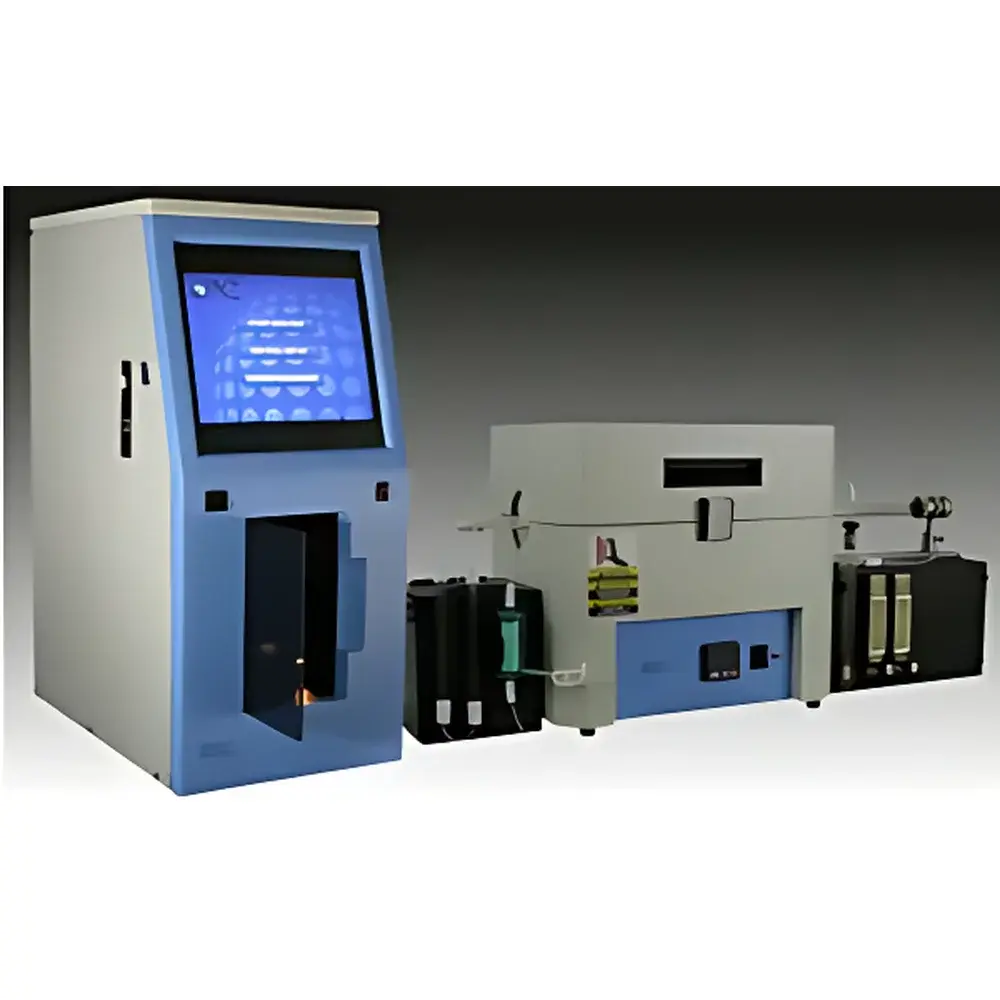
UIC CM130 Liquid Total Carbon–Total Organic Carbon Analyzer
| Brand | UIC (United Instrumentation Corporation) |
|---|---|
| Origin | USA |
| Model | CM130 |
| Instrument Type | Laboratory TOC Analyzer |
| Oxidation Method | High-Temperature Catalytic Combustion |
| Measurement Range | 0–10,000 µg C |
| Accuracy | ±0.2% (for 1,000–3,000 µg C samples) |
| Resolution | 0.01 µg C |
| Detection Limit | 0.01 ppm C |
| Repeatability | ≤3% RSD |
| Compliance | ASTM D4129 |
Overview
The UIC CM130 Liquid Total Carbon–Total Organic Carbon Analyzer is a laboratory-grade combustion-based elemental carbon analyzer engineered for precise, trace-level quantification of total carbon (TC) and total organic carbon (TOC) in aqueous and challenging liquid matrices. It operates on the principle of high-temperature catalytic combustion oxidation (950–1100 °C), followed by coulometric detection of evolved CO2—a method grounded in Faraday’s law of electrolysis. Unlike NDIR or conductivity-based TOC systems, the CM130 employs a proprietary coulometric CO2 sensor (CM5015) that delivers absolute quantification without user calibration, eliminating drift-related uncertainty and enabling direct mass-based carbon reporting in microgram units. Designed for regulatory and research-grade water quality analysis, it meets ASTM D4129 for determination of TC and TOC in saline, acidic, and industrial process liquids—including seawater, brines, wastewater effluents, and aggressive chemical streams where conventional TOC analyzers may suffer from corrosion or catalytic poisoning.
Key Features
- High-temperature horizontal furnace (CM5300) programmable up to 1100 °C, with dual-stage combustion cleaning: pre-combustion scrubber removes impurities from carrier oxygen; post-combustion scrubber eliminates SOx, NOx, halides, and moisture prior to CO2 detection
- Coulometric CO2 analyzer (CM5015) with inherent zero-drift stability, 0.01 µg C resolution, and linear dynamic range spanning 1–10,000 µg C per injection
- No routine calibration required—traceable accuracy maintained via electrochemical equivalence and certified reference materials
- Automated TC/TOC differential protocol: TC measured directly via combustion; TOC determined after acidification and sparging to remove inorganic carbon (IC), ensuring compliance with standard TOC definition (TOC = TC − IC)
- Sample introduction via precision syringe; compatible with liquid volumes from 10 µL to 1 mL, accommodating high-salinity and low-pH samples without dilution or matrix interference
- Integrated data handling: onboard storage for up to 50 sample records including mass, volume, dilution factor, and analysis date; soft-disk drive for export to LIMS or spreadsheet software
Sample Compatibility & Compliance
The CM130 is validated for use across diverse aqueous matrices requiring robust interference mitigation. It routinely analyzes drinking water, municipal and industrial wastewater, reverse osmosis permeate, seawater, geothermal brines, pharmaceutical process rinsates, and acidic leachates (pH < 2). Its quartz and ceramic combustion pathway resists corrosion from chloride, sulfate, and fluoride ions. The system satisfies method requirements for ASTM D4129 and is suitable for laboratories operating under GLP or GMP frameworks. While not inherently 21 CFR Part 11 compliant (as it lacks electronic signature and audit trail features), its raw data output, manual intervention logs, and traceable calibration verification support validation documentation for regulated environments when paired with appropriate SOPs and record-keeping practices.
Software & Data Management
The CM130 operates via dedicated front-panel controls and an integrated LCD interface—no external PC or proprietary software is required. All analytical parameters (combustion temperature, hold time, gas flow rates) are configured via hardware menus. Sample metadata—including name, weight/volume, dilution factor, and analysis mode (TC or TOC)—are entered manually and stored with each result. Final reports display carbon concentration in µg C, % recovery, and relative standard deviation where replicate runs are performed. Data export is supported via 3.5″ floppy disk (formatted FAT12), enabling transfer to Excel, LabArchives, or LIMS platforms. No cloud connectivity or remote diagnostics are implemented; data integrity relies on physical media control and procedural documentation.
Applications
- Regulatory compliance testing for EPA Method 415.3 and ISO 8245 in municipal water utilities
- TOC monitoring in semiconductor ultrapure water loops and pharmaceutical water-for-injection (WFI) systems
- Carbon balance studies in bioreactor effluents and anaerobic digestion processes
- Corrosion inhibitor efficacy evaluation via organic carbon depletion kinetics
- Environmental forensics of hydrocarbon-contaminated groundwater using TC/TOC ratios and speciation trends
- Educational laboratories requiring hands-on instruction in combustion analytics, redox stoichiometry, and electrochemical detection principles
FAQ
Does the CM130 require daily calibration standards?
No. The coulometric detection principle ensures intrinsic calibration stability. Only periodic verification with certified carbon standards (e.g., potassium hydrogen phthalate) is recommended per ASTM D4129—typically before each analytical batch or at least once per day.
Can the CM130 analyze solid or suspended particulate samples?
No. The CM130 is designed exclusively for homogeneous liquid samples. Suspended solids must be filtered (0.45 µm) prior to analysis to prevent clogging and incomplete oxidation.
What is the typical analysis time per sample?
Standard TC or TOC analysis requires 5–7 minutes, including combustion, gas transfer, electrolytic integration, and result calculation.
Is the CM5015 CO2 analyzer serviceable in the field?
Yes. The CM5015 module uses replaceable electrolyte cartridges and platinum electrodes; routine maintenance (electrolyte refill, electrode polishing) can be performed by trained lab personnel using UIC-supplied kits.
How does the system handle high-chloride samples like seawater?
The post-combustion scrubber (CM5321) contains silver-coated traps that quantitatively remove HCl and Cl2 prior to CO2 detection, preventing chloride-induced signal suppression or electrode passivation.







