
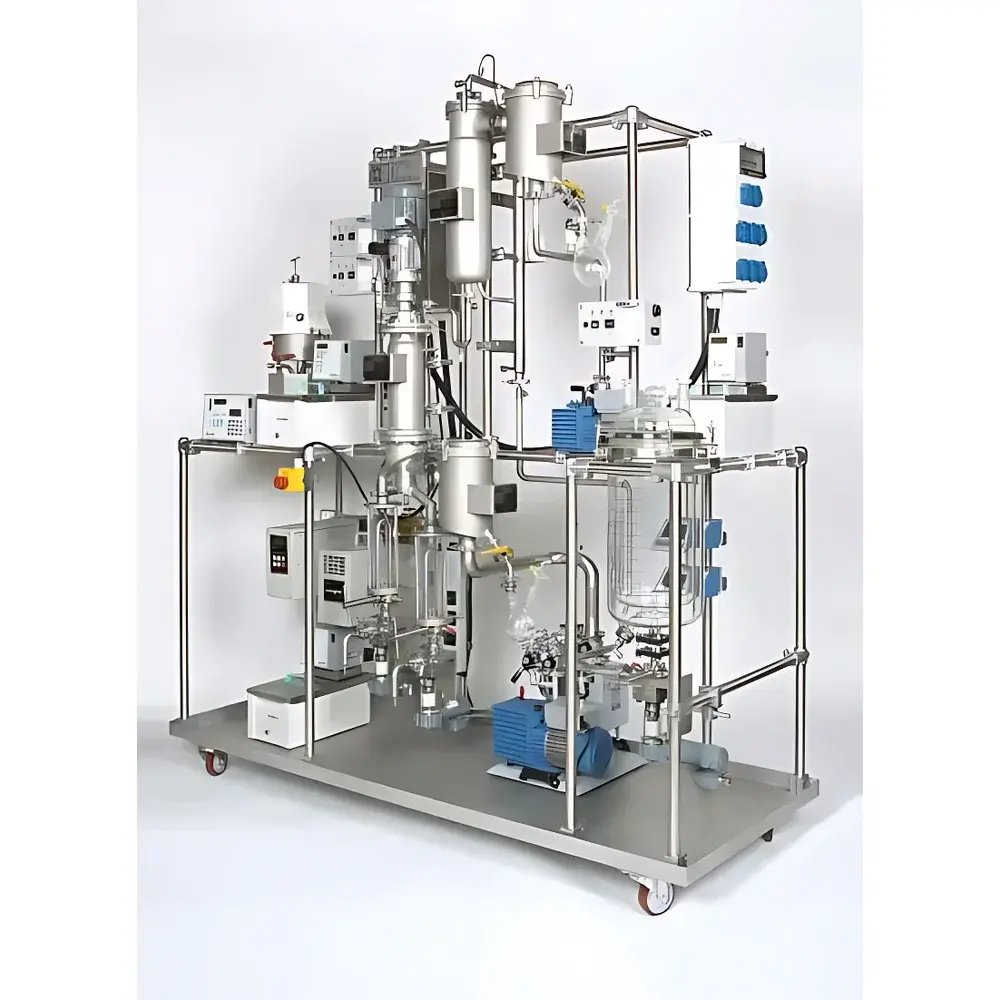
UIC KD6 Pilot-Scale Short-Path Molecular Distillation System
| Brand | UIC GmbH |
|---|---|
| Origin | Germany |
| Model | KD6 |
| Feed Rate | 3–9 kg/h |
| Effective Evaporation Area | 0.08 m² |
| Evaporator Internal Diameter | 180 mm |
| Condenser Area | 0.06 m² |
| Collecting Flasks | 3 |
| Max Operating Temperature | 350 °C |
| Min Operating Pressure | 0.001 mbar |
| Construction Material | Stainless Steel (optional: Hastelloy® upon request) |
| Heating Method | Independent Oil-Bath Heating for Evaporator Surface, Feed Line, Distillate Outlet, Residue Outlet, and Internal Condenser |
| Film Formation | Self-Cleaning Roller-Type Wiper System |
Overview
The UIC KD6 is a pilot-scale short-path molecular distillation system engineered for high-precision thermal separation of thermally sensitive, high-boiling-point, or low-volatility compounds under ultra-high vacuum conditions. Based on the fundamental principle of molecular distillation—where separation occurs when the mean free path of vapor molecules exceeds the distance between evaporator and condenser surfaces—the KD6 enables efficient fractionation without bulk boiling, minimizing thermal degradation. Designed for scalability from laboratory R&D to small-batch GMP-compliant production, it bridges the gap between benchtop feasibility studies and commercial process validation. Its operation at pressures as low as 0.001 mbar and temperatures up to 350 °C ensures compatibility with heat-labile actives such as polyunsaturated fatty acids (PUFAs), tocopherols, cannabinoids, sterols, and pharmaceutical intermediates. The system’s compact geometry, precise temperature zoning, and laminar vapor flow path support reproducible mass transfer kinetics critical for regulatory documentation and process transfer.
Key Features
- Modular architecture allowing configuration customization per application—including optional Hastelloy® construction for aggressive feedstocks (e.g., acidic oils or halogenated compounds)
- Self-cleaning roller-type wiper system ensuring uniform, turbulence-free thin-film formation across the 180 mm-diameter evaporator surface (effective evaporation area: 0.08 m²)
- Fully independent heating zones: evaporator wall, feed preheater, distillate collector jacket, residue discharge line, and internal condenser—all digitally controlled with ±1 °C stability
- Integrated cold trap and dual-stage vacuum system compatible with diffusion pumps or turbomolecular pumps to sustain ≤0.001 mbar during continuous operation
- Three-position fractional collection manifold with cryo-cooled receiving flasks (standard 500 mL, configurable up to 2 L) enabling sequential cut isolation under constant vacuum
- Robust stainless-steel frame with ISO-KF vacuum porting, DIN-standard instrumentation interfaces, and CE/ATEX-compliant electrical design
Sample Compatibility & Compliance
The KD6 accommodates viscous, polymer-containing, or particulate-laden feeds via its positive-displacement feed pump and heated inlet line. It is routinely deployed for purification of natural extracts (e.g., fish oil concentrates, rosemary oleoresin), synthetic precursors (e.g., silicone monomers, epoxy diluents), and biopharmaceutical residuals (e.g., solvent removal post-extraction). All wetted parts comply with FDA 21 CFR 177.1520 for food-contact polymers where applicable; surface finish meets Ra ≤ 0.8 µm for cleanability. The system supports GLP/GMP documentation workflows through optional audit-trail-enabled PLC logging (IEC 62443-3-3 compliant), and its pressure/temperature profiles are traceable to NIST-traceable calibrations. It conforms to ISO 27427 (vacuum equipment safety) and EN 61000-6-4 (EMC emission standards).
Software & Data Management
UIC’s proprietary DistilControl™ software provides real-time monitoring and closed-loop regulation of all critical parameters: evaporator temperature, condenser temperature, feed rate, vacuum level, distillate mass accumulation, and residue viscosity (via optional inline viscometer interface). Data is timestamped, encrypted, and exportable in CSV or ASTM E1785-compliant .xmi format. The system supports 21 CFR Part 11 compliance via role-based user authentication, electronic signatures, and immutable audit trails covering parameter changes, alarm events, and maintenance logs. Optional integration with LIMS (e.g., Thermo Fisher SampleManager) enables automated batch record generation aligned with Annex 11 requirements.
Applications
- Purification of omega-3 concentrates (EPA/DHA) from crude fish oil while preserving cis-configuration integrity
- Deacidification and deodorization of vegetable oil distillates without stripping natural antioxidants
- Isolation of full-spectrum cannabinoid fractions (CBD, CBG, Δ9-THC) under non-oxidative conditions
- Removal of residual solvents (e.g., chloroform, toluene) from peptide synthesis intermediates
- Recovery of high-purity squalene from amaranth or olive oil deodorizer distillate
- Thermal stabilization of vitamin E acetate prior to sterile filtration in topical formulations
FAQ
What vacuum level is required to achieve molecular distillation regime with the KD6?
A base pressure ≤0.001 mbar is necessary to ensure the mean free path exceeds the evaporator-to-condenser gap (~35 mm), satisfying Knudsen number criteria (Kn > 10) for true molecular distillation behavior.
Can the KD6 be validated for GMP manufacturing use?
Yes—when equipped with IQ/OQ documentation packages, calibrated transducers (TÜV-certified), and 21 CFR Part 11 software modules, the KD6 meets EMA and FDA expectations for Category 3 process equipment in non-sterile API manufacturing.
Is roller wiper replacement required between batches?
No—the self-cleaning mechanism eliminates manual disassembly; wiper blades are designed for ≥1,000 hours of continuous operation with feedstocks having ≤5 wt% solids content.
How is feed rate accuracy maintained across viscosity variations?
The integrated gear pump features pulse-width-modulated speed control and upstream pressure feedback, delivering ±2% volumetric repeatability across dynamic viscosities from 10 to 5,000 cP.
Does UIC provide installation qualification support?
Yes—UIC engineers perform on-site FAT/SAT, including vacuum leak testing (helium mass spectrometry), thermal mapping (16-point RTD array), and distillation efficiency benchmarking using certified reference materials (e.g., USP-grade glycerol monostearate).



