
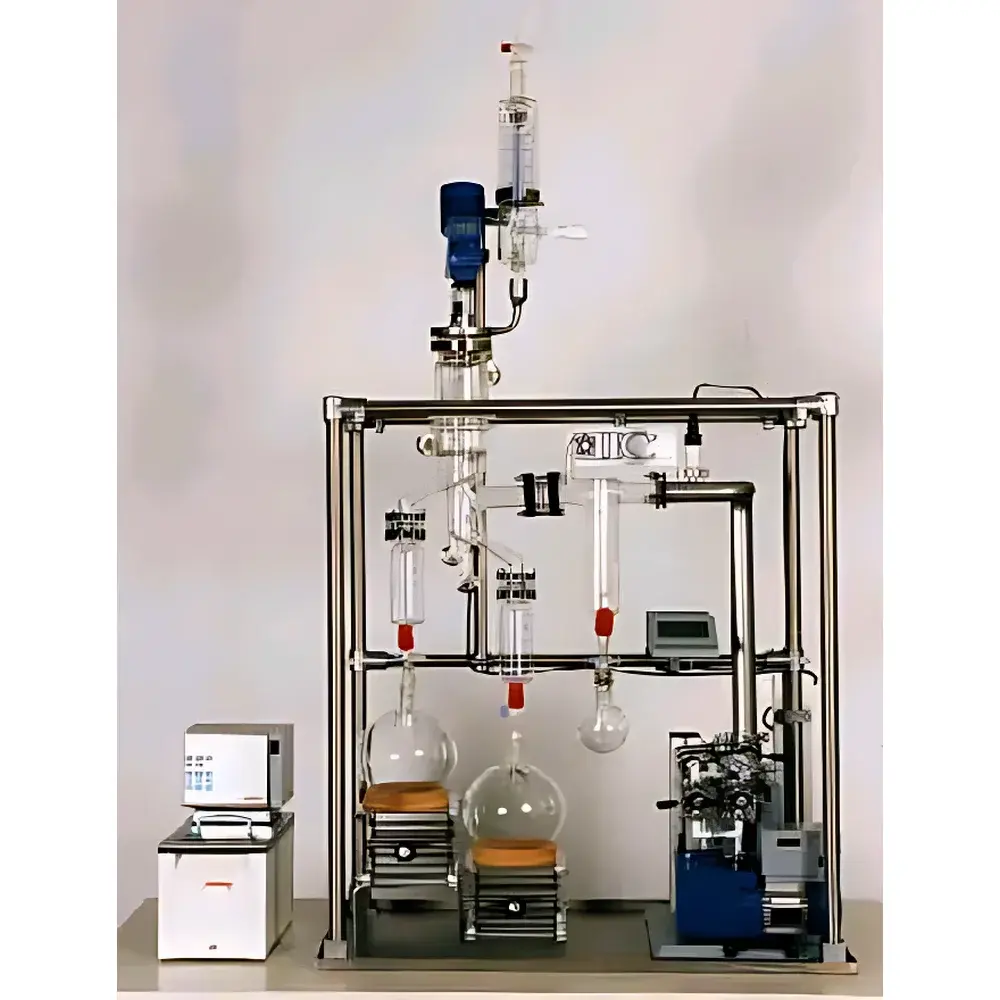
UIC KDL5 Short-Path (Molecular) Distillation System
| Brand | UIC GmbH |
|---|---|
| Origin | Germany |
| Model | KDL5 |
| Feed Rate | 3.0 kg/h |
| Effective Evaporation Area | 5.0 dm² |
| Evaporator Internal Diameter | 10 cm |
| Condenser Area | 8 dm² |
| Collecting Vessels | 2 |
| Construction Material | Borosilicate Glass 3.3 |
| Max Evaporation Temperature | 350 °C |
| Min Operating Pressure | 0.001 mbar |
| Heating Method | Thermostatic Oil Bath |
| Film Formation | Dual-stage (centrifugal + mechanical roller) |
Overview
The UIC KDL5 Short-Path (Molecular) Distillation System is a laboratory-scale, modular vacuum distillation platform engineered for high-precision thermal separation of thermally sensitive, high-boiling, or high-molecular-weight compounds under ultra-high vacuum conditions. Operating on the principle of molecular distillation—where separation occurs based on differences in mean free path rather than boiling point—the KDL5 enables efficient fractionation of substances with minimal thermal degradation. Designed for both R&D process development and small-batch production of high-value materials—including active pharmaceutical ingredients (APIs), cosmetic actives, nutraceuticals, and specialty polymers—the system integrates full visual process monitoring with precise thermal and vacuum control. Its all-borosilicate glass 3.3 construction ensures chemical inertness, optical transparency, and compliance with stringent material compatibility requirements across pharmaceutical and fine chemical applications.
Key Features
- Modular architecture with independently heated zones: evaporator surface, heavy fraction outlet, distillate outlet, and integrated spiral-coil condenser—enabling uniform thermal management across the entire separation pathway.
- Dual-stage film formation mechanism: combines centrifugal distribution with forced mechanical rolling to ensure homogeneous, stable liquid films—even for viscous, waxy, or semi-solid feedstocks at ambient temperature.
- Full-jacketed feed system: includes a calibrated, oil-heated borosilicate glass dosing vessel, heated stainless steel top cover, and jacketed feed line—supporting controlled introduction of solids, pastes, or high-melting-point materials.
- Integrated condenser with 8 dm² surface area—exceeding the 5 dm² evaporation area—to guarantee complete condensation of volatile fractions under sub-0.001 mbar operating pressure.
- Downward-oriented vacuum port located at the evaporator base, aligning vapor flow direction with pumping axis—minimizing backstreaming and secondary contamination while enhancing separation selectivity.
- Real-time visual observation throughout the entire process: from feed introduction and film formation to distillate collection—facilitating method optimization, troubleshooting, and operator training without compromising vacuum integrity.
Sample Compatibility & Compliance
The KDL5 accommodates a broad spectrum of thermally labile and high-boiling samples—including unsaturated fatty acids, vitamin esters, phospholipids, cannabinoids, polyphenols, and polymer oligomers—without decomposition or oxidative side reactions. Its borosilicate glass 3.3 wetted parts meet USP Class A and ISO 3585 specifications for laboratory glassware, ensuring trace-metal-free operation and resistance to thermal shock up to 350 °C. The system supports GLP-compliant documentation when paired with validated data acquisition protocols and is compatible with IQ/OQ/PQ qualification frameworks required for regulated environments. While not pre-certified to FDA 21 CFR Part 11, its analog/digital interface architecture permits integration with compliant LIMS or ELN systems supporting audit trails, electronic signatures, and data integrity controls.
Software & Data Management
The KDL5 operates as a standalone instrument with analog temperature and vacuum instrumentation, supplemented by optional digital controllers for programmable ramp/soak profiles, pressure logging, and real-time feed rate modulation. All critical parameters—including bath temperature, internal evaporator zone temperatures, absolute pressure (via capacitance manometer), and feed volume—are accessible via front-panel displays or analog outputs (4–20 mA / 0–10 V). For advanced data capture, UIC provides optional RS485/Modbus RTU connectivity enabling integration into centralized SCADA or LabVIEW-based monitoring platforms. Raw sensor data can be time-stamped and exported in CSV format for post-run analysis, supporting reproducibility verification and regulatory submission packages.
Applications
- Purification of omega-3 concentrates (EPA/DHA ethyl esters) from fish oil hydrolysates.
- Isolation of tocopherol and phytosterol fractions from deodorizer distillates in vegetable oil refining.
- Deacidification and decolorization of crude cannabis extracts prior to chromatographic refinement.
- Removal of residual monomers and catalysts from silicone prepolymers and acrylic resins.
- Recovery of heat-sensitive flavor compounds (e.g., lactones, terpenoids) from natural extracts without aroma loss.
- Process development for continuous molecular distillation scale-up—leveraging KDL5-derived residence time, film thickness, and mass transfer coefficients.
FAQ
What vacuum level is required for optimal molecular distillation performance on the KDL5?
A base pressure of ≤0.001 mbar (1 × 10⁻³ mbar) is recommended for most high-molecular-weight separations; this is typically achieved using a two-stage rotary vane pump coupled with a diffusion or turbomolecular booster pump.
Can the KDL5 handle solid or semi-solid feedstocks?
Yes—the fully jacketed feed vessel, heated inlet tubing, and top cover allow pre-melting and temperature-controlled delivery of waxes, resins, and crystalline APIs directly into the evaporator zone.
Is the condenser removable for cleaning or maintenance?
The spiral-coil condenser is permanently integrated within the evaporator housing but is fully accessible via disassembly of the upper flange assembly; all glass components are autoclavable and solvent-rinse compatible.
How is distillate collected during extended runs?
Two primary options are available: (1) A.7 Carousel receiver with six 300 mL tubes enables sequential, vacuum-intact fraction collection without process interruption; (2) A.8/A.9 gear pump system transfers distillate continuously from vacuum to atmospheric pressure for inline storage.
Does UIC provide validation support for GMP environments?
UIC supplies comprehensive technical documentation—including dimensional drawings, material certifications (EN 1555-1), and calibration certificates for integrated sensors—to support user-led IQ/OQ execution in compliance with EU Annex 15 and ASTM E2500 standards.



