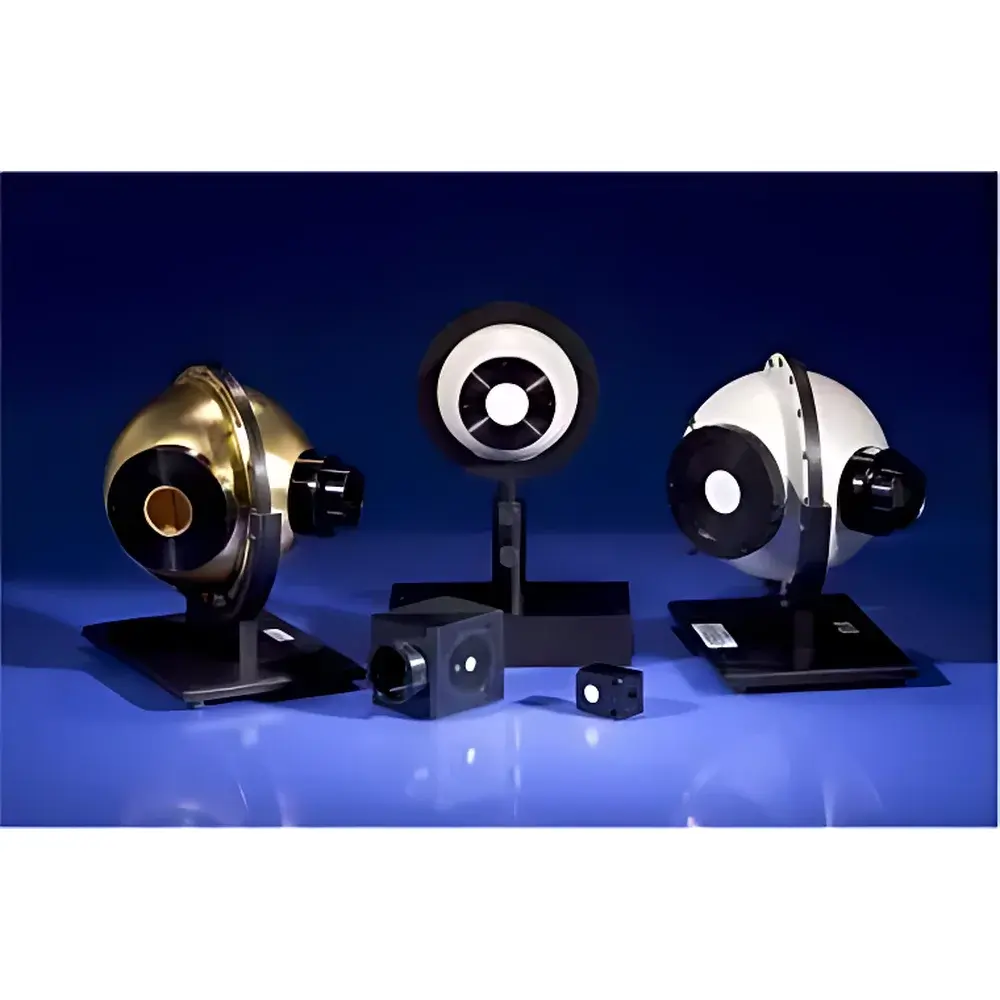
UIS Universal Integrating Sphere Series by Optronic Laboratories
| Brand | Optronic Laboratories |
|---|---|
| Origin | USA |
| Manufacturer Type | Authorized Distributor |
| Product Category | Imported Optical Instrument Component |
| Model | UIS Series Integrating Sphere |
| Component Type | Custom-Configurable Integrating Sphere |
| Coating Options | Spectralon® (UV–VIS–NIR), Gold-Coated (MIR–FIR), Water-Washable PTFE-Based Coatings |
| Diameter Range | 25 mm (1″) to 2032 mm (80″), including standard sizes from 102 mm (4″) to 1930 mm (76″) |
| Configuration Flexibility | Adjustable port count, port geometry (collimated, fiber-coupled, baffle-integrated), internal baffle positioning, and coating selection per spectral band |
| Measurement Modes | 4π (total flux), 2π (hemispherical), and directional reflectance/transmittance |
| Compliance | NIST-traceable calibration support available |
Overview
The UIS Universal Integrating Sphere Series, engineered and supported by Optronic Laboratories (USA), represents over four decades of precision optical design expertise in diffuse light measurement systems. Built upon fundamental principles of Lambertian scattering and multiple internal reflections, the UIS series achieves high spatial uniformity and near-perfect cosine angular response across full 2π or 4π solid angles—critical for photometric, radiometric, and spectroradiometric traceability. Each sphere operates as a spatial integrator, transforming directional or non-uniform incident radiation into a spatially homogeneous exit irradiance at detector ports. This physical behavior underpins its use in absolute radiant flux quantification, spectral responsivity calibration, and bidirectional reflectance distribution function (BRDF) characterization. The UIS platform is not a fixed-form instrument but a modular optical subsystem—designed for integration into larger metrology chains, including spectroradiometers, laser power meters, and automated test benches compliant with CIE S 025/E:2015, ISO/IEC 17025, and ANSI/NIST Handbook 150 guidelines.
Key Features
- Modular architecture enabling fully customizable configurations: selectable sphere diameter (25 mm to 2032 mm), port count (1–8), port type (SMA905, FC/PC, collimated lens mount, or vacuum flange), and internal baffle geometry (fixed or adjustable position)
- Spectral-grade coatings optimized per application band: Spectralon® (≥99% reflectance, 250–2500 nm), gold-evaporated (≥97% reflectance, 2–20 µm), and proprietary water-rinsable PTFE-based coatings (UV-stable, non-dusting, ISO 10110-compliant surface finish)
- Dual-path optical layout option for high-accuracy differential measurements—supporting simultaneous reference and sample channel monitoring without mechanical switching
- NIST-traceable calibration services available for spectral radiance, irradiance, and total luminous flux (lumens), with documented uncertainty budgets per ILAC-P14 requirements
- Integrated thermal management for long-term stability in continuous operation (>8 h at 40 °C ambient); optional active cooling for IR-coated variants
- Mechanically robust aluminum or stainless-steel housing with black anodized interior; ESD-safe construction for cleanroom-compatible deployment (ISO Class 5–7)
Sample Compatibility & Compliance
The UIS series accommodates diverse sample geometries—including LEDs, OLEDs, VCSEL arrays, optical filters, diffusers, thin-film coatings, and biological tissue phantoms—via configurable port placement and removable sample holders. All standard models meet CIE Publication No. 84 (2014) recommendations for integrating sphere geometry and baffle placement. For regulatory compliance, UIS-configured systems support FDA 21 CFR Part 11 audit trails when paired with validated Optronic Lab software (v5.2+), and align with GLP/GMP documentation workflows for pharmaceutical photostability testing (ICH Q1B). UV-grade variants are compatible with ISO 17025-accredited labs performing UV-C disinfection validation (ISO 15858), while gold-coated spheres satisfy ASTM E1933-21 for mid-infrared source calibration.
Software & Data Management
Optronic Laboratories provides the UIS Control Suite—a Windows-based application supporting real-time spectral acquisition, multi-channel synchronization, and automated sequence scripting (e.g., lamp warm-up stabilization, auto-zero, gain optimization). Data export conforms to ASTM E1331 and ISO 11664-1 formats (CIE XYZ, CIELAB, spectral irradiance in W/m²/nm). Raw datasets include full metadata: coating lot number, NIST calibration certificate ID, temperature/humidity logs, and baffle position encoding. Optional API access enables integration with LabVIEW, Python (PyVISA), or MATLAB for custom algorithm development—essential for machine-learning–assisted BRDF modeling or spectral mismatch correction in solar simulator validation.
Applications
- Absolute photometric calibration of LED packages and modules (LM-79, LM-80)
- Radiometric validation of hyperspectral imaging systems (VNIR–SWIR bands)
- Reflectance and transmittance measurement of optical materials per ASTM E903 and ISO 9050
- Luminous efficacy and color rendering index (CRI/Rf) determination for SSL products
- Calibration of satellite Earth observation sensors (e.g., VIIRS, OLI) using solar diffuser simulators
- Quantitative fluorescence quantum yield analysis with dual-excitation path configuration
- Low-light detection system characterization (e.g., single-photon avalanche diodes) using ultra-low-noise 4π collection mode
FAQ
What spectral ranges are supported by different UIS coatings?
Spectralon®-coated spheres operate from 250 nm to 2500 nm; gold-coated variants cover 2 µm to 20 µm; custom hybrid coatings extend coverage to 150 nm (vacuum UV) with MgF₂ window integration.
Can UIS spheres be used in vacuum or controlled atmosphere environments?
Yes—stainless-steel housings with CF-63 or KF-40 flanges are available; outgassing rates comply with NASA SP-R-0022A for space simulation applications.
Is NIST traceability included with purchase?
Standard delivery includes a certificate of conformance; NIST-traceable calibration (with uncertainty budget) is offered as an optional service per ISO/IEC 17025 scope.
How is baffle placement optimized for specific measurement geometries?
Baffle position is calculated using Monte Carlo ray tracing (validated against ASME B46.1 surface scatter models) to minimize first-reflection error; Optronic provides baffle alignment templates and verification protocols.
Are there compatibility constraints when interfacing with third-party spectrometers?
All UIS models feature standardized SMA905, FC/PC, or free-space collimated outputs; fiber coupling loss is characterized per IEC 61290-1-3, and spectral flatness deviation remains <±0.3% across 350–1000 nm with calibrated quartz fibers.