
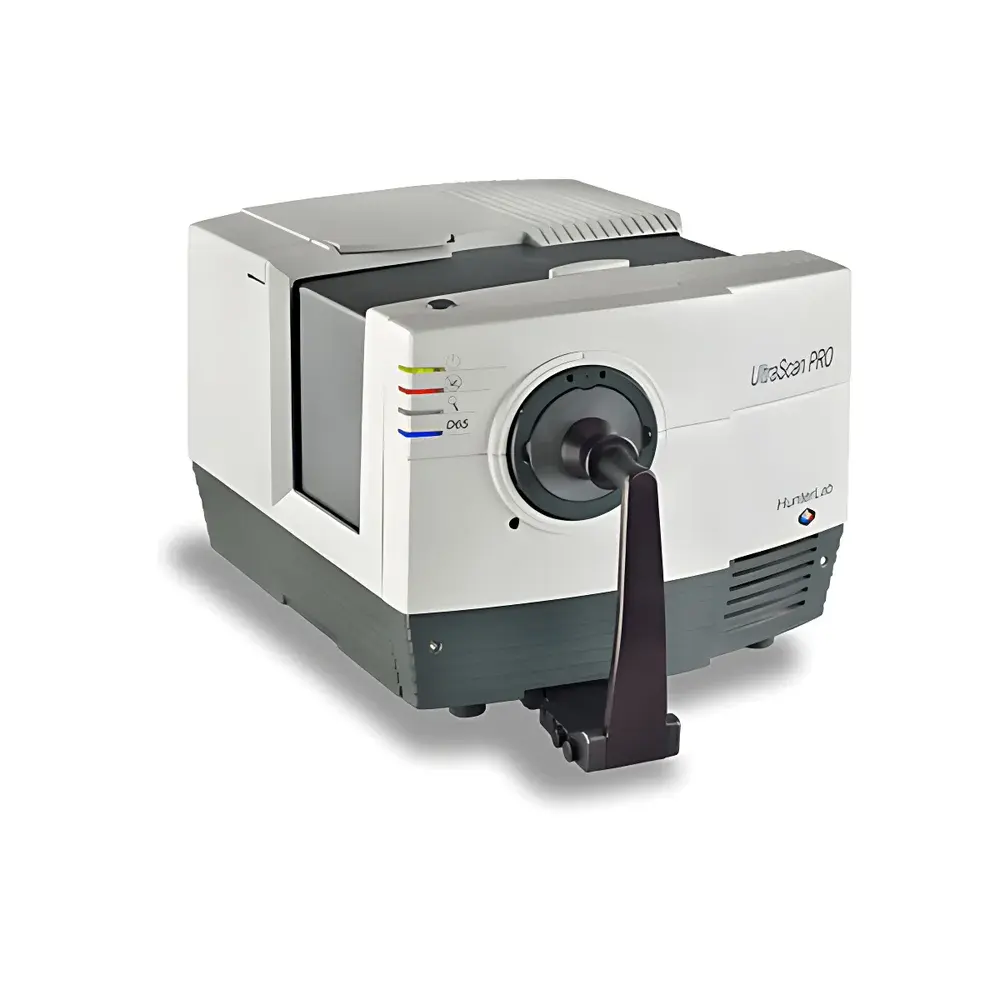
UltraScan PRO PET Solar Backsheet Film Colorimeter by HunterLab
| Brand | HunterLab |
|---|---|
| Origin | USA |
| Model | UltraScan PRO |
| Type | Benchtop Spectrophotometric Colorimeter |
| Optical Geometry | d/8° Integrating Sphere |
| Light Source | Pulsed Xenon Lamp |
| Spectral Range | 350–1050 nm |
| Repeatability | ΔE*ab ≤ 0.02 (mean, CIE Lab) |
Overview
The UltraScan PRO PET Solar Backsheet Film Colorimeter is a high-precision, benchtop spectrophotometer engineered specifically for color quality control of polyethylene terephthalate (PET) films used in photovoltaic module backsheet applications. It operates on the principle of diffuse reflectance and transmittance measurement using a d/8° integrating sphere geometry—compliant with CIE, ASTM E308, ISO 11664, and JIS Z 8722 standards—to deliver metrologically traceable L*, a*, b* values under standardized illuminants (e.g., CIE D65). Its extended spectral coverage from 350 nm to 1050 nm enables simultaneous evaluation of visible color performance and near-infrared (NIR) response—critical for assessing UV stability, thermal reflectivity, and spectral selectivity of solar backsheet materials. Unlike conventional colorimeters limited to the visible range, the UltraScan PRO captures full-spectrum interaction data, supporting advanced metrics such as Yellowness Index (ASTM E313), Whiteness Index (CIE/ISO 11475), Haze (ASTM D1003), Total Transmittance/Reflectance, and K/S (Kubelka-Munk) absorption coefficients—essential for quantifying aging-induced discoloration and optical degradation in outdoor-exposed PV components.
Key Features
- True dual-beam, dual-grating optical architecture with real-time reference compensation for long-term photometric stability
- 350–1050 nm spectral range with 2 nm effective resolution and 5 nm reporting interval—enabling NIR-inclusive color analysis beyond standard CIELAB
- Pulsed xenon lamp system with three independent flash sources ensures consistent irradiance across UV, visible, and NIR bands without thermal drift
- 15.2 cm (6″) Spectraflect-coated integrating sphere with automated specular component included/excluded (SCI/SCE) modes
- Three selectable measurement apertures: 19 mm (LAV), 9 mm (MAV), and 4 mm (SAV) for flexible sampling of textured, laminated, or narrow-width PET backsheet strips
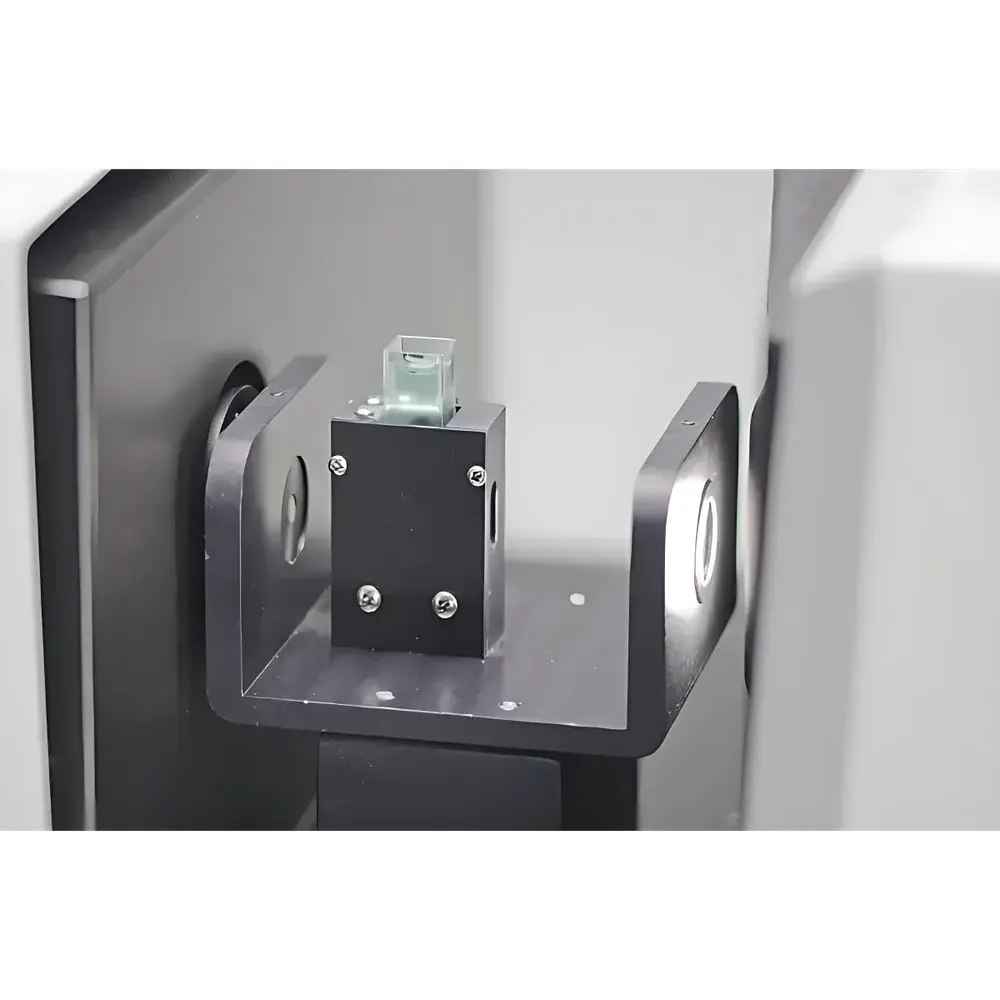
- Integrated transmission chamber accommodating up to 80 mm path-length cuvettes—supporting both opaque and semi-transparent film characterization
- Measurement time ≤ 2 seconds per reading; photometric accuracy ±0.003% (0.01% display resolution); wavelength accuracy ±0.1 nm
Sample Compatibility & Compliance
The UltraScan PRO accommodates rigid and flexible PET-based backsheet substrates—including fluoropolymer-coated, acrylic-laminated, and co-extruded multilayer films—regardless of surface finish (matte, gloss, embossed) or optical behavior (opaque, translucent, or selectively transmitting). It meets regulatory requirements for color consistency verification in IEC 61215-2 (photovoltaic module qualification), UL 1703 (PV module safety), and ISO 9001-compliant manufacturing environments. Data integrity adheres to FDA 21 CFR Part 11 when paired with HunterLab EasyMatch-QC software featuring audit trail, electronic signatures, and role-based access control. Instrument calibration is traceable to NIST SRM standards, and routine verification follows ASTM D2244 and ISO 13655 protocols for color difference reporting.
Software & Data Management
HunterLab EasyMatch-QC v5.x provides comprehensive color data management tailored for solar material QA/QC workflows. The software supports custom pass/fail tolerancing against master standards (e.g., Delta E*ab ≤ 0.5 for batch-to-batch PET film matching), statistical process control (SPC) charting, trend analysis over time, and automated report generation compliant with GLP/GMP documentation practices. It natively exports spectral data in ASTM E2534-compliant .qtx format and integrates with LIMS platforms via OPC UA or CSV export. Optional modules include NIR spectral overlay comparison, metamerism index calculation (MI), and multi-angle color mapping for anisotropic backsheet surfaces.
Applications
- Quantitative assessment of yellowing and graying in aged PET backsheet films under accelerated UV/weathering tests
- Batch release testing for color uniformity across production rolls (±0.02 ΔE*ab repeatability supports tight specification limits)
- Correlation of NIR reflectance profiles with thermal emissivity and module operating temperature predictions
- Verification of pigment dispersion homogeneity in colored backsheet formulations (e.g., black PET for bifacial modules)
- Monitoring optical property shifts during lamination, corona treatment, or fluoropolymer coating processes
- Supporting root-cause analysis of delamination-related color variation through layer-specific reflectance modeling
FAQ
Does the UltraScan PRO comply with IEC 61215-2 Annex D for backsheet color stability testing?
Yes—the instrument’s d/8° geometry, D65 illumination, and 350–1050 nm spectral coverage satisfy the spectral acquisition requirements outlined in IEC 61215-2:2016 Annex D for measuring color shift after damp heat and UV exposure cycles.
Can it measure PET films with anti-reflective or hydrophobic coatings?
Yes—automated SCI/SCE mode selection allows separation of surface reflection from bulk scattering effects, enabling accurate color assessment regardless of top-layer optical interference.
Is spectral data export supported for third-party aging model development?
Yes—full 350–1050 nm reflectance/transmittance spectra are exportable in ASCII, .qtx, or .csv formats, suitable for integration into MATLAB, Python-based degradation forecasting models, or DOE statistical analysis tools.
What maintenance is required to sustain NIST-traceable accuracy?
Annual recalibration using certified ceramic tile standards (e.g., HunterLab CR-400/CR-500 series) and quarterly verification with white/dark reference tiles are recommended per ISO/IEC 17025 guidelines.
How does it differ from standard visible-range colorimeters for solar backsheet QC?
Standard instruments (380–780 nm only) cannot detect NIR-driven chromatic shifts that correlate strongly with polymer chain scission and UV absorber depletion—making the UltraScan PRO uniquely capable of predictive color stability assessment.



