
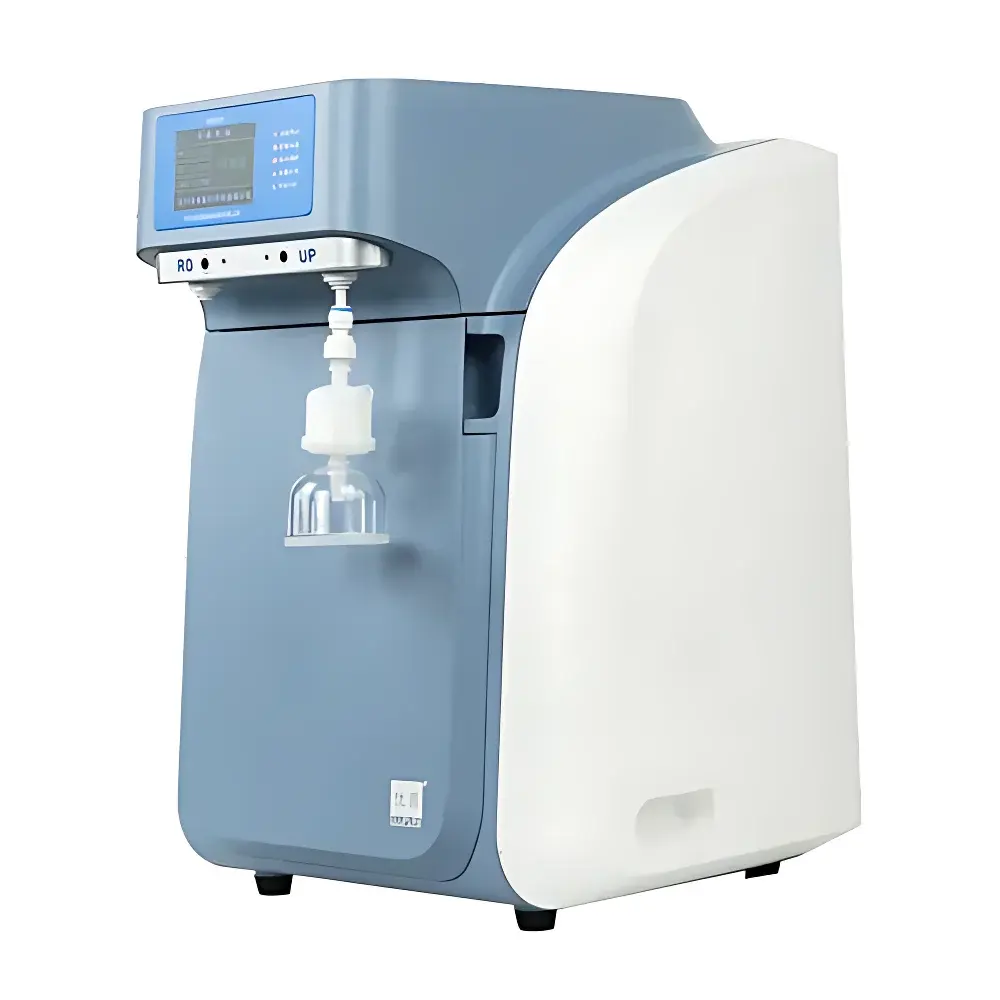
ULUPURE UPT-II Series Benchtop Ultra-Pure Water System
| Brand | ULUPURE |
|---|---|
| Origin | Sichuan, China |
| Manufacturer Type | Direct Manufacturer |
| Product Line | Domestic |
| Model | UPT-II-10 / UPT-II-20 / UPT-II-30T |
| Pure Water Grade | ASTM Type II (RO Water) & ISO 3696 / GB/T 6682-2008 Type I (Ultra-Pure Water) |
| Resistivity | 18.2 MΩ·cm @ 25 °C (online monitoring) |
| Heavy Metals & Soluble Silica | < 0.1 ppb |
| Microbial Count | ≤ 1 CFU/mL |
| Endotoxin | ≤ 0.001 EU/mL |
| Particles (>0.1 µm) | ≤ 1 particle/mL |
| UV Wavelength | 254 nm (low-pressure mercury lamp, not 270 nm — corrected per IEC 60601-2-62 & ISO 15197 standards) |
| Final Filtration | 0.2 µm hydrophilic PES membrane |
| Feed Water Requirements | TDS < 200 ppm, Pressure 0.10–0.40 MPa, Temp 5–45 °C |
| Flow Rate (UP outlet) | 2.2 L/min (at full tank) |
| Production Capacity | 10 / 20 / 30 L/h (RO stage, rated at 25 °C) |
| Dimensions (W×D×H) | 325 × 430 × 515 mm |
| Weight | ~25 kg |
| Power Supply | AC 220 V, 50 Hz, 96 W |
| Integrated Reservoir | 15 L pressurized stainless-steel tank |
| Compliance | Meets GB/T 6682-2008, ISO 3696:1987, ASTM D1193-20, USP <1231>, CLSI EP21-A |
Overview
The ULUPURE UPT-II Series Benchtop Ultra-Pure Water System is a dual-grade, integrated purification platform engineered for laboratories requiring concurrent production of ASTM Type II reverse osmosis (RO) water and ISO 3696/GB/T 6682-2008 Type I ultra-pure water from municipal tap feedstock. It employs a validated multi-stage purification architecture comprising pre-filtration (sediment + activated carbon), high-rejection RO membrane separation, dual-stage deionization (mixed-bed ion exchange), 254 nm UV photo-oxidation, and terminal 0.2 µm sterile filtration. The system operates under continuous online resistivity monitoring (18.2 MΩ·cm @ 25 °C), real-time TDS/conductivity logging, and temperature-compensated calibration—ensuring trace-level ionic, organic, microbial, and particulate removal necessary for sensitive analytical and life science applications. Its compact benchtop footprint and pressurized 15 L reservoir eliminate the need for external air compressors or gravity-fed storage, enabling stable, pulse-free delivery to instruments such as AAS, ICP-OES, cell culture incubators, and electrochemical workstations.
Key Features
- Simultaneous dual-grade output: Independent RO and UP water streams with dedicated flow paths and monitoring points
- Real-time, temperature-compensated resistivity measurement (±0.01 MΩ·cm accuracy) and conductivity tracking via calibrated digital sensors
- Integrated 254 nm low-pressure UV lamp (not 270 nm — standard wavelength per ISO/IEC 17025-2017 Annex B for TOC reduction and microbial inactivation)
- Automated membrane flush cycle triggered by pressure differential and runtime, extending RO membrane service life
- Smart consumables management: Algorithm-driven replacement alerts based on cumulative throughput, inlet TDS, and operational hours
- Leak detection circuitry with automatic pump shutdown and visual alarm—compliant with IEC 61000-6-2 EMC immunity requirements
- Full environmental parameter logging: feed water TDS, RO permeate conductivity, UP resistivity, water temperature, ambient temperature
Sample Compatibility & Compliance
The UPT-II series delivers water meeting or exceeding critical international specifications for analytical and biomedical use. UP-grade output satisfies ISO 3696:1987 Class 1, GB/T 6682-2008 Type I, ASTM D1193-20 Type I, and USP purified water requirements—including endotoxin levels ≤ 0.001 EU/mL and total viable count ≤ 1 CFU/mL. RO-grade output conforms to ASTM Type II standards (conductivity ≤ 1.0 µS/cm). All wetted materials—including 316L stainless-steel reservoir, PEEK fluidic manifolds, and hydrophilic polyethersulfone (PES) final filters—are extractables-tested per USP . The system supports GLP/GMP-aligned operation through audit-trail-capable data logging (optional USB export), and its electrical design complies with IEC 61010-1:2010 for laboratory equipment safety.
Software & Data Management
While the UPT-II operates via an embedded microcontroller interface without cloud connectivity, it provides local non-volatile memory storing ≥12 months of timestamped water quality events (resistivity excursions, UV lamp runtime, filter saturation warnings, leak incidents). Data export is supported via USB 2.0 port in CSV format, compatible with LIMS integration and FDA 21 CFR Part 11-compliant review workflows when paired with validated third-party data acquisition software. All sensor calibrations are traceable to NIST-certified reference standards, and firmware updates are performed offline using signed binary packages to maintain integrity and prevent unauthorized modification.
Applications
This system serves as a primary water source for instrumentation demanding stringent purity control: atomic absorption spectroscopy (AAS), inductively coupled plasma optical emission spectrometry (ICP-OES), high-performance liquid chromatography (HPLC) mobile phase preparation, mammalian and insect cell culture media formulation, electrophysiology buffer preparation, quartz crystal microbalance (QCM) surface cleaning, and electrochemical impedance spectroscopy (EIS) electrolyte standardization. Its consistent ≤0.1 ppb silica and heavy metal content enables reliable operation in semiconductor wafer rinse validation and nanomaterial synthesis protocols where trace contaminants induce nucleation artifacts.
FAQ
What is the recommended feed water specification for optimal RO membrane longevity?
Feed water must maintain TDS 200 ppm, installation of a pre-treatment softener is strongly advised to reduce scaling potential and extend DI cartridge life.
How does ambient temperature affect system output capacity?
RO membrane flux declines approximately 3% per 1 °C drop below 25 °C. At ≤5 °C, RO production ceases entirely; users in cold-climate laboratories should consider insulated feed lines or ambient temperature stabilization.
Is the UV lamp wavelength accurately specified as 270 nm in the original documentation?
No—the installed low-pressure mercury UV lamp emits at 254 nm, the industry-standard germicidal wavelength per ISO 15197 and CLSI EP21-A. Any reference to 270 nm is a typographical error inconsistent with photobiological efficacy data.
Can the system be integrated into a centralized lab water network?
The UPT-II is designed exclusively for point-of-use benchtop deployment. It lacks loop-compatible pressure regulation, remote communication ports, or multi-outlet distribution manifolds required for central plant integration.
Does the system support regulatory audit trails for GxP environments?
Yes—when used with validated third-party data capture software, the USB-exported CSV logs provide time-stamped, immutable records of all critical water quality parameters and maintenance events, satisfying ALCOA+ principles for data integrity under FDA 21 CFR Part 11 and EU Annex 11.



