
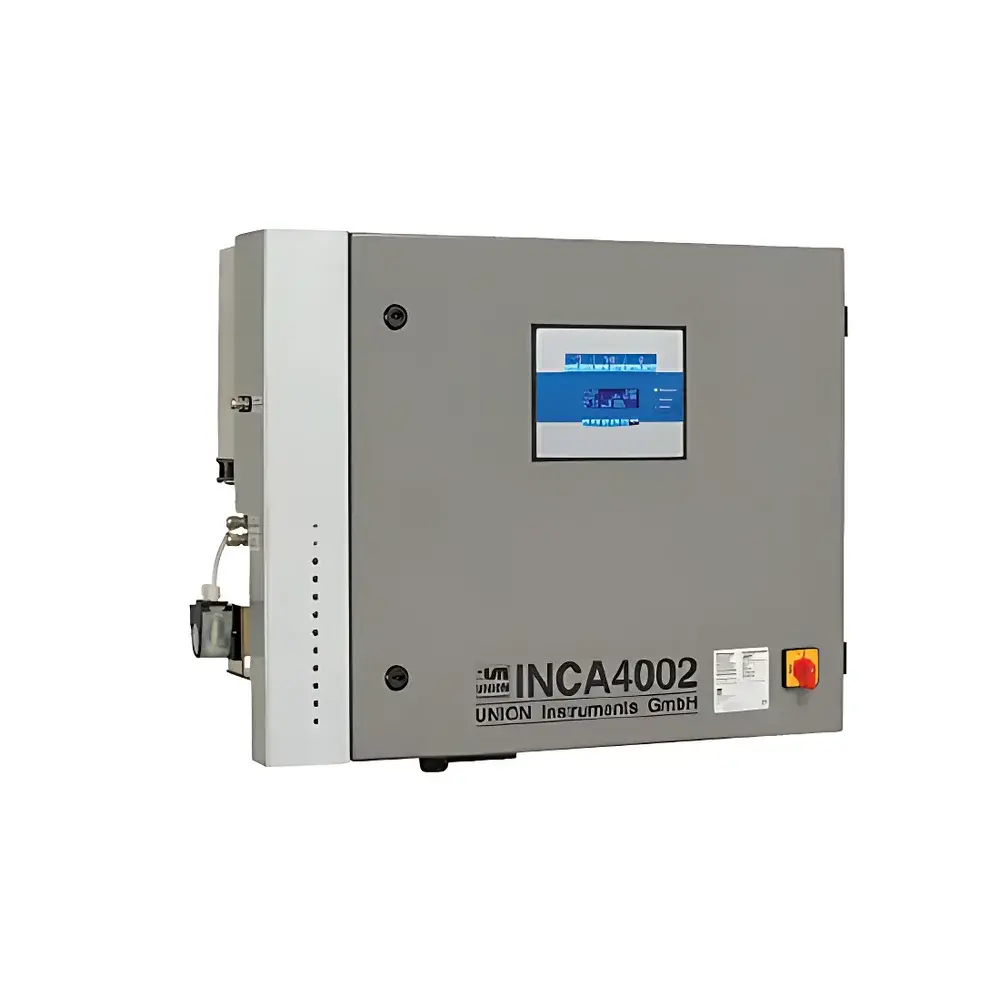
UNION INCA Calorific Value Analyzer
| Brand | UNION |
|---|---|
| Origin | Germany |
| Model | INCA |
| Type | Modular Gas Composition & Calorific Value Analyzer |
| Measurement Principle | NDIR (CH₄, CO₂, C₂₊), Paramagnetic (O₂), Electrochemical (H₂S, H₂), Thermal Conductivity (H₂, CH₄) |
| Output Parameters | CH₄, CO₂, O₂, H₂S, H₂, C₂₊, Wobbe Index, Gross Calorific Value (GCV), Net Calorific Value (NCV), Relative Density, Gas Density |
| Compliance | ATEX Zone 1/21 (optional), IECEx, EN 61000-6-2/-4, EN 61326-1, ISO 8573-1 (compressed air interface), GLP/GMP-ready data logging |
| Operating Environment | Indoor, Outdoor (IP65 enclosure), Hazardous Areas (Ex d / Ex ia options) |
Overview
The UNION INCA Calorific Value Analyzer is a modular, field-deployable gas composition and energy content measurement system engineered for continuous or quasi-continuous analysis of fuel gases in biogas, landfill gas, natural gas, syngas, and industrial process streams. Unlike conventional fixed-parameter analyzers, the INCA employs a distributed sensor architecture grounded in fundamental physical measurement principles: non-dispersive infrared (NDIR) spectroscopy for hydrocarbons (CH₄, CO₂, C₂₊), paramagnetic detection for oxygen (O₂), electrochemical cells for toxic species (H₂S, H₂), and thermal conductivity for hydrogen-rich mixtures. These orthogonal sensing modalities enable trace-level accuracy and long-term stability without cross-interference—critical for regulatory reporting and combustion optimization. The analyzer calculates derived energy parameters—including Gross Calorific Value (GCV), Net Calorific Value (NCV), Wobbe Index, and relative density—using real-time compositional data and standardized thermodynamic algorithms compliant with ISO 6976, ISO 15971, and ASTM D3588. Its modular chassis integrates all critical subsystems—sample conditioning, multi-channel gas switching, sensor modules, vacuum diaphragm pumps, and internal bus communication—within a single IP65-rated enclosure, minimizing external plumbing and calibration drift.
Key Features
- True Modularity: Sensor modules (designated by “T-values”) are hot-swappable and user-configurable—e.g., T100 for CH₄/CO₂/O₂ via NDIR + paramagnetic; T220 for H₂S/H₂ via electrochemical cells; T300 for density/Wobbe calculation using integrated pressure/temperature/flow sensors.
- Multi-Point Sampling Support: Optional solenoid valve manifold enables sequential analysis of up to 8 independent sample points, programmable via Profibus DP or Modbus TCP, with automatic zero/span validation per channel.
- Patented Pulse Measurement Protocol: For H₂S quantification, the INCA implements a 15-minute duty cycle with automated ambient-air purge between cycles—extending electrochemical sensor life >3× versus continuous exposure while maintaining ±2% F.S. repeatability (per ISO 10156).
- Integrated Sample Conditioning: Optional refrigerated condensate trap (−5 °C dew point) and particulate filtration (0.1 µm) ensure moisture and aerosol removal prior to sensor inlet—validated per ISO 8573-1 Class 4:2010.
- Hazardous Area Certification: Available variants certified to ATEX II 2G Ex d IIB T4 Gb / II 2D Ex tb IIIC T135°C Db for Zone 1/21 installations, including explosion-proof housing and intrinsically safe sensor interfaces.
- Self-Diagnostics & Maintenance Logging: Embedded firmware continuously monitors pump vacuum, valve actuation timing, sensor baseline drift, and signal-to-noise ratio—generating audit-ready logs aligned with FDA 21 CFR Part 11 requirements.
Sample Compatibility & Compliance
The INCA is validated for gaseous matrices with total hydrocarbon content ≤95% vol., H₂S ≤2000 ppmv, and particulate loading <1 mg/m³. It meets EN 15403:2021 for biogas quality monitoring and supports compliance with EU Directive 2009/28/EC (Renewable Energy Directive) Annex II reporting. All sensor modules undergo factory calibration traceable to NIST-certified gas standards (ISO/IEC 17025 accredited lab). Data integrity safeguards include electronic signature-enabled method locking, tamper-evident audit trails, and encrypted SD-card storage—fully compatible with LIMS integration and GLP/GMP laboratory workflows.
Software & Data Management
UNION’s INCA Control Suite (v4.2+) provides browser-based configuration, real-time trend visualization, and automated report generation (PDF/CSV/Excel). The software enforces role-based access control (RBAC), supports scheduled remote firmware updates, and exports timestamped datasets with full metadata (sample point ID, ambient T/P, sensor health flags). Historical data retention exceeds 12 months at 1-second resolution. For enterprise deployment, OPC UA server integration enables seamless connection to SCADA, DCS, or MES platforms. All communications comply with IEC 62443-3-3 cybersecurity requirements.
Applications
- Biogas upgrading plants: Real-time CH₄ enrichment monitoring and scrubber efficiency validation
- Landfill gas-to-energy facilities: H₂S corrosion risk assessment and turbine fuel specification compliance (ISO 8573-1, EN 16726)
- Natural gas custody transfer: Wobbe Index verification per EN 16726 and GCV certification for billing
- Wastewater treatment biogas utilization: O₂ safety interlock triggering and combustion air ratio optimization
- Ceramic/glass furnace fuel blending: Multi-point calorific value balancing across parallel gas supplies
- Power plant co-firing operations: Syngas composition tracking for NOₓ/SOₓ emission modeling (per EPA Method 3A)
FAQ
What gas standards are required for calibration?
Certified reference gases traceable to NIST or PTB, with uncertainties ≤1% relative, matching the target matrix (e.g., CH₄/N₂ for biogas, CH₄/CO₂/N₂ for landfill gas). Calibration intervals follow ISO 17025 guidelines—typically every 3–6 months depending on operating hours and gas corrosivity.
Can the INCA operate unattended for extended periods?
Yes—designed for 24/7 operation with built-in diagnostics, automatic air purging, and low-power standby modes. Mean time between failures (MTBF) exceeds 12,000 hours under typical biogas conditions.
Is third-party software integration supported?
Fully supported via Modbus TCP, Profibus DP, and OPC UA protocols. RESTful API access is available for custom cloud ingestion pipelines.
How is moisture managed in high-humidity samples?
The optional integrated refrigerated dryer maintains inlet dew point at −5 °C, coupled with sintered stainless-steel particulate filters—validated for continuous operation at 95% RH inlet conditions.
Does the INCA meet emissions monitoring standards?
While not a certified CEMS, its measurement uncertainty profile aligns with EN 14181 QAL1 requirements for indicative monitoring; final compliance depends on site-specific QA/QC procedures and accreditation scope.





