
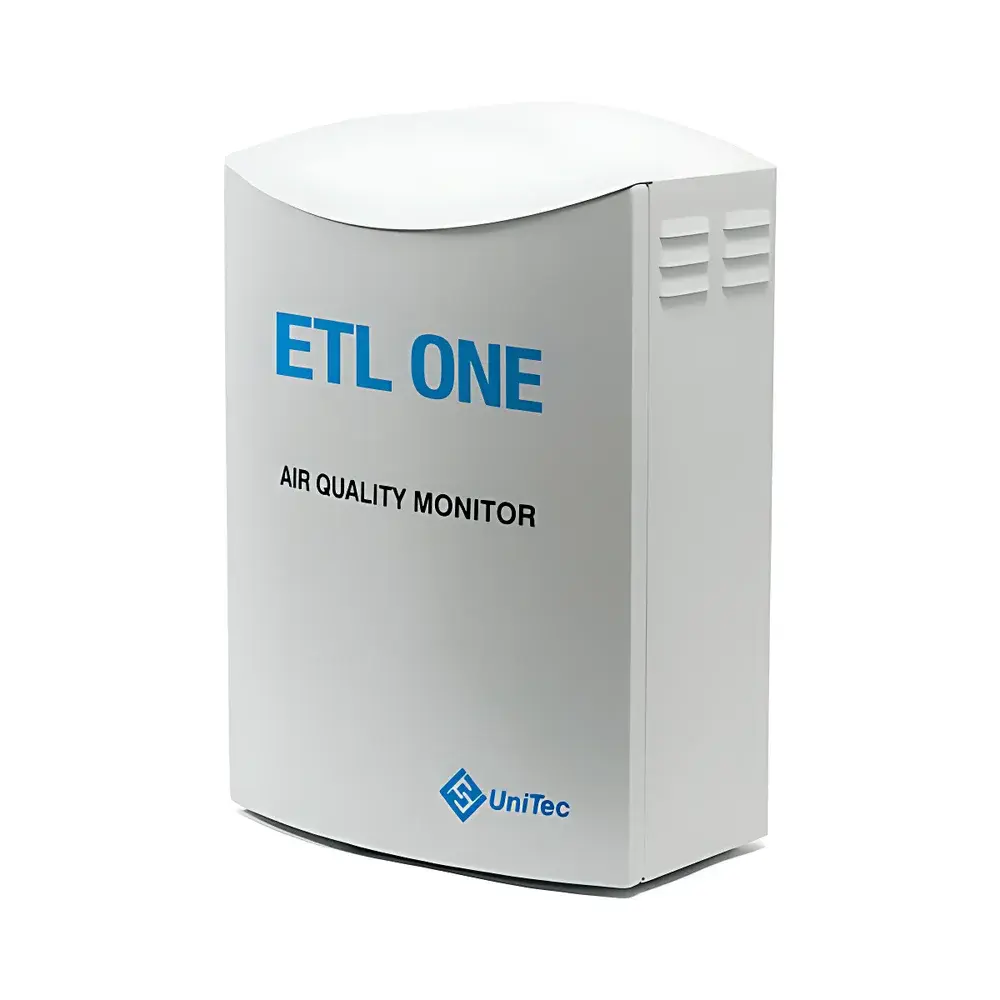
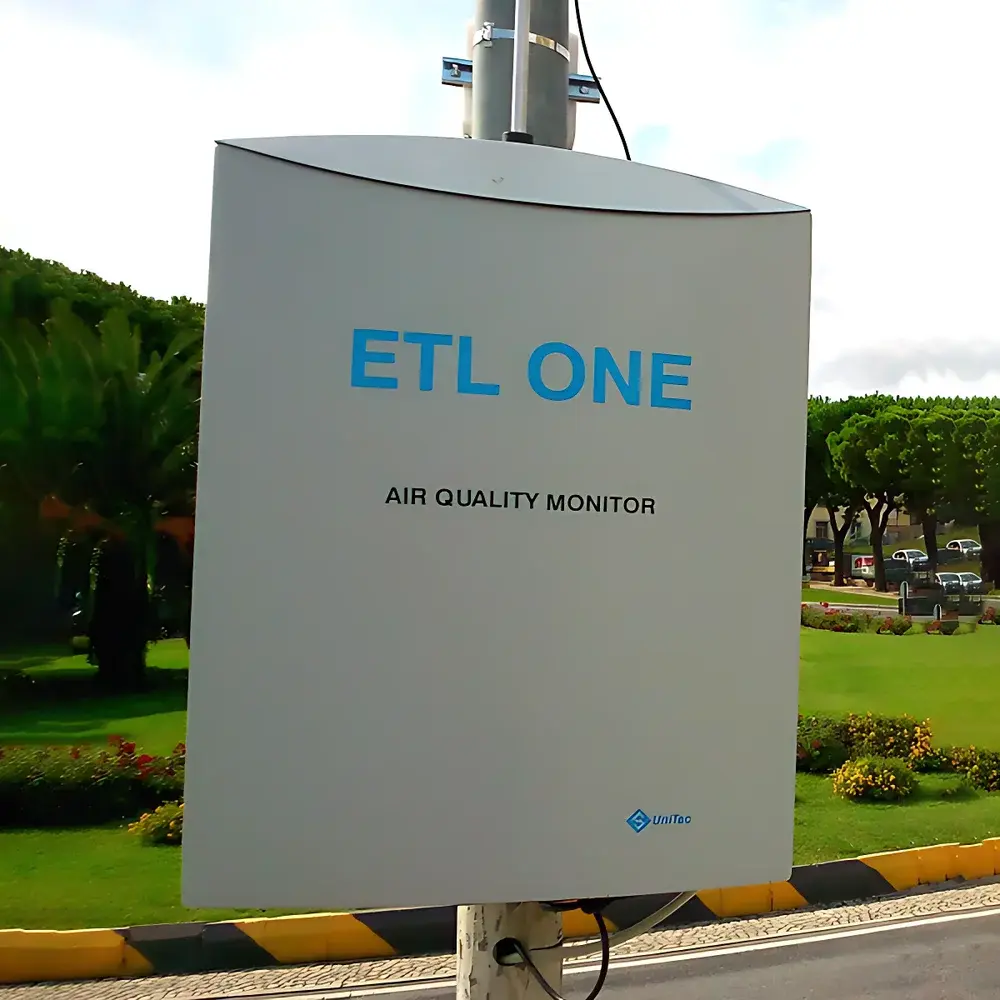
Unitec ETL-One Automatic Air Quality Monitoring System
| Brand | UNITEC |
|---|---|
| Origin | Italy |
| Model | ETL-One |
| Pollutants Measured | SO₂, H₂S, CO₂, VOC, NH₃, C₆H₆, PM₁, PM₂.₅, PM₁₀ |
| Sensor Technologies | TF-MOS (metal oxide semiconductor), Electrochemical (EC), Non-Dispersive Infrared (NDIR), Orthogonal Light Scattering (for PM), Optical Particle Counting (OPC) |
| Operating Temperature | −20 °C to +50 °C |
| Humidity Range | 10–95% RH (non-condensing) |
| Enclosure Rating | IP55 |
| Power Options | 220 VAC / 110 VAC / 12 VDC |
| Typical Power Consumption | 50–70 W |
| Dimensions | 540 × 710 × 310 mm |
| Weight | 15 kg |
Overview
The Unitec ETL-One is a fully integrated, field-deployable automatic air quality monitoring system engineered for continuous, real-time measurement of gaseous pollutants and particulate matter in ambient outdoor environments. Designed and manufactured in Italy, the ETL-One complies with EU Directive 2008/50/EC on ambient air quality and cleaner air for Europe, supporting regulatory-grade data acquisition for official monitoring networks. Its architecture integrates proprietary Unitec SENS-IT gas sensors—based on three validated transduction principles (thick-film metal oxide semiconductor [TF-MOS], electrochemical [EC], and non-dispersive infrared [NDIR])—with orthogonal light scattering (OLS) and optical particle counting (OPC) modules for aerosol characterization. Unlike laboratory-based analyzers requiring conditioned sample air, the ETL-One operates autonomously in unsheltered outdoor installations without active cooling, drying, or dilution systems—enabled by its IP55-rated enclosure and thermally robust sensor design. The system delivers high selectivity and sensitivity (e.g., sub-ppb detection limits for O₃ and C₆H₆) while maintaining long-term baseline stability through automated zero-correction routines for particulate modules.
Key Features
- Proprietary SENS-IT sensor platform: Each gas-specific sensor connects via dedicated interface to the central data logger, enabling modular replacement without system downtime or recalibration of adjacent channels.
- Dual particulate measurement capability: Integrated OLS module supports selectable PM₁, PM₂.₅, or PM₁₀ reporting; optional OPC module provides simultaneous, independent quantification of PM₁, PM₂.₅, and PM₁ with enhanced dynamic range (up to 6,000 µg/m³).
- Automated zero calibration: Both particulate modules execute scheduled auto-zero cycles daily, minimizing drift and ensuring metrological traceability over extended deployment periods.
- Low-power, high-reliability operation: Consumes only 50–70 W depending on configuration; compatible with solar-battery hybrid power systems (including charge controller and 24-hr regulation) for off-grid installations.
- Field-ready mechanical design: Compact 540 × 710 × 310 mm footprint, 15 kg mass, and IP55 ingress protection allow direct pole mounting without shelter or climate control infrastructure.
- Flexible communication architecture: Standard RS232 ASCII output; optional GSM or UMTS modems support secure VPN tunnels for remote telemetry, firmware updates, and configuration management.
Sample Compatibility & Compliance
The ETL-One is validated for ambient air sampling under natural atmospheric conditions (−20 °C to +50 °C, 10–95% RH, non-condensing). Its SENS-IT sensors are type-approved for fixed-site reference monitoring per EN 14625 (O₃), EN 14626 (NO₂), EN 14627 (SO₂), and EN 15267-3 (performance certification of automated measuring systems). Particulate modules conform to EN 12341 (PM₁₀ and PM₂.₅ reference methods) and EN 16450 (OPC performance requirements). Data integrity meets GLP-aligned audit trails: all zero events, calibration logs, sensor status flags, and environmental metadata (temperature, humidity, pressure if meteorological station attached) are time-stamped and stored internally. Optional UMTS modem enables encrypted data transmission compliant with GDPR and national environmental data portal protocols.
Software & Data Management
The ETL-One supports three interoperable software tools: @COM3000 (local PC-based configuration, firmware update, and raw data download in CSV/ASCII); ETL BAR (real-time dashboard with configurable alarm thresholds, trend plots, and multi-parameter overlays); and ETL TOTEM (full-featured client application supporting multilingual UI, automated report generation, QA/QC flagging, and export to national databases such as EEA’s AirBase format). All software packages enforce role-based access control and maintain immutable logs of user actions per ISO/IEC 17025:2017 Annex A.2.3. Internal flash memory stores ≥12 months of 15-minute averaged data (including min/max/avg per parameter), with timestamp resolution of ±1 s. Data export supports ISO 8601-compliant UTC timestamps and SI-unit formatting (e.g., µg/m³, ppb, ppm).
Applications
- Urban background and traffic-oriented monitoring networks for compliance with EU Air Quality Limit Values.
- Industrial fence-line monitoring at petrochemical plants, waste treatment facilities, and landfill sites—particularly for NH₃, H₂S, VOC, and benzene (C₆H₆) tracking.
- Early-warning systems for sensitive receptors (schools, hospitals) using real-time threshold alerts for PM₂.₅ and O₃.
- Long-term trend analysis in regional air quality assessment programs requiring stable, low-maintenance instrumentation.
- Mobile monitoring deployments via vehicle-mount kits or temporary tripod installations supported by 12 VDC operation and solar options.
FAQ
Does the ETL-One meet EU reference method equivalency requirements?
Yes—SENS-IT sensors and particulate modules are certified per EN 15267-3 and EN 12341, granting equivalency to reference methods under Directive 2008/50/EC for official reporting.
Can the system operate without grid power?
Yes—when equipped with the optional solar power kit (panel, deep-cycle battery, and 24-hour regulator), it supports continuous operation for up to five gas sensors, one meteorological station, and GSM telemetry.
How frequently does the particulate module perform zero calibration?
The internal OLS and optional OPC modules execute an automated zero cycle once every 24 hours, triggered during low-activity periods (e.g., nighttime) to avoid interference with ambient sampling.
Is remote firmware update supported?
Yes—via UMTS modem with authenticated TLS 1.2 connection, enabling secure over-the-air updates and parameter reconfiguration without site visits.
What meteorological parameters can be integrated?
The optional co-located weather station measures wind speed/direction, ambient temperature, relative humidity, barometric pressure, rainfall, global solar radiation, and UV index—all synchronized to air quality data streams with common UTC timestamps.
Related Products







