
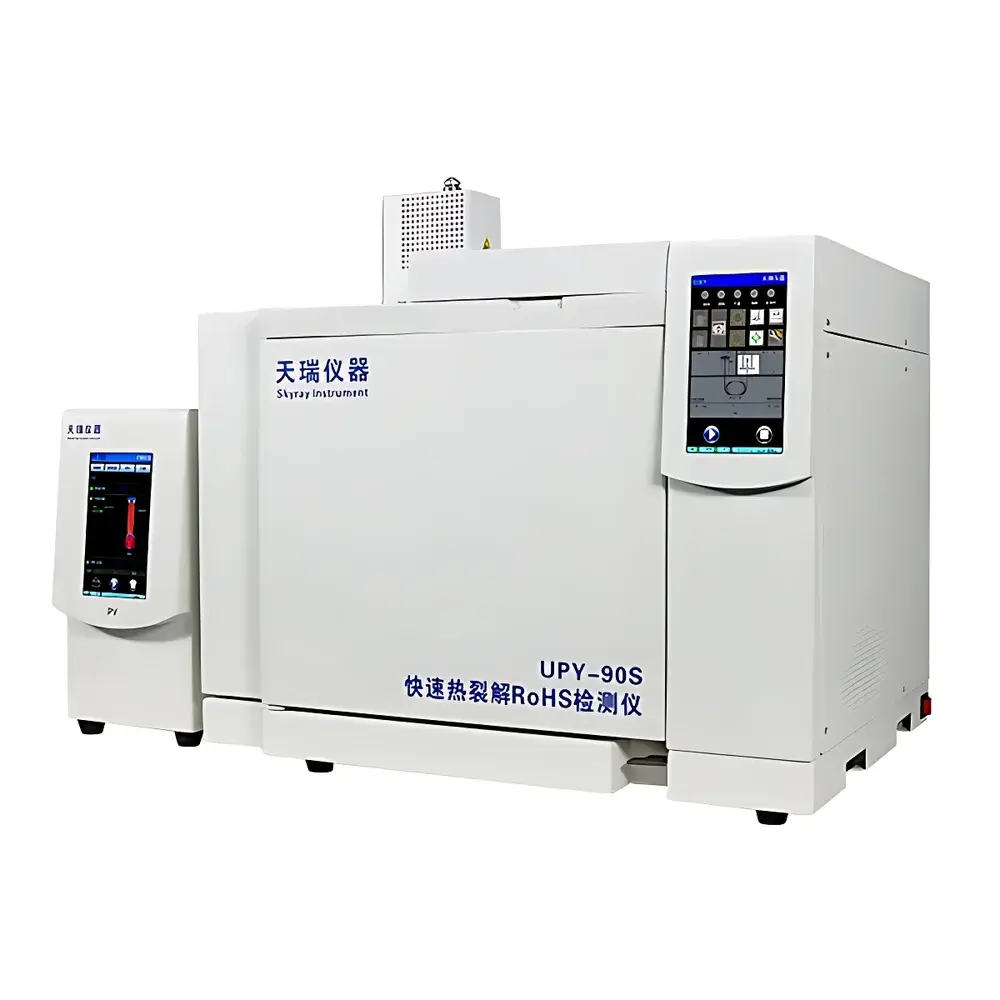
UPY-90S Rapid Pyrolysis-GC System for RoHS Compliance Testing
| Brand | Skyray Instrument |
|---|---|
| Model | UPY-90S |
| Origin | Jiangsu, China |
| Manufacturer Type | Direct Manufacturer |
| Instrument Type | Laboratory Gas Chromatograph (GC) with Integrated Pyrolysis Unit |
| Application Scope | Universal RoHS Screening (Phthalates, TBBPA, MCCPs, PBBs, PBDEs) |
| Detection Principle | Pyrolysis-Thermal Desorption Coupled with Capillary GC-FID/ECD (Configurable) |
| Sample Introduction | Solid/Liquid/Gel/Powder via Direct Probe or Auto-sampler (36/72-position optional) |
| Control Interface | 7-inch IP65-rated IPS Touchscreen |
| Software | Proprietary Pyrolysis-GC Control Suite with Audit Trail, CFR Part 11 Compliance Mode, and Custom Report Engine |
| Regulatory Alignment | Designed to support ISO/IEC 17025 workflows, ASTM D7984 (phthalates), IEC 62321-8:2017 (RoHS), and EU Directive 2015/863 (RoHS 2.0 & 3.0) |
Overview
The UPY-90S Rapid Pyrolysis-GC System is a fully integrated laboratory gas chromatograph engineered specifically for regulatory screening of restricted substances under the RoHS Directive (2011/65/EU), including the four phthalate esters added in Amendment 2015/863 (DIBP, BBP, DBP, DEHP), as well as TBBPA, medium-chain chlorinated paraffins (MCCPs), PBBs, and PBDEs. Unlike conventional solvent-extraction-based methods, the UPY-90S employs direct thermal pyrolysis coupled with capillary gas chromatography — eliminating derivatization, acid digestion, or organic solvent use. This pyrolysis-thermal desorption (Py/TD) approach converts target analytes into volatile fragments in situ, which are then separated on a fused-silica column and detected using flame ionization (FID) or electron capture (ECD) detection — depending on configuration. The system operates on a closed-loop, low-waste principle: no hazardous reagents, zero liquid waste generation, and full compliance with ISO 14001 environmental management requirements. It is validated for routine analysis in QC laboratories operating under GLP or ISO/IEC 17025 frameworks.
Key Features
- Integrated pyrolysis unit with dual-mode operation: static pyrolysis (for thermally stable volatiles) and dynamic pyrolysis (for complex polymeric matrices)
- Ceramic-heated pyrolysis furnace with uniform thermal distribution and <0.5 °C temperature stability; programmable ramp rates from 10 to 1000 °C/s
- No cold spots in the pyrolysis path — optimized transfer line design ensures quantitative analyte transmission to GC inlet
- 7-inch industrial-grade IPS touchscreen with IP65 dust/water resistance; operable across -10 to +50 °C ambient range
- Proprietary control software with dual-instrument synchronization (PY + GC), real-time method monitoring, and automated baseline correction
- Compliant architecture supporting 21 CFR Part 11 audit trails, electronic signatures, and user-access-level permissions (Admin/Operator/Viewer)
- Modular inlet compatibility: accepts 36- or 72-position auto-samplers for unattended overnight operation; also supports liquid autosamplers and headspace modules
Sample Compatibility & Compliance
The UPY-90S accepts raw, untreated samples across physical states — rigid plastics, flexible PVC, adhesives, elastomers, printed circuit board substrates, coatings, and powder-based pigments — without grinding, extraction, or filtration. Its direct-probe introduction eliminates matrix interference commonly observed in Soxhlet-based protocols. Method validation follows IEC 62321-8:2017 Annex A (pyrolysis-GC for phthalates) and ASTM D7984-19 (standard test method for phthalates in polyvinyl chloride). System performance meets ISO/IEC 17025 clause 7.2.2 (method validation) and supports traceability per ILAC-G8:2021. All firmware and software updates are documented under change control procedures compliant with GxP environments.
Software & Data Management
The embedded Skyray Pyrolysis-GC Suite provides end-to-end workflow automation: method setup, real-time chromatogram visualization, peak integration using iterative Gaussian deconvolution, and customizable report generation (PDF/CSV/XLSX). Each analysis record includes full metadata: operator ID, instrument state logs, pyrolysis temperature profile, GC oven program, detector settings, and raw data checksums. The system supports LIMS integration via ASTM E1384-compliant XML export. Software upgrades are delivered remotely and installed without downtime; version history and patch notes are archived for audit readiness. User-defined templates allow alignment with internal QA forms or customer-specific submission formats (e.g., IPC-1752A, JIG-101).
Applications
- Routine screening of RoHS 2.0/3.0 substances in electronics manufacturing supply chains
- Verification testing for ISO 9001-certified component suppliers
- Failure analysis labs assessing out-of-specification plastic housings or cable insulation
- Third-party testing laboratories performing accredited RoHS conformity assessments
- Research applications in polymer degradation kinetics and additive migration studies
- Multi-residue analysis of legacy flame retardants (TBBPA, HBCDD) alongside emerging contaminants (MCCPs)
FAQ
Does the UPY-90S require certified reference materials for daily calibration?
Yes — initial qualification requires NIST-traceable phthalate standards (e.g., SRM 3075) and system suitability tests per IEC 62321-8. Routine checks use internal standard spiking (e.g., D4-DBP) at start-of-shift.
Can the system quantify MCCPs below 100 ppm in PVC?
When configured with ECD detection and optimized pyrolysis parameters (e.g., 600 °C hold, 20 s), the UPY-90S achieves LODs of 25–50 ppm for C14–C17 MCCPs in homopolymer matrices.
Is method transfer possible between UPY-90S units across different sites?
Yes — all methods are stored as portable .pyg files containing complete instrument parameters, calibration curves, and integration rules. Cross-site validation follows ISO/IEC 17025 clause 7.2.2.2.
How does the system handle high-boiling-point additives like DEHP in thermoset resins?
Dynamic pyrolysis mode with helium carrier gas sweep and cryo-focusing at the GC inlet enables reproducible release and separation of high-molecular-weight phthalates from cross-linked networks.
What cybersecurity measures are implemented in the control software?
The OS runs on a hardened Linux kernel; network interfaces support TLS 1.2+ encryption, MAC address binding, and disabled default credentials. Audit logs are write-once and cannot be edited post-generation.
Related Products






