
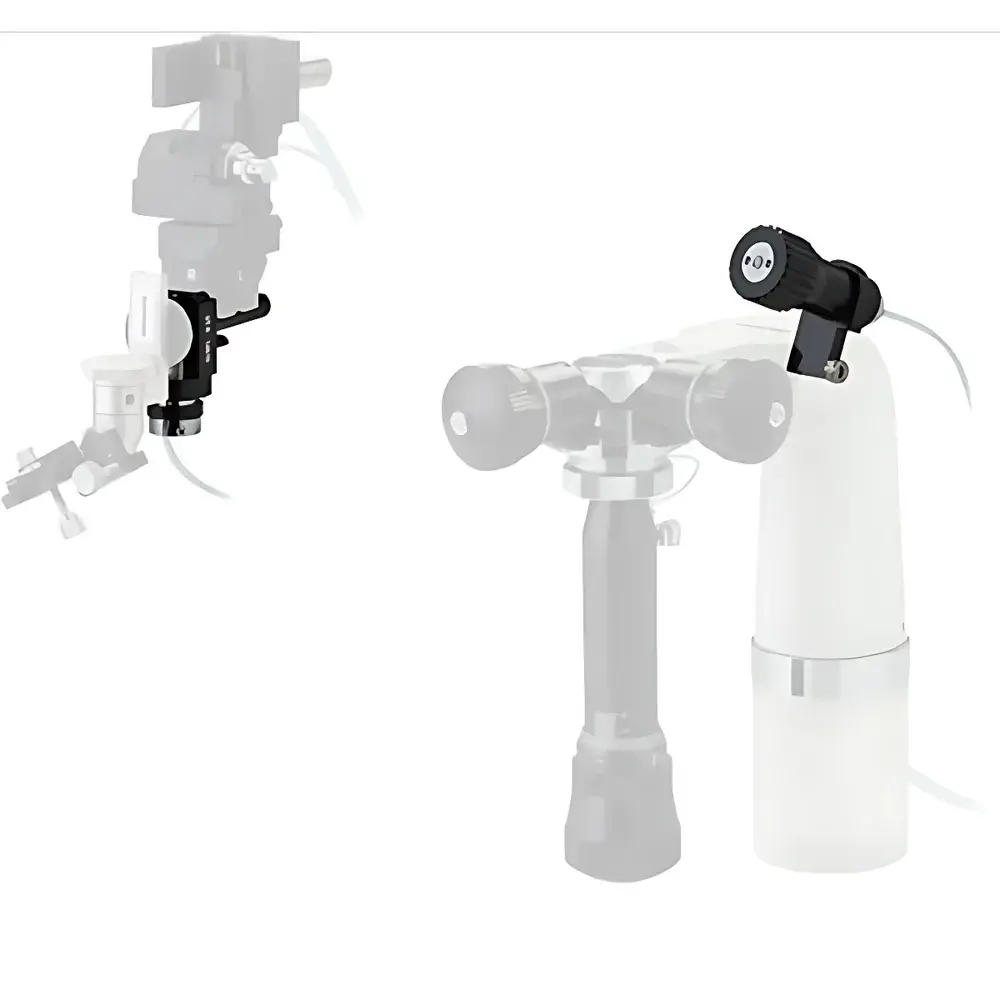
UT-R Recovery Mechanism for Narishige Hydraulic Micromanipulators
| Brand | Narishige |
|---|---|
| Origin | Japan |
| Model | UT-R |
| Compatibility | MMO-4 / MMO-202ND Hydraulic Micromanipulators |
| Mechanical Redundancy | Dual-sensor & dual-actuator architecture |
| Control Unit Dimensions | 22 × 36 × 60 mm, 55 g |
| Drive Unit Dimensions | 20 × 60 × 45 mm, 85 g |
| Hydraulic Tubing Length | 0.9 m |
| Hex Wrench Stroke Range | 10 mm |
| Operating Principle | Hydraulic pressure–driven retraction with failover control logic |
Overview
The UT-R Recovery Mechanism is an engineered subsystem designed exclusively for integration with Narishige’s high-precision hydraulic micromanipulators—specifically the MMO-4 and MMO-202ND series. It functions as a purpose-built redundancy and fault-resilience module that ensures uninterrupted operation during demanding electrophysiology, patch-clamp, microinjection, and single-cell manipulation protocols. Its core operational principle relies on hydraulically actuated retraction: upon command or autonomous trigger, the UT-R initiates rapid, controlled withdrawal of the manipulator’s pipette holder or probe assembly by reversing hydraulic pressure in the master cylinder circuit. This mechanical recovery action prevents sample damage, electrode breakage, or stage collision during unexpected events such as sudden tissue movement, operator error, or transient signal loss. Unlike passive safety stops, the UT-R executes active, deterministic retraction with sub-millisecond latency—critical for maintaining experimental integrity in real-time intracellular recording or live-cell imaging workflows.
Key Features
- Hydraulic retraction interface compatible with Narishige MMO-4 and MMO-202ND manipulators via standardized pressure coupling ports
- Dual-channel sensor architecture: independent pressure transducers and position encoders provide cross-validated status feedback for fail-safe decision logic
- Hardware-level redundancy: redundant solenoid valves, dual-pressure regulators, and parallel signal conditioning paths eliminate single-point failure modes
- Real-time embedded diagnostics: onboard ARM Cortex-M7 processor continuously monitors hydraulic response time, actuation consistency, and thermal drift across all critical subsystems
- Programmable retraction profiles: users define velocity, acceleration, and endpoint parameters via RS-232 or TTL-triggered input; supports both manual override and automated event-driven activation
- Modular mechanical design: compact control unit (22 × 36 × 60 mm) and drive unit (20 × 60 × 45 mm) enable flexible benchtop integration without compromising optical access or vibration isolation
Sample Compatibility & Compliance
The UT-R imposes no intrinsic limitations on specimen type or preparation method—it operates independently of biological or material properties, interfacing solely with the manipulator’s mechanical and hydraulic infrastructure. It is routinely deployed in GLP-compliant neuroscience laboratories conducting ICH-aligned preclinical studies, where continuity of recording sessions directly impacts data validity per FDA Guidance for Industry on Bioanalytical Method Validation (2018). All firmware and hardware components conform to IEC 61000-6-2 (immunity) and IEC 61000-6-4 (emission) standards for laboratory equipment. The hydraulic fluid (Narishige-certified silicone oil, viscosity grade ISO VG 10) meets USP Class VI biocompatibility requirements for closed-system applications involving sterile environments.
Software & Data Management
The UT-R does not require standalone software but integrates transparently with Narishige’s optional NIS-Elements Microscope Control Suite and third-party acquisition platforms (e.g., pCLAMP, Spike2, Axograph) via TTL pulse triggering and ASCII-based serial commands. Diagnostic logs—including timestamped pressure transients, valve switching events, and error codes—are stored in non-volatile memory and exportable as CSV for audit trail reconstruction. Firmware supports secure over-the-air updates signed with X.509 certificates, satisfying 21 CFR Part 11 requirements for electronic records and signatures when deployed in regulated QC/QA environments. Audit trails include operator ID, session start/stop timestamps, and change history for all configuration parameters—fully traceable for GMP process validation.
Applications
- Automated emergency retraction during whole-cell patch-clamp experiments to preserve membrane seal integrity following spontaneous depolarization bursts
- Synchronized withdrawal during multi-electrode array (MEA) calibration sequences to prevent tip-to-tip contact in high-density probe configurations
- Fault-tolerant operation in long-duration optogenetic stimulation assays where >12-hour unattended recording is required
- Collision avoidance in combined confocal + patch-clamp rigs where Z-axis drift or stage misalignment may compromise pipette positioning
- Standardized recovery protocol execution in teaching laboratories to enforce reproducible safety practices across trainee cohorts
FAQ
Is the UT-R compatible with non-Narishige micromanipulators?
No. The UT-R is mechanically and hydraulically engineered for direct interface only with Narishige MMO-4 and MMO-202ND systems. Interfacing with other brands would require custom pressure adapters, flow calibration, and firmware reconfiguration—not supported under warranty.
Does the UT-R require periodic recalibration?
No. The system uses factory-trimmed MEMS pressure sensors and sealed hydraulic pathways. Calibration is performed during final assembly and verified per ISO/IEC 17025-accredited procedures; field recalibration is neither necessary nor user-accessible.
Can the retraction speed be adjusted for different pipette sizes?
Yes. Retraction velocity (range: 0.1–5 mm/s) and acceleration profile are programmable via serial command set and persist across power cycles. Optimal settings depend on pipette taper, filling solution viscosity, and target distance from cell surface.
What happens if hydraulic pressure drops below operational threshold?
The UT-R detects sub-threshold pressure (< 0.8 MPa) and triggers immediate mechanical lockout while logging a Level-2 diagnostic flag. Manual reset via hex wrench is required before resuming operation—preventing unintended motion under insufficient actuation force.
Related Products



