
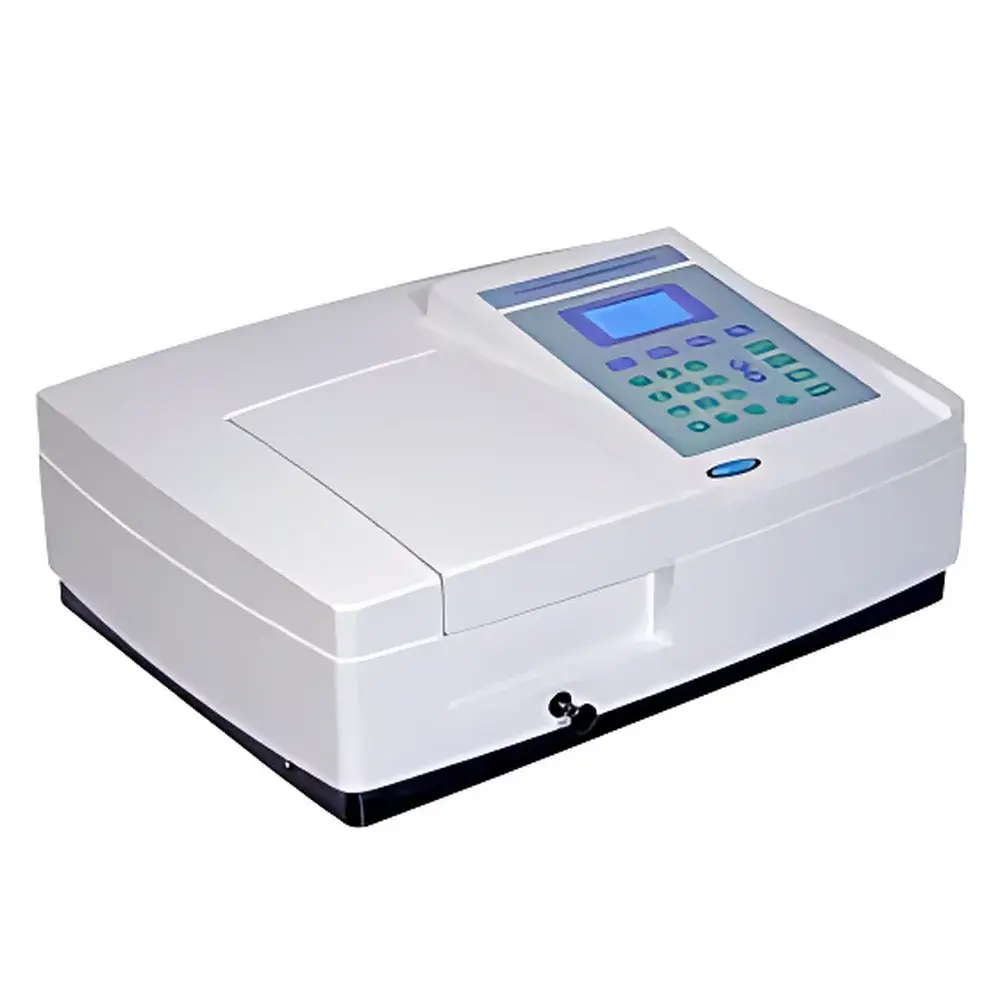
UV-5800 UV-Visible Spectrophotometer
| Brand | Jihepu |
|---|---|
| Origin | Shandong, China |
| Model | UV-5800 |
| Optical System | Single-beam |
| Detector | Photodiode Array |
| Wavelength Range | 190–1100 nm |
| Wavelength Accuracy | ±0.5 nm |
| Spectral Bandwidth | 2 nm |
| Stray Light | ≤0.05% T |
| Wavelength Repeatability | ≤0.2 nm |
| Photometric Accuracy | ±0.3% T |
| Photometric Repeatability | ≤0.15% T |
| Baseline Flatness | ±0.001 A |
| Drift | ±0.001 A/h (at 500 nm) |
| Noise | ±0.0005 A/h |
| Photometric Range | 0–200% T, –0.3–3 A, 0–9999 C |
| Data Interface | USB |
| Display | 128×64 LCD |
| Light Sources | Long-life imported tungsten and deuterium lamps |
| Dimensions | 460×380×180 mm |
| Weight | 18 kg |
Overview
The Jihepu UV-5800 UV-Visible Spectrophotometer is a precision single-beam optical instrument engineered for routine and research-grade quantitative and qualitative analysis in the ultraviolet, visible, and near-infrared spectral regions (190–1100 nm). It operates on the fundamental principle of Beer–Lambert law-based absorbance measurement, where sample transmittance or absorbance is determined by comparing incident and transmitted light intensities at defined wavelengths. Designed with a robust suspended optical architecture—mounted rigidly on an 8-mm machined aluminum base—the system minimizes sensitivity to mechanical vibration and thermal drift, ensuring long-term photometric stability. Its 2 nm spectral bandwidth enables sufficient resolution for most standard analytical applications, including concentration determination, purity assessment, and spectral scanning of organic and inorganic compounds. The instrument complies with core performance expectations outlined in ISO 8577-2 (spectrophotometers for chemical analysis) and supports method validation protocols aligned with USP and ASTM E275 for spectrophotometric instrumentation.
Key Features
- Single-beam optical design with high-stability photodiode array detection for reliable intensity measurement across the full 190–1100 nm range
- Integrated wavelength auto-calibration and self-correction algorithm ensures continuous accuracy without manual intervention
- 24-bit high-speed analog-to-digital conversion delivers enhanced signal resolution and rapid response (<1 s per data point)
- Suspended optical bench fabricated from precision-machined 8 mm aluminum alloy—immune to base deformation and external mechanical perturbation
- Plug-and-play tungsten and deuterium lamp assembly; lamp replacement requires no optical realignment or recalibration
- Onboard memory stores up to 200 absorbance/transmittance datasets and 200 user-defined calibration curves, each accessible via numeric ID
- Real-time baseline correction and dark-current compensation algorithms improve low-absorbance measurement fidelity
Sample Compatibility & Compliance
The UV-5800 accommodates standard 10 mm pathlength quartz, glass, or plastic cuvettes (including matched pairs for ratio-based measurements), as well as microvolume adapters (optional). It supports liquid, solution-phase samples compliant with common laboratory safety and handling protocols. Instrument performance meets essential metrological criteria for routine QC/QA workflows in pharmaceutical, environmental, food, and academic laboratories. While not pre-certified for GMP or GLP environments, its traceable wavelength and photometric accuracy—verified against NIST-traceable standards—enable integration into validated methods under FDA 21 CFR Part 11–compliant software environments (e.g., UV-5800PC scanning software with audit trail and electronic signature capability). All optical components conform to RoHS directives; power supply complies with IEC 61010-1 safety standards.
Software & Data Management
The optional UV-5800PC configuration includes Jihepu’s proprietary Windows-based spectrophotometric software, supporting six primary operational modes: photometric measurement, quantitative analysis (single/multi-point calibration), spectral scanning, kinetic monitoring, multi-wavelength quantitation, and nucleic acid/protein analysis (A260/A280 ratio, extinction coefficient application). Data export is supported in CSV, TXT, and native .SPC formats; graphical outputs include overlayable spectra, derivative plots, and time-concentration curves. The software implements role-based access control, automated timestamping, and raw-data integrity safeguards—features critical for regulatory documentation and internal audit readiness. USB 2.0 interface ensures plug-and-play connectivity with modern Windows OS platforms (Windows 10/11, 64-bit).
Applications
- Quantitative determination of analytes in pharmaceutical formulations (e.g., assay of active ingredients per USP monographs)
- Enzyme kinetics studies requiring time-resolved absorbance monitoring at fixed or scanned wavelengths
- DNA/RNA concentration and purity evaluation using A260/A280 and A260/A230 ratios
- Water quality analysis: nitrate, phosphate, and heavy metal ion quantification via colorimetric derivatization
- Quality control of dyes, pigments, and polymer additives based on spectral fingerprinting and λmax verification
- Educational use in undergraduate chemistry and biochemistry laboratories for method development and instrument validation exercises
FAQ
Is the UV-5800 compatible with GLP-compliant data integrity requirements?
Yes—when used with the UV-5800PC software suite and configured with appropriate IT controls (user authentication, audit trail logging, and electronic signatures), it supports documented compliance with GLP principles and FDA 21 CFR Part 11 Annex 11 expectations.
Can the instrument perform spectral scanning below 190 nm?
No—the lower limit is fixed at 190 nm due to atmospheric oxygen absorption and inherent limitations of the deuterium lamp output and optical path design.
What is the recommended calibration frequency for routine use?
Wavelength calibration should be verified quarterly using holmium oxide or didymium filters; photometric accuracy should be checked daily with neutral density filters or potassium dichromate solutions per ISO 6060.
Does the UV-5800 support cuvette position auto-detection?
No—it relies on manual placement and fixed beam geometry; however, its high photometric repeatability (≤0.15% T) mitigates positioning variability across replicates.
Is firmware upgrade available directly through the instrument interface?
Firmware updates require connection to a host PC via USB and execution of Jihepu’s dedicated update utility—no over-the-air or embedded OTA capability is provided.



