
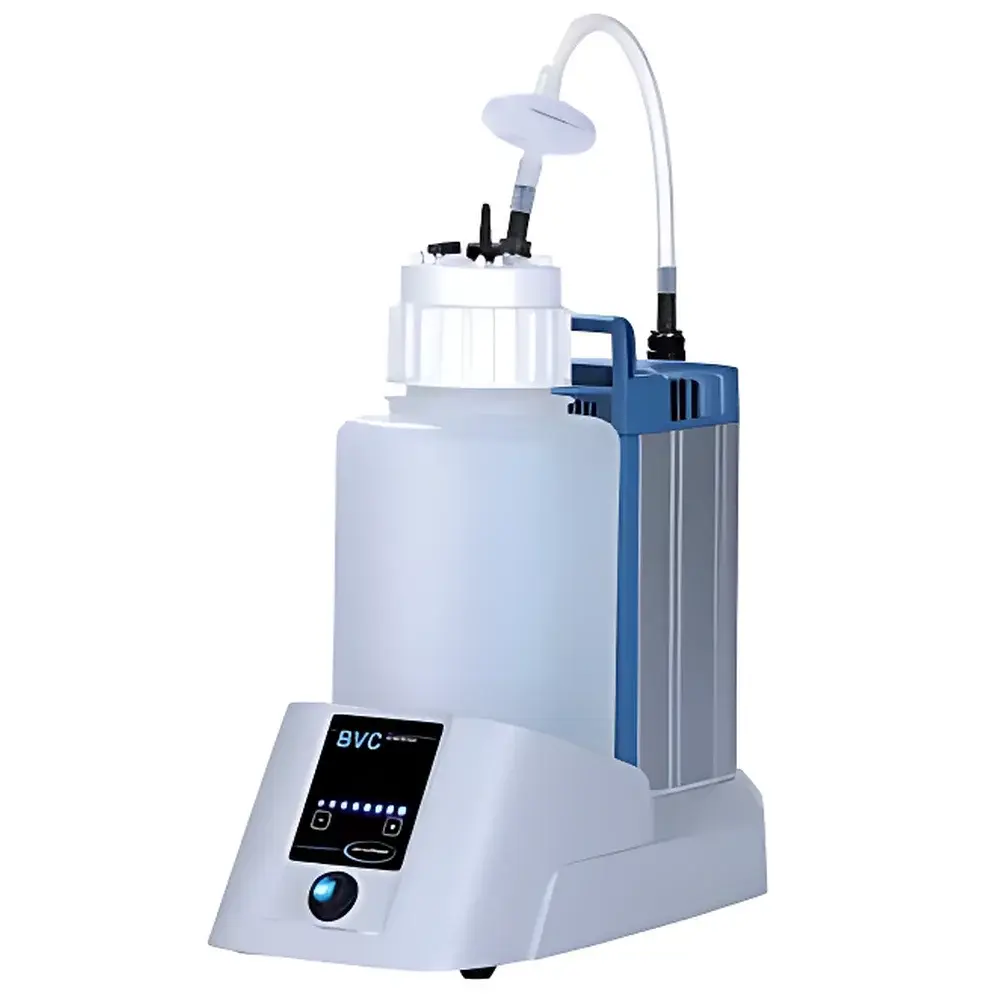
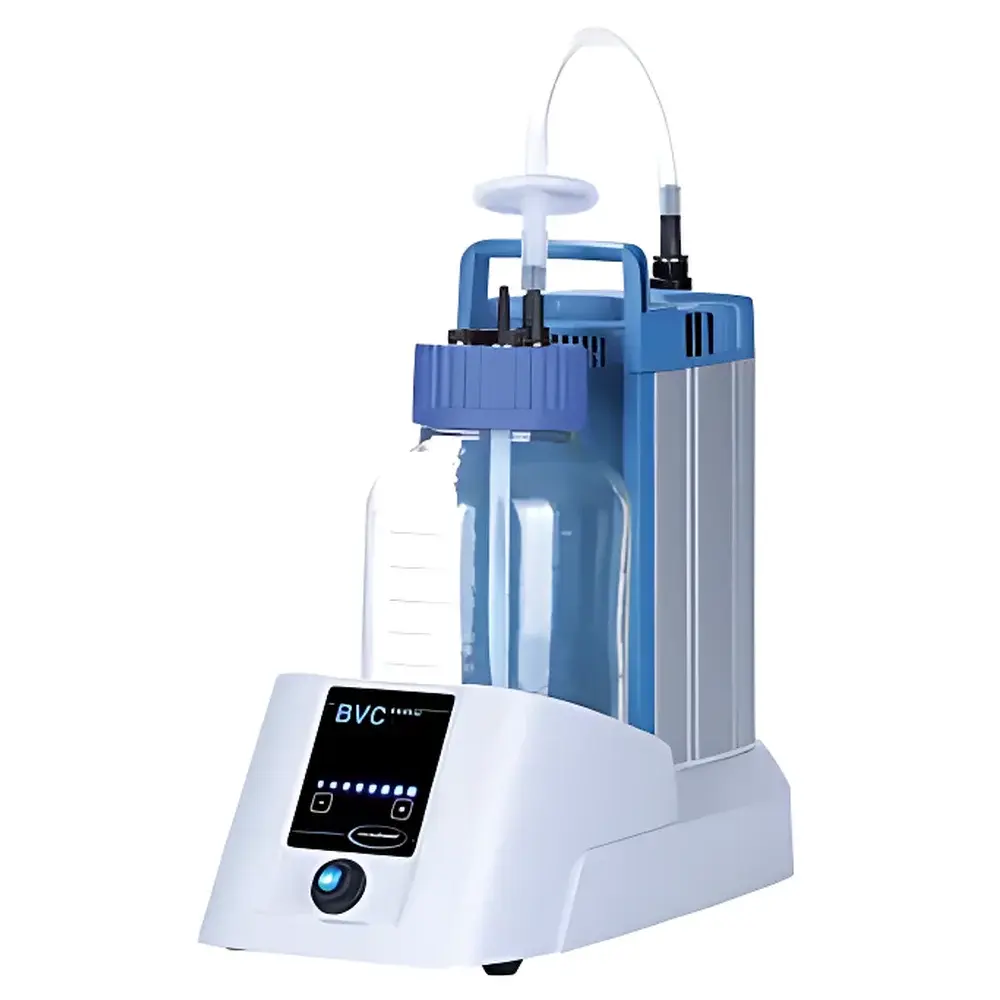
VACUUBRAND BVC control Vacuum Liquid Handling System
| Brand | VACUUBRAND® |
|---|---|
| Origin | Germany |
| Model | BVC control |
| Collection Capacity | 2 L (borosilicate glass with anti-shatter film) or 4 L (chemical-resistant PP) |
| Filtration | Integrated 0.2 µm sterile filter |
| Sterilization | Fully autoclavable components (bottle, tubing, quick-connect fittings optional) |
| Pump Type | Chemically resistant diaphragm vacuum pump with automatic on/off control |
| Control Interface | Touch-sensitive electronic panel for precise, repeatable suction adjustment |
| Noise Level | Low (<50 dB(A)) |
| Footprint | Compact benchtop design |
| Optional Dual-Handpiece Support | Compatible with second VHC handpiece for simultaneous dual-user operation |
| Compliance | Designed for GLP-compliant liquid waste handling |
Overview
The VACUUBRAND BVC control Vacuum Liquid Handling System is an engineered solution for controlled, safe, and repeatable aspiration of supernatants, culture media, wash buffers, and other aqueous or mildly corrosive liquids in life science, clinical diagnostics, and pharmaceutical laboratories. Based on positive-displacement diaphragm vacuum technology, the system delivers stable, pulse-free suction across a precisely adjustable pressure range (typically 0–800 mbar vacuum), enabling consistent removal of surface layers without disturbing underlying cell pellets or precipitates. Its core architecture integrates a chemically inert, oil-free diaphragm pump—designed for long service life and minimal maintenance—with intelligent electronic regulation that eliminates manual valve tuning and reduces operator variability. The BVC control is not a generic vacuum source but a purpose-built liquid handling platform where vacuum generation, filtration, containment, and ergonomics are co-optimized for routine benchtop workflows under ISO 13485-aligned environments.
Key Features
- Touch-sensitive electronic control panel enables stepless, real-time adjustment of vacuum level—supporting both high-flow aspiration (e.g., rapid medium exchange) and ultra-gentle aspiration (e.g., fragile monolayers or low-volume supernatant recovery).
- Auto-start/stop pump logic activates the diaphragm pump only during active aspiration, significantly reducing acoustic emissions (<50 dB(A) at 1 m) and extending pump lifetime.
- Two validated collection configurations: a 2 L borosilicate glass bottle with shatter-resistant polymer film and chemical barrier coating (resistant to sodium hypochlorite, ethanol, acetone, and 1 M NaOH); and a 4 L polypropylene (PP) bottle rated for broader solvent compatibility and higher mechanical durability.
- All wetted components—including bottle, lid, tubing, and optional VACUUBRAND VHC handpieces—are fully autoclavable at 121 °C, 2 bar for ≥20 min, supporting reuse in GMP/GLP-regulated processes requiring traceability and sterility assurance.
- Integrated 0.2 µm hydrophobic PTFE membrane filter prevents aerosol ingress into the pump and ensures protection against microbial contamination of the vacuum line.
- Modular design allows seamless integration of a second VHC handpiece (sold separately), enabling parallel operation by two technicians without cross-contamination risk—ideal for high-throughput cell culture facilities or shared core labs.
Sample Compatibility & Compliance
The BVC control accommodates a wide spectrum of liquid types encountered in molecular biology, cell culture, histology, and quality control labs—including PBS, DMEM, FBS-supplemented media, enzymatic dissociation reagents (e.g., trypsin-EDTA), fixatives (e.g., formalin, methanol), and diluted disinfectants. Its chemically resistant construction complies with DIN EN ISO 10993-5 (cytotoxicity) for materials in contact with biological samples. While not a medical device per se, its design supports adherence to USP and requirements for environmental controls in compounding and handling hazardous drugs. All filtration and containment elements meet ASTM F838-22 criteria for bacterial retention validation. Documentation packages—including material declarations, autoclave cycle validation guidelines, and pump performance curves—are available upon request for internal audit or regulatory submission.
Software & Data Management
The BVC control operates as a standalone hardware platform without embedded firmware or cloud connectivity. However, its repeatable electronic control interface supports procedural standardization critical for SOP-driven environments. Operators can define and document preferred vacuum setpoints per application (e.g., “75 mbar for HEK293 monolayer aspiration”, “220 mbar for 50 mL centrifuge tube decanting”) in lab notebooks or electronic lab notebooks (ELNs) such as LabArchives or Benchling. Audit trails are maintained manually or via integrated facility logging systems. For laboratories subject to FDA 21 CFR Part 11, the absence of digital data capture eliminates electronic record integrity concerns—making it suitable for legacy-compliant or paper-based QA/QC workflows.
Applications
- Supernatant removal during centrifugation steps in plasmid prep, protein purification, and viral vector production.
- Aseptic aspiration of spent media from adherent mammalian cell cultures prior to passaging or harvesting.
- Drainage of staining and washing solutions in IHC, IF, and H&E protocols without splashing or aerosol generation.
- Controlled aspiration of excess liquid from microplates, blotting membranes, and gel electrophoresis cassettes.
- Safe handling of low-hazard biohazardous waste streams in BSL-2 cabinets when paired with appropriate secondary containment.
FAQ
Is the BVC control compatible with vacuum manifolds or central vacuum systems?
No—the BVC control is a self-contained system with an integrated diaphragm pump and is not designed for connection to external vacuum sources or manifolds.
Can the 0.2 µm filter be replaced in-house, and what is its expected service life?
Yes, the filter housing is user-serviceable; filter replacement is recommended after 50 autoclave cycles or upon visible discoloration or flow restriction.
Does the glass collection bottle require special handling during autoclaving?
Yes—ensure uniform heating and cooling rates; avoid thermal shock by placing the bottle on a wire rack and allowing ≥60 minutes of post-cycle equilibration before handling.
What certifications does the pump motor carry?
The diaphragm pump meets CE marking requirements under the EU Machinery Directive 2006/42/EC and Electromagnetic Compatibility Directive 2014/30/EU.
Is the BVC control suitable for aspiration of viscous solutions like glycerol or agarose?
It is optimized for aqueous and low-viscosity liquids (<100 mPa·s); for highly viscous or particulate-laden fluids, a peristaltic pump or alternative aspiration method is recommended.



