
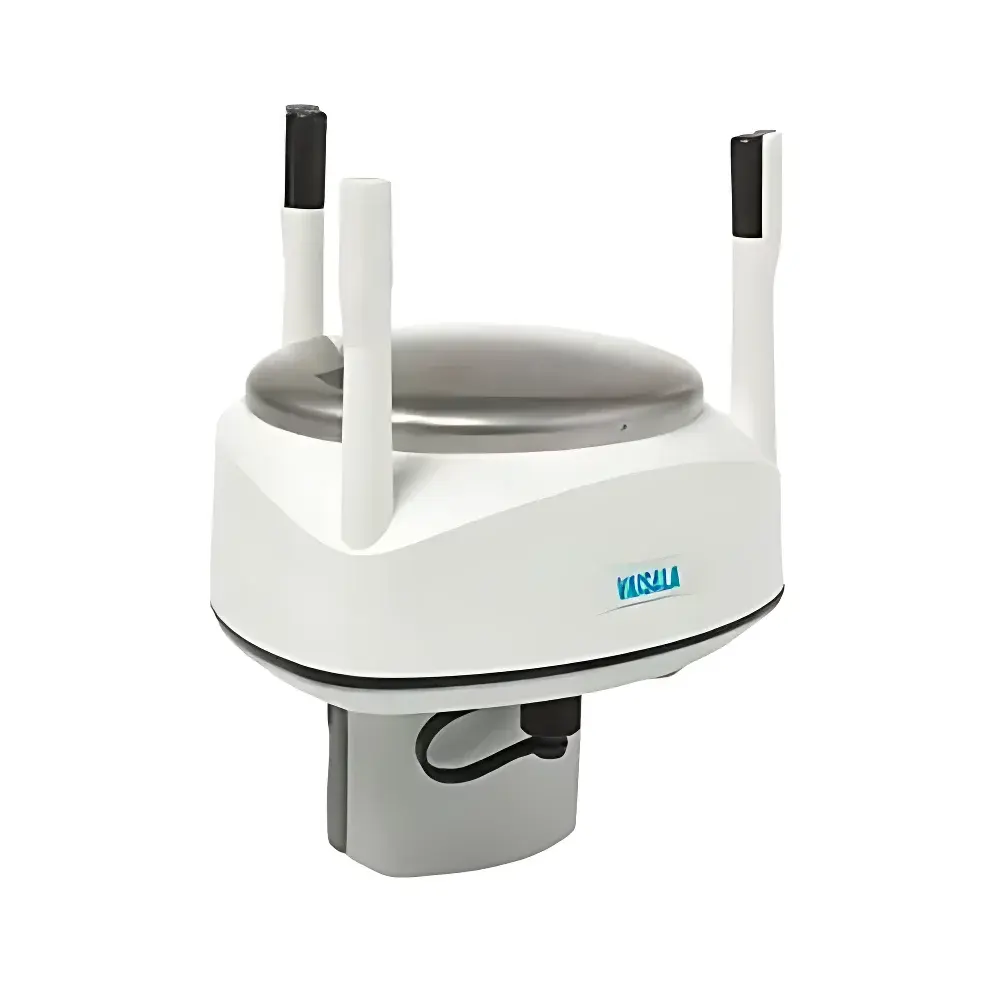
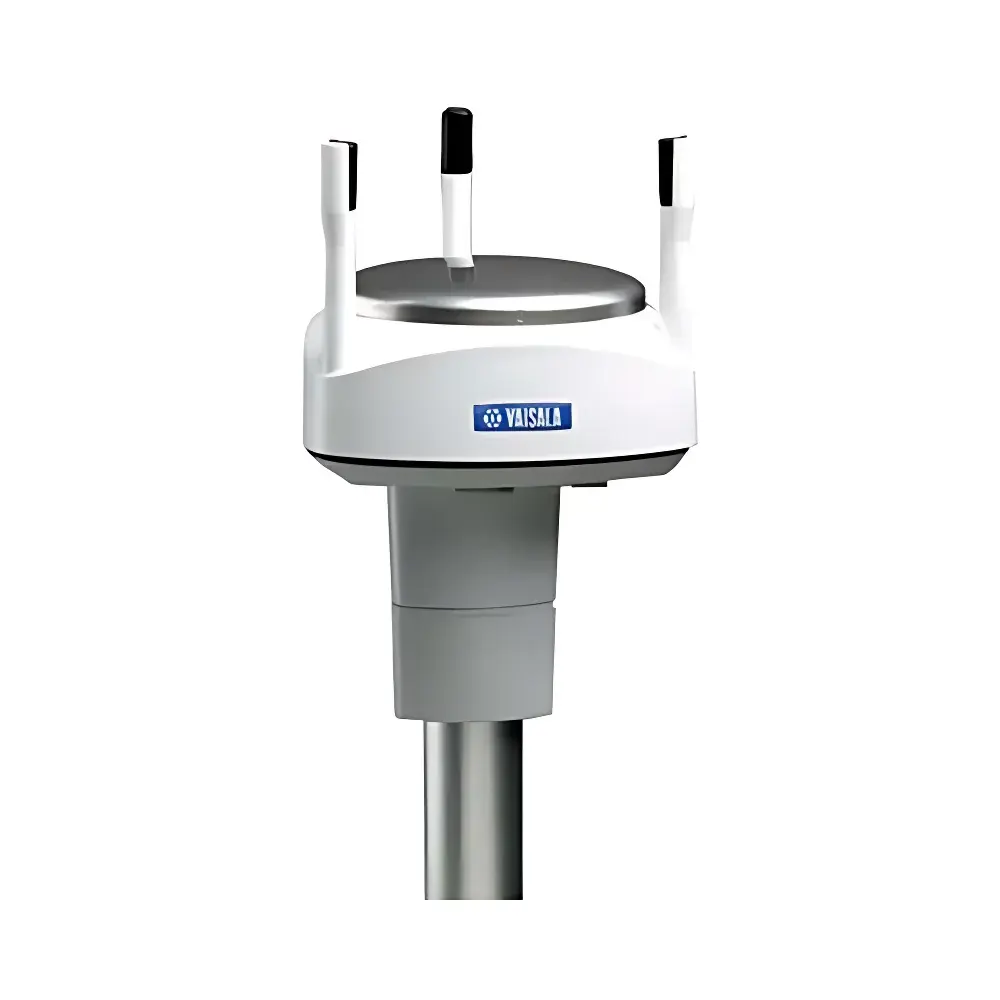
Vaisala WXT532 Ultrasonic Anemometer
| Brand | Vaisala |
|---|---|
| Origin | Finland |
| Model | WXT532 |
| Instrument Type | Ultrasonic Anemometer |
| Resolution | 0.1 m/s |
| Measurement Range | 0–60 m/s |
| Accuracy | ±3% @ 10 m/s |
| Operating Temperature | −52 °C to +60 °C |
| Relative Humidity Range | 0–100% RH |
| Ingress Protection | IP65 (without mounting adapter), IP66 (with mounting adapter) |
| Output Options | SDI-12 v1.3, RS-232, RS-485, RS-422, NMEA 0183 v3.0 |
| Analog Outputs (optional) | 0–20 mA or 4–20 mA for wind speed and wind direction |
| Power Supply | 6–24 VDC |
| Typical Current Consumption | 3 mA @ 12 VDC (default measurement interval) |
| Heater Supply | 12–24 VDC / 12–17 VAC |
| Heater Current | 0.8 A @ 12 VDC, 0.4 A @ 24 VAC |
| Response Time | 0.25 s |
| Wind Direction Range | 0–360° |
| Wind Direction Accuracy | ±3° @ 10 m/s |
| Wind Direction Resolution | 1° |
Overview
The Vaisala WXT532 Ultrasonic Anemometer is a precision-engineered component of the modular WXT530 series meteorological transmitter platform. Designed for continuous, maintenance-free operation in demanding environmental monitoring applications, the WXT532 employs time-of-flight ultrasonic wind sensing technology—based on Vaisala’s proprietary WINDCAP® transducer architecture—to measure horizontal wind speed and wind direction without moving parts. This solid-state approach eliminates mechanical wear, bearing degradation, and icing-related drift, delivering high reproducibility across extreme ambient conditions. The sensor operates independently within the WXT530 system but is fully interoperable with other integrated modules—including PTU (pressure, temperature, humidity), RAINCAP® acoustic precipitation detection, and optional analog inputs—enabling flexible, application-specific configurations. Its compact, low-power design supports off-grid deployment via solar power, while its compliance with IEC 60945 maritime environmental standards underscores its suitability for marine, coastal, aviation, and industrial site monitoring where long-term stability and traceable metrology are critical.
Key Features
- Ultrasonic wind measurement using time-of-flight principle—no moving parts, no inertia-induced lag or calibration drift
- Robust aluminum housing rated IP65 (IP66 with mounting adapter) for resistance to dust, rain, salt spray, and condensation
- Wide operational temperature range (−52 °C to +60 °C) validated for polar research, alpine stations, and desert installations
- Integrated heater option (12–24 VDC / 12–17 VAC) prevents snow/ice accumulation on transducers without compromising measurement continuity
- Low average power consumption (3 mA @ 12 VDC typical) enabling multi-year battery or solar-powered operation
- Multiple digital communication interfaces: SDI-12 v1.3 (for hydrological networks), RS-232/RS-485/RS-422 (for SCADA integration), and NMEA 0183 v3.0 (for marine navigation systems)
- Optional 4–20 mA analog outputs for wind speed and wind direction—compatible with legacy PLCs, DCS systems, and industrial alarm controllers
- Configurable output frequency (1 Hz, 1 min, 1 hr) and data reporting modes (averages, min/max extremes, instantaneous values)
Sample Compatibility & Compliance
The WXT532 is engineered for direct exposure to unfiltered atmospheric conditions. It requires no sample conditioning, inlet filters, or aspiration systems—making it suitable for open-field, rooftop, mast-mounted, buoy-based, and UAV-integrated deployments. Its measurement performance adheres to internationally recognized reference practices for wind instrumentation, including WMO Guide to Meteorological Instruments and Methods of Observation (CIMO Guide) Chapter 12 recommendations for ultrasonic anemometers. While not certified to ISO/IEC 17025 as a standalone calibration standard, the WXT532’s factory calibration traceability extends to national metrology institutes (NMI) via Vaisala’s accredited calibration laboratory. For regulatory-grade environmental reporting, the device supports audit-ready data logging when paired with compliant host systems implementing GLP/GMP-aligned timestamping, secure storage, and user-access controls per FDA 21 CFR Part 11 requirements.
Software & Data Management
Vaisala provides free configuration and diagnostic software (Vaisala Insight PC Software) supporting firmware updates, parameter customization (e.g., averaging periods, output scaling, heater activation thresholds), and real-time diagnostics—including transducer health status, signal-to-noise ratio, and internal temperature compensation logs. Raw sensor data is output in ASCII-formatted strings compatible with industry-standard data acquisition platforms (Campbell Scientific CR series, Delta-T Devices GP1, Onset HOBO loggers). When deployed in networked environments, the WXT532 integrates seamlessly with cloud-based environmental data platforms (e.g., Vaisala’s viewLinc, AWS IoT Core, or custom MQTT brokers) through gateway devices. All digital protocols support command-query architectures with checksum validation, ensuring data integrity during transmission over noisy or long-distance serial links.
Applications
- Automated weather stations (AWS) for aviation safety, airport wind shear detection, and NOTAM generation
- Renewable energy site assessment and turbine control feedback loops (onshore/offshore wind farms)
- Environmental impact assessments (EIA) and air dispersion modeling input for EPA-regulated facilities
- Maritime meteorological buoys and coastal observatories meeting IEC 60945 Class B environmental resilience criteria
- Urban climate monitoring networks requiring high spatial density and low maintenance overhead
- Research-grade micrometeorology studies—including eddy covariance flux towers—when synchronized with co-located CO₂/H₂O analyzers
- Industrial stack emission monitoring systems requiring redundant wind vector inputs for plume trajectory modeling
FAQ
Does the WXT532 require periodic recalibration?
No scheduled recalibration is required under normal operating conditions. Vaisala specifies a 2-year calibration stability interval; however, field verification against a reference cup-and-vane anemometer is recommended annually for regulatory or quality assurance purposes.
Can the WXT532 operate without the heater in sub-zero environments?
Yes, but ice formation on transducers may cause temporary signal attenuation or zero-offset drift below −10 °C with high humidity. The heater is strongly advised for continuous operation in freezing fog or wet snow conditions.
Is the analog output truly isolated and intrinsically safe?
The optional 4–20 mA outputs are non-isolated and not intrinsically safe by default. For hazardous area installation (e.g., Zone 2), external galvanic isolators and barrier modules compliant with IEC 60079-11 must be implemented in the loop.
How does the WXT532 handle turbulent or gusty flow near obstacles?
Its 0.25 s response time and built-in 1-second averaging algorithm minimize high-frequency noise while preserving transient gust detection capability. For turbulence intensity analysis, post-processing of raw 1 Hz samples is recommended using third-party spectral analysis tools.
What is the expected service life in coastal salt-laden environments?
With proper mounting (vertical orientation, drip-loop cabling, and routine visual inspection every 6 months), the WXT532 demonstrates >10 years of functional service life in ISO 9223 C5-M (marine) corrosion class environments.
Related Products







