
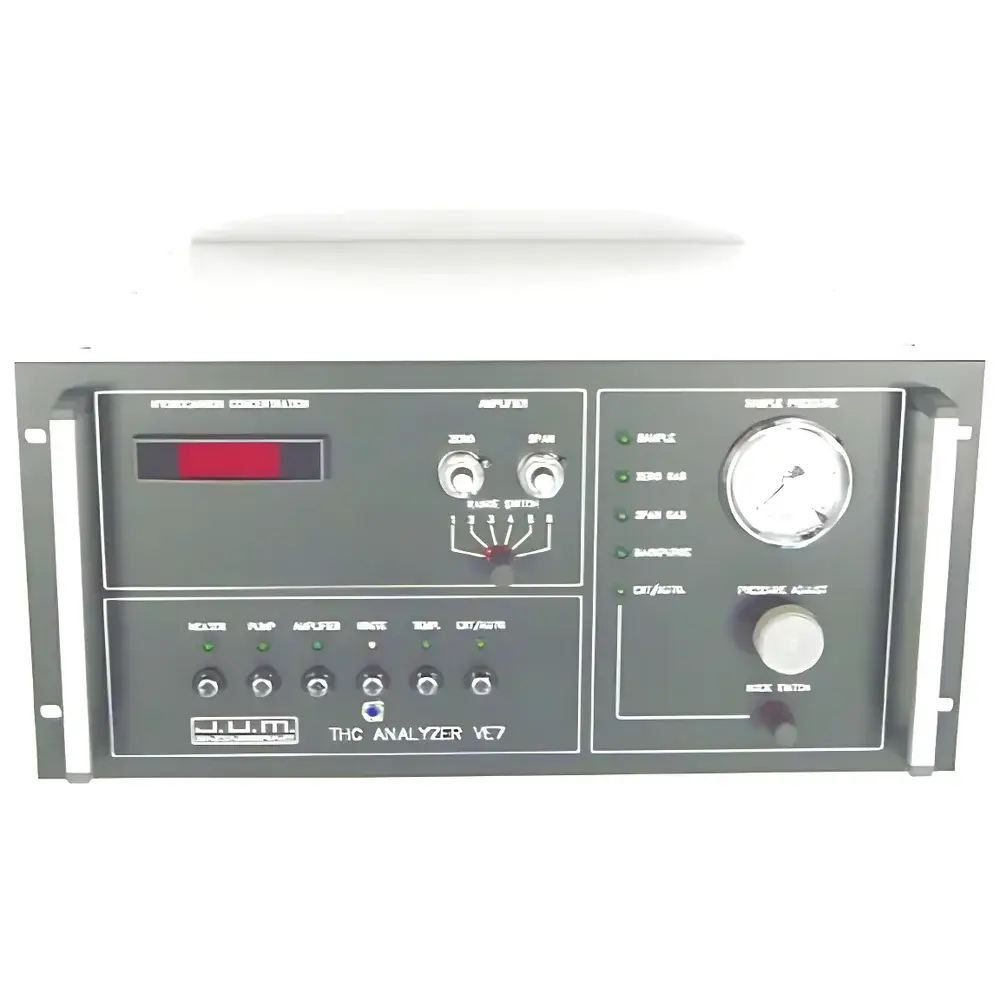
J.U.M. VE7-1 Online Total Hydrocarbons (THC) & VOC Analyzer
| Brand | J.U.M. |
|---|---|
| Origin | Germany |
| Instrument Type | Online Analyzer |
| Detection Principle | Flame Ionization Detection (FID) |
| Measurement Target | Total Volatile Organic Compounds (TVOC) and Non-Methane Hydrocarbons (NMHC) |
| Detection Range | 0–1000 ppm (expandable to 0–100,000 ppm) |
| Resolution | 0.1 ppm |
| Accuracy | ±5% of reading |
| Response Time (T90) | <60 s |
| FID Sensitivity | ≤1 ppm CH₄ full scale |
| Oven Temperature | 190 °C |
| Carrier/Combustion Air | Integrated zero-air generator |
| Sample Conditioning | Heated sample line & filter with automated back-purge |
Overview
The J.U.M. VE7-1 Online Total Hydrocarbons (THC) & VOC Analyzer is a high-reliability, continuous-emission monitoring system engineered for regulatory-compliant measurement of total volatile organic compounds and non-methane hydrocarbons in industrial exhaust streams, ambient air, and process gases. Utilizing flame ionization detection (FID) — the reference method for hydrocarbon quantification per EPA Method 25A, EN 12619, and ISO 8573-5 — the VE7-1 delivers trace-level sensitivity, thermal stability, and long-term baseline reproducibility. Its fully heated optical and reaction path (190 °C oven temperature) prevents condensation and adsorption losses of higher-boiling VOCs, ensuring representative sampling across complex matrices including humid flue gas, catalytic exhaust, and solvent-laden airstreams. Designed for unattended operation in demanding environments, the analyzer meets stringent requirements for continuous emission monitoring systems (CEMS) under German BImSchV regulations (13th and 17th Ordinances), EU Industrial Emissions Directive (IED) compliance, and U.S. EPA Performance Specifications (PS-8, PS-13).
Key Features
- Fully integrated heated sample path (190 °C) with heated filter and programmable reverse-purge cycle to minimize fouling and extend maintenance intervals
- Onboard zero-air generator eliminates dependency on external compressed air or bottled calibration gas for combustion support
- Modular FID detector with CH₄-equivalent sensitivity ≤1 ppm at full scale, optimized for linear response across six selectable ranges (0–10 ppm to 0–100,000 ppm)
- Robust mechanical architecture with service-accessible components, tool-free filter replacement, and front-panel diagnostics
- Real-time digital signal processing with automatic gain control and drift compensation algorithms for stable low-concentration measurements
- Compliance-ready analog (4–20 mA) and digital (RS-485, Modbus RTU) outputs; optional Ethernet/IP or Profibus DP interfaces
Sample Compatibility & Compliance
The VE7-1 accommodates gaseous samples with particulate loading ≤10 mg/m³ and moisture content up to 30% v/v (non-condensing). It is certified for use in Class 1, Division 2 hazardous locations (optional ATEX/IECEx version available). Regulatory alignment includes: EN 13526 (performance requirements for VOC analyzers), EN 12619 (stack gas monitoring), EPA Method 25A (total gaseous organic concentration), EPA Method 503 (calibration and validation), and German TA Luft and 17. BImSchV Annex 4 testing protocols. Data integrity complies with EU GMP Annex 11 and FDA 21 CFR Part 11 when paired with J.U.M.’s optional audit-trail-enabled data acquisition software.
Software & Data Management
The VE7-1 operates with J.U.M.’s VISION CEMS software suite, supporting remote configuration, automated calibration scheduling (span/zero checks), and real-time trend visualization. All operational events — including maintenance alerts, calibration logs, and sensor fault flags — are timestamped and stored with user-identifiable audit trails. Raw data export is supported in CSV and XML formats compliant with EMAS and national EEA reporting frameworks. Optional integration with SCADA systems enables alarm-triggered shutdown interlocks and dynamic range switching based on process load profiles.
Applications
- Continuous monitoring of NMHC/TVOC emissions from thermal oxidizers, RTOs, and catalytic incinerators
- Regulatory stack testing per EN 14181 QAL1/QAL2 and EPA PS-8 verification protocols
- In-line monitoring of solvent recovery units and carbon adsorption beds for breakthrough detection
- Engine test cell exhaust analysis during development of low-emission powertrains
- Trace hydrocarbon surveillance in ultra-high-purity nitrogen or argon supply lines (semiconductor fab cleanrooms)
- Ambient air quality networks measuring urban VOC precursors to ozone formation
- Leak detection and repair (LDAR) program support via fixed-point fence-line monitoring
FAQ
Does the VE7-1 require external zero air or calibration gas cylinders?
No — it features an integrated zero-air generator producing hydrocarbon-free combustion air at regulated flow and pressure.
Can the detection range be customized beyond the standard 0–1000 ppm?
Yes — factory-configurable ranges include 0–10 ppm, 0–100 ppm, 0–10,000 ppm, and 0–100,000 ppm; range switching is software-selectable and auto-scales signal output.
Is the instrument suitable for high-humidity or corrosive flue gas applications?
Yes — the fully heated sample train (190 °C) and corrosion-resistant 316L stainless-steel wetted parts ensure compatibility with wet stacks and acidic gas mixtures when used with appropriate inlet conditioning (e.g., Nafion dryer or chiller, optional).
Related Products







