
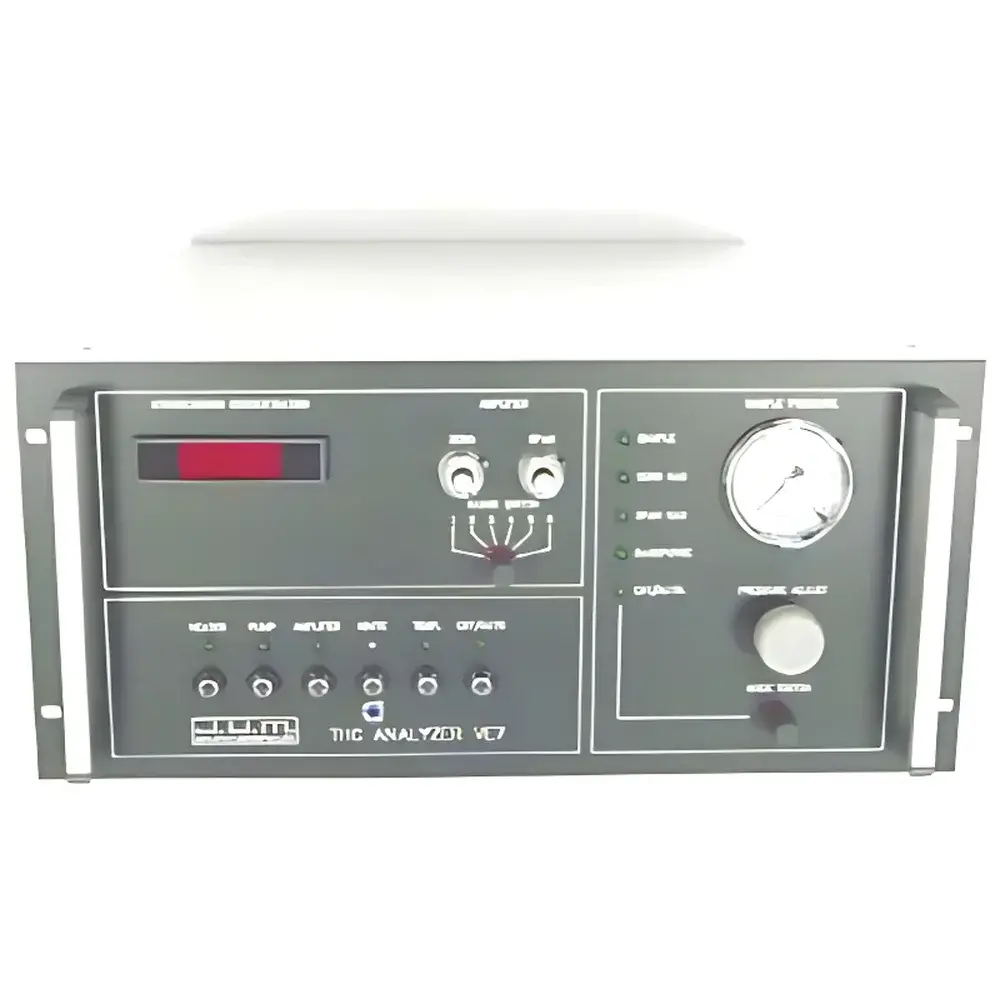
J.U.M. VE7 Online Total Hydrocarbons (THC) Analyzer
| Brand | J.U.M. |
|---|---|
| Origin | Germany |
| Model | VE7 |
| Detection Principle | Flame Ionization Detection (FID) |
| Measurement Range | 0–10, 0–100, 0–1,000, 0–10,000, 0–100,000 ppm (CH₄ equivalent) |
| Full-Scale Sensitivity | ≤1 ppm CH₄ |
| Response Time (T₉₀) | ≤0.2 s |
| Oven Temperature | 190 °C |
| Carrier/Combustion Air Supply | Integrated zero-air generator |
| Compliance | BImSchV 2nd, 13th & 17th Ordinances |
Overview
The J.U.M. VE7 Online Total Hydrocarbons (THC) Analyzer is a certified, continuous emission monitoring system (CEMS) engineered for high-precision, real-time quantification of non-methane hydrocarbons (NMHC) and total hydrocarbons (THC) in industrial exhaust streams and ambient air. Based on flame ionization detection (FID) — the reference method for hydrocarbon quantification per EN 12619 and EPA Method 25A — the VE7 delivers trace-level sensitivity, rapid dynamic response, and long-term stability under demanding process conditions. Its heated measurement chamber (190 °C) prevents condensation and adsorption losses of higher-boiling hydrocarbons, ensuring representative sampling across C₁–C₁₂ species. Designed for permanent installation in stack ducts, flue gas lines, or cleanroom supply systems, the VE7 meets the metrological and operational requirements of regulatory-grade environmental monitoring, including compliance with German BImSchV ordinances, European EN standards, and U.S. EPA protocols.
Key Features
- FID-based detection with linear dynamic range spanning six decades (0–100,000 ppm CH₄-equivalent), configurable via software-selectable full-scale ranges.
- Sub-second response time (T₉₀ ≤ 0.2 s), enabling accurate tracking of transient emission events during start-up, load changes, or catalyst regeneration cycles.
- Integrated zero-air generator eliminating dependency on external compressed air sources; air purity complies with EN 14625 and ISO 8573-1 Class 1 requirements for FID operation.
- Heated sample path and reaction chamber maintained at 190 °C to prevent wall losses of semi-volatile compounds (e.g., benzene, toluene, xylene, heavier aliphatics).
- Robust stainless-steel construction rated for IP65 enclosure protection; suitable for outdoor mounting and industrial environments with vibration, dust, and temperature fluctuations.
- Auto-calibration capability with integrated span gas valves; supports dual-point (zero/span) verification per EN 14181 QAL2 and QAL3 requirements.
Sample Compatibility & Compliance
The VE7 accepts gaseous samples across a wide matrix: flue gases (up to 200 °C pre-conditioned), diluted engine exhaust, purified process air, nitrogen blank streams, and ultra-high-purity (UHP) carrier gases used in semiconductor fabrication. It is compatible with standard 6-mm OD PTFE or fused silica sample lines and interfaces seamlessly with heated sample probes, particulate filters (ceramic or sintered metal), and moisture removal systems (permeation dryers or Nafion™ membranes). Regulatory alignment includes full adherence to EN 12619 (automated FID analyzers for stack gas), EN 13526 (performance criteria for NMHC analyzers), and EPA Methods 25A (THC) and 503 (calibration and validation). The system supports audit-ready documentation required for GLP/GMP environments and satisfies data integrity provisions under FDA 21 CFR Part 11 when paired with compliant data acquisition software.
Software & Data Management
The VE7 operates with J.U.M.’s proprietary VISION CEMS software suite, providing local HMI control, remote Ethernet-based configuration, and secure OPC UA integration into plant DCS or SCADA networks. All measurements are timestamped with microsecond precision and stored with full audit trail: operator actions, calibration logs, alarm states, and sensor diagnostics. Raw analog outputs (4–20 mA) and digital Modbus RTU/TCP interfaces allow interoperability with legacy PLCs. Data export complies with EN 14181 reporting formats, including hourly averages, daily maxima, and exceedance flags aligned with TA Luft and IED (Industrial Emissions Directive) thresholds. Optional cloud gateway enables encrypted TLS 1.2 transmission to centralized environmental data platforms.
Applications
- Continuous monitoring of THC/NMHC emissions from thermal oxidizers, incinerators, and catalytic cracking units per BImSchV 13th and 17th Ordinances.
- Real-time combustion efficiency assessment in gas turbines, diesel generators, and industrial boilers using hydrocarbon slip as an indicator of incomplete oxidation.
- LEL (Lower Explosive Limit) surveillance in solvent recovery systems and paint spray booths, with programmable alarm thresholds at 10%, 25%, and 50% LEL equivalents.
- In-line purity verification of bulk nitrogen, argon, and hydrogen used in semiconductor manufacturing — detecting sub-ppb to low-ppm hydrocarbon contaminants that compromise wafer yield.
- Engine development testing: transient THC profiling during WLTC, RDE, and FTP-75 drive cycles in dynamometer labs.
- Ambient air quality stations measuring background VOC levels near petrochemical facilities or landfill sites, supporting EU Air Quality Directive reporting.
FAQ
Does the VE7 measure methane separately from other hydrocarbons?
No — the VE7 is configured as a total hydrocarbons analyzer. For NMHC determination, it must be paired with a parallel methane-specific analyzer (e.g., IR or GC-FID) and configured for subtraction-based calculation per EN 13526.
Can the VE7 operate without external zero air?
Yes — its built-in zero-air generator produces hydrocarbon-free air meeting FID specification limits (<0.1 ppm THC), eliminating need for bottled zero air or external compressors.
Is the VE7 suitable for high-moisture flue gas applications?
It requires upstream conditioning: a heated probe, particle filtration, and a permeation dryer or chilled mirror dew point controller to maintain sample dew point below 4 °C before entering the analyzer.
What maintenance intervals are recommended for routine operation?
FID jet cleaning and detector electrode inspection every 3 months; annual replacement of combustion air filter and ceramic igniter; biannual verification of linearity and zero drift per EN 14181 QAL2.
Does the system support remote firmware updates and diagnostic telemetry?
Yes — via secure SSH or HTTPS interface; firmware updates are digitally signed and validated prior to installation, with rollback capability and change logging compliant with IEC 62443-3-3.







